
Pulp Fiction, 1866 · page 20 of 100
Beadle's Dime Novels, No. 91: The Lost Cache — page 20: what you’re looking at
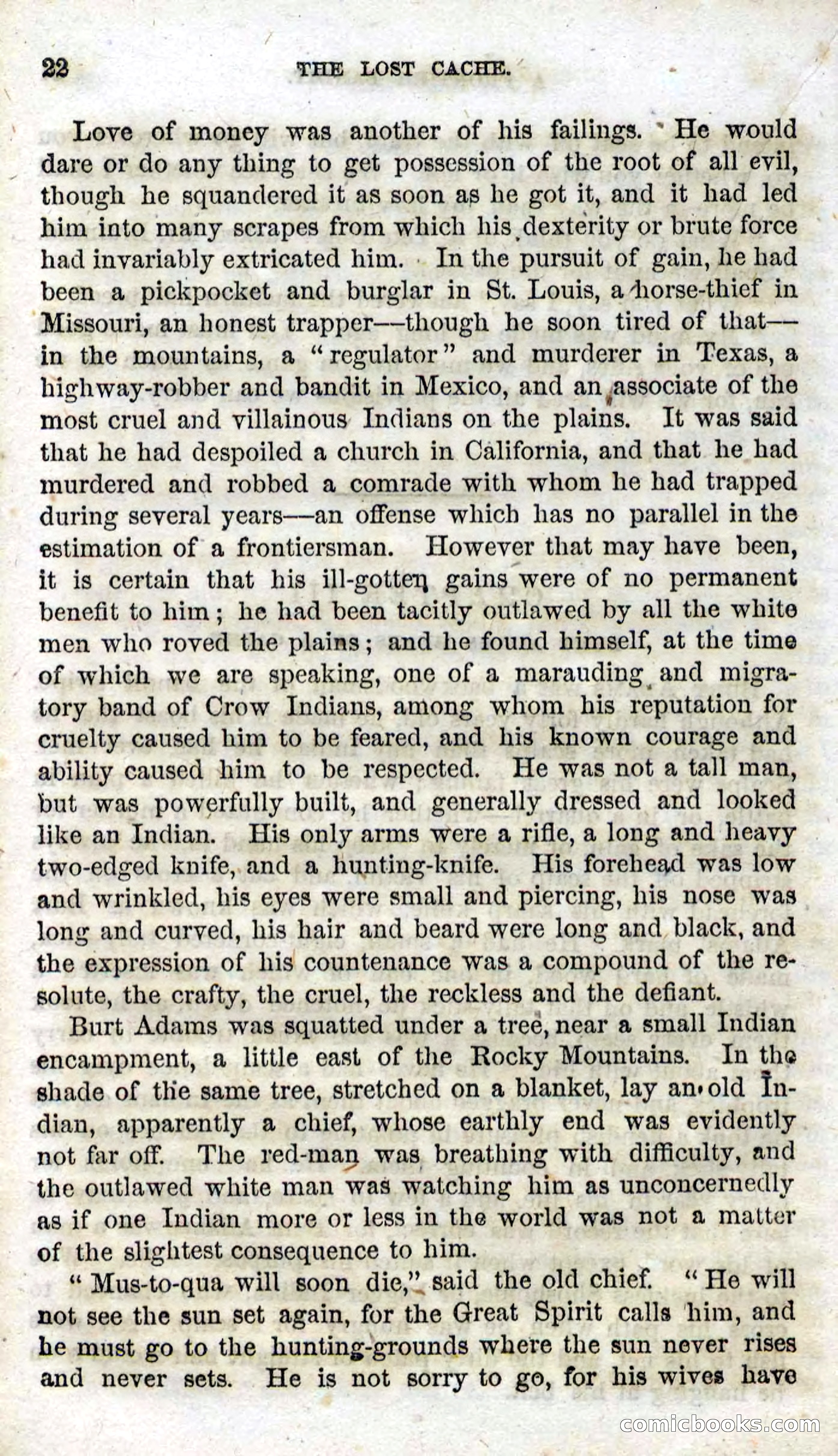
A restored page from Pulp Fiction, 1866. Page through the whole issue in the reader above.
📄 Transcribed text from this page (OCR, searchable)
Machine-transcribed from the original scan — historical spelling and the odd misread are preserved.
22 THE LOST CACHE. Love of money was another of his failings. ~ He would dare or do any thing to get possession of the root of all evil, though he squandered it as soon as he got it, and it had led him into many scrapes from which his dexterity or brute force had invariably extricated him. . In the pursuit of gain, he had been a pickpocket and burglar in St. Louis, a /orse-thief in ‘Missouri, an honest trapper—-though he soon tired of that— in the mountains, a “regulator” and murderer in Texas, a highway-robber and bandit in Mexico, and an associate of the most cruel and villainous Indians on the plains, It was said that he had despoiled a church in California, and that he had murdered and robbed a comrade with whom he had trapped during several years—an offense which has no parallel in the estimation of a frontiersman. However that may have been, it is certain that his ill-gotten gains were of no permanent benefit to him; he had been tacitly outlawed by all the white men who roved the plains; and he found himself, at the time of which we are speaking, one of a marauding and migra- tory band of Crow Indians, among whom his reputation for cruelty caused him to be feared, and his known courage and ability caused him to be respected. He was not a tall man, but was powerfully built, and generally dressed and looked like an Indian. His only arms were a rifle, a long and heavy two-edged knife, and a hunting-knife. His forehead was low and wrinkled, his eyes were small and piercing, his nose was long and curved, his hair and beard were long and_ black, and the expression of his countenance was a compound of the re- solute, the crafty, the cruel, the reckless and the defiant. Burt Adams was squatted under a tree, near a small Indian encampment, a little east of the Rocky Mountains. In the shade of the same tree, stretched on a blanket, lay an-old In- dian, apparently a chief, whose earthly end was evidently not far off. The red-man was breathing with difficulty, and the outlawed white man was watching him as unconcernedly as if one Indian more or less in the world was not a matter of the slightest consequence to him. “ Mus-to-qua will soon die,” said the old chief. “ He will not see the sun set again, for the Great Spirit calls ‘him, and he must go to the hunting-grounds where the sun never rises and never sets. He is not sorry to go, for his wives have comicbooks.com