
Pulp Fiction, 1860 · page 95 of 104
The Slave Sculptor — page 95: what you’re looking at
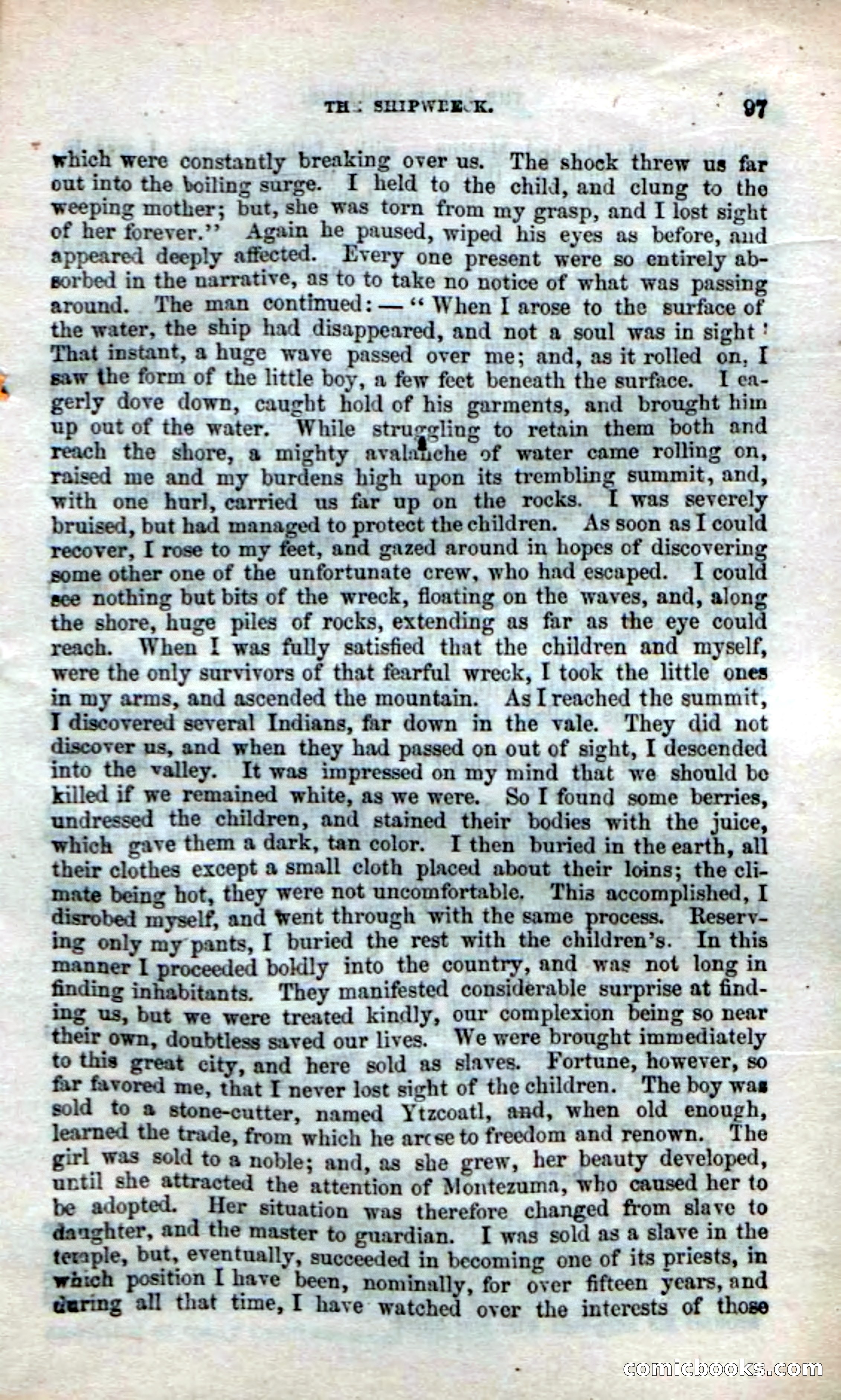
A restored page from Pulp Fiction, 1860. Page through the whole issue in the reader above.
📄 Transcribed text from this page (OCR, searchable)
Machine-transcribed from the original scan — historical spelling and the odd misread are preserved.
TH: SHIPWEECK. - OF which were constantly breaking over us. The shock threw us far out into the boiling surge. I held to the child, and clung to the weeping mother; but, she was torn from my grasp, and I lost sight of her forever.’? Again he paused, wiped his eyes as before, and appeared deeply affected. Every one present were so entirely ab- sorbed in the narrative, as to to take no notice of what was passing around. The man continued: — ‘* When I arose to the surface of the water, the ship had disappeared, and not a soul was in sight! That instant, a huge wave passed over me; and, as it rolled on, I saw the form of the little boy, a few feet beneath the surface. I ea- gerly dove down, caught hold of his garments, and brought him up out of the water. While struggling to retain them both and reach the shore, a mighty avaladehe of water came rolling on, raised me and my burdens high upon its trembling summit, and, with one hurl, carried us far up on the rocks. [ was severely bruised, but had managed to protect the children. As soon asI could recover, I rose to my feet, and gazed around in hopes of discoverin some other one of the unfortunate crew, who had escaped. I could | see nothing but bits of the wreck, floating on the waves, and, alon the shore, huge piles of rocks, extending as far as the eye could reach. When I was fully satisfied that the children and myself, were the only survivors of that fearful wreck, I took the little ones in my arms, and ascended the mountain. AsI reached the summit, T discovered several Indians, far down in the vale. They did not discover us, and when they had passed on out of sight, I descended into the valley. It was impressed on my mind that we should be killed if we remained white, as we were. So I found some berries, undressed the children, and stained their bodies with the juice, which gave them a dark, tan color. I then buried in the , all their clothes gs a small a poet pas “oa loins; the 3 mate being were not uncom e, is accomplished, myself, mts went through with the same process. Reserv- ing only my pants, I buried the rest with the children’s. In this manner I proceeded boldly into the country, and was not long in finding inhabitants. They manifested considerable surprise at find- ing us, but we were treated kindly, our complexion being so near own, doubtless saved our lives. We were brought immediately to this great city, and here sold as slaves. Fortune, however, so far favored me, that I never lost sight of the children. The boy was sold to @ stone-cutter, named Ytzcoatl, and, when old enough, learned the trade, from which he arcse to freedom and renown. The girl was sold to a noble; and, as she grew, her beauty developed, until she attracted the attention of Montezuma, who caused her to be adopted. Her situation was therefore changed from slave to daughter, and the master to guardian. I was sold as a slave in the uple, but, eventually, succeeded in becoming one of its priests, in which position I have been, nom , for over fifteen years, and dering all that time, I have wa over the interests of those - comilclooks.conn