
Pulp Fiction, 1865 · page 20 of 100
Beadle's Dime Novels No. 85: The Fugitives — page 20: what you’re looking at
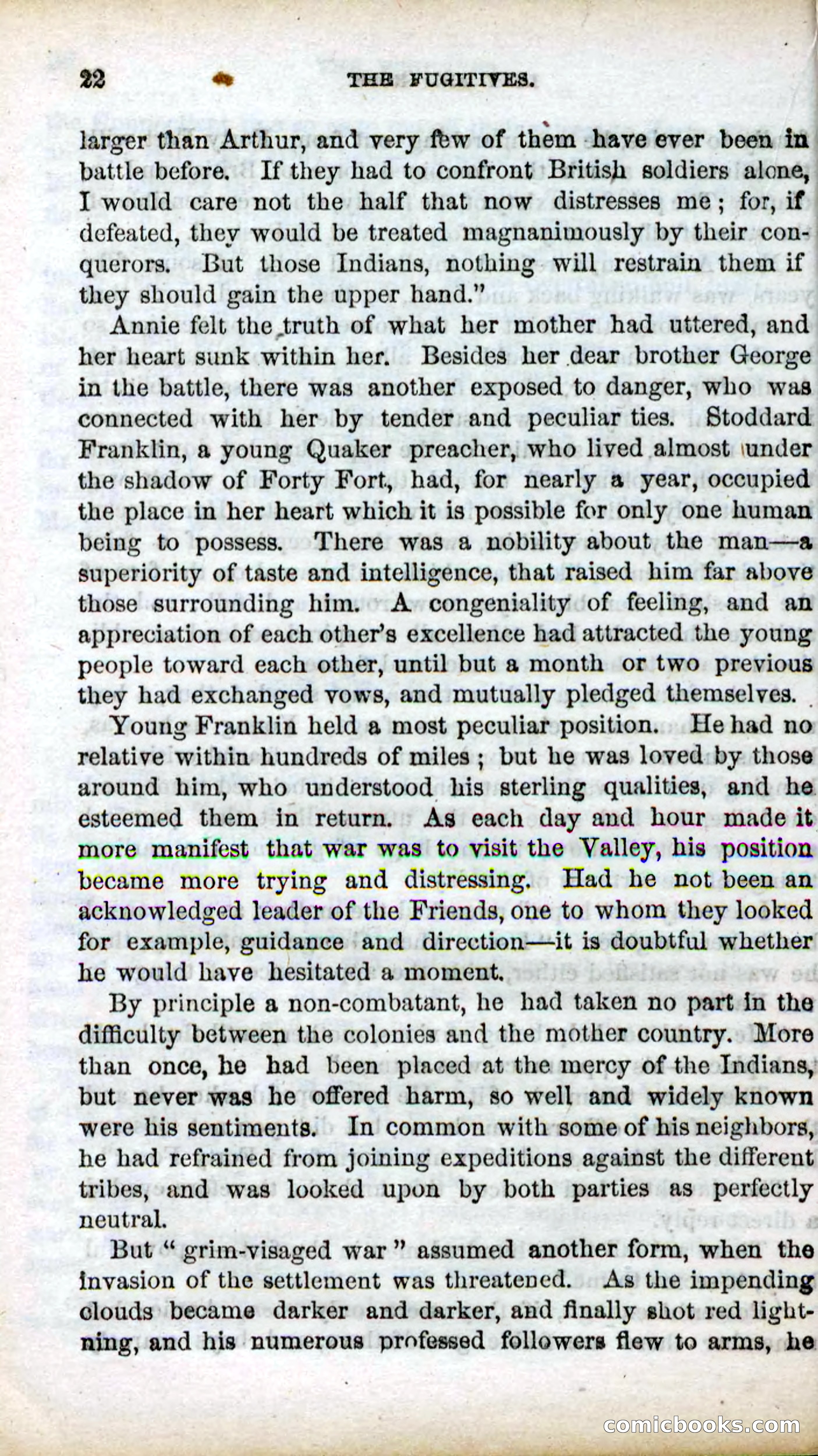
A restored page from Pulp Fiction, 1865. Page through the whole issue in the reader above.
📄 Transcribed text from this page (OCR, searchable)
Machine-transcribed from the original scan — historical spelling and the odd misread are preserved.
22 «y THE FUGITIVES. larger than Arthur, and very few of them have ever been in battle before. If they had to confront British soldiers alone, I would care not the half that now distresses me; for, if defeated, they would be treated magnanimously by their con- querors, But those Indians, nothing will restrain them if they should gain the upper hand.” Annie felt the truth of what her mother had uttered, and her heart sunk within her. Besides her dear brother George in the battle, there was another exposed to danger, who was connected with her by tender and peculiar ties. Stoddard Franklin, a young Quaker preacher, who lived almost \under the shadow of Forty Fort, had, for nearly a year, occupied the place in her heart which it is possible for only one human being to possess. There was a nobility about the man—a superiority of taste and intelligence, that raised him far above those surrounding him. A congeniality of feeling, and an appreciation of each other’s excellence had attracted the young people toward each other, until but a month or two previous they had exchanged vows, and mutually pledged themselves. | Young Franklin held a most peculiar position. Hehad no relative within hundreds of miles; but he was loved: by those around him, who understood his sterling qualities, and he esteemed them in return. As each day and hour made it more manifest that war was to visit the Valley, his position - became more trying and distressing, Had he not been an acknowledged leader of the Friends, one to whom they looked for example, guidance and direction—it is doubtful whether he would have hesitated a moment, By principle a non-combatant, he had taken no part in the difficulty between the colonies and the mother country. More than once, he had been placed at the mercy of the Indians, but never was he offered harm, so well and widely known were his sentiments. In common with some of his neighbors, he had refrained from joining expeditions against the different tribes, and was looked upon by both parties as perfectly neutral, But “ grim-visaged war” assumed another form, when the invasion of the settlement was threatened. As the impending clouds became darker and darker, and finally shot red light- ning, and his numerous professed followers flew to arms, he Conmicooolks.comnn ~