
Pulp Fiction, 1862 · page 100 of 120
Beadle's Dime Novels No. 38: The Wrong Man — page 100: what you’re looking at
A restored page from Pulp Fiction, 1862. Page through the whole issue in the reader above.
📄 Transcribed text from this page (OCR, searchable)
Machine-transcribed from the original scan — historical spelling and the odd misread are preserved.
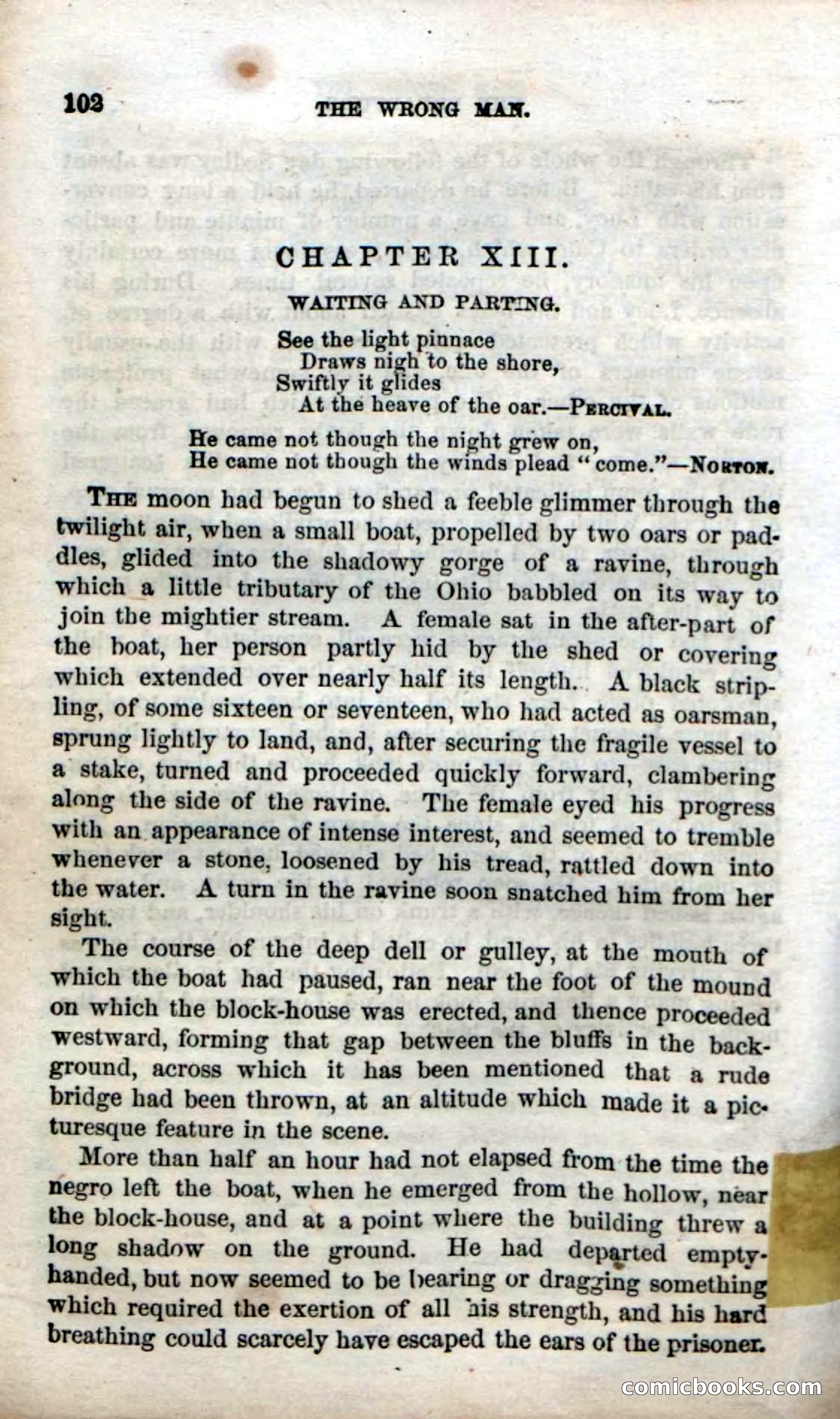
103 THE WRONG MAN. CHAPTER XIII. WAITING AND PARTING, See the light pinnace Draws nigh to the shore, Swiftly it glides At the heave of the oar.—Percrvau. He came not though the night grew on, He came not though the winds plead “ come.”—Norron. THE moon had begun to shed a feeble glimmer through the twilight air, when a small boat, propelled by two oars or pad- dles, glided into the shadowy gorge of a ravine, through which a little tributary of the Ohio babbled on its way to join the mightier stream. A female sat in the after-part of the boat, her person partly hid by the shed or covering which extended over nearly half its length. A black strip- ling, of some sixteen or seventeen, who had acted as oarsman, sprung lightly to land, and, after securing the fragile vessel to a stake, turned and proceeded quickly forward, clambering along the side of the ravine. The female eyed his progress with an appearance of intense interest, and seemed to tremble _ whenever a stone, loosened by his tread, rattled down into the water. A turn in the ravine soon snatched him from her sight. _ ‘The course of the deep dell or gulley, at the mouth of which the boat had paused, ran near the foot of the mound on which the block-house was erected, and thence proceeded westward, forming that gap between the bluffs in the back- ground, across which it has been mentioned that a rude bridge had been thrown, at an altitude which made it a pic- turesque feature in the scene. More than half an hour had not elapsed from the time the negro left the boat, when he emerged from the hollow, near the block-house, and at a point where the building threw long shadow on the ground. He had departed empty handed, but now seemed to be bearing or dragzing somethi which required the exertion of all is strength, and his breathing could scarcely have escaped the ears of the prisoner. eee ee