
Pulp Fiction, 1862 · page 115 of 130
Beadle's Dime Novels No. 37: Godbold, the Spy — page 115: what you’re looking at
A restored page from Pulp Fiction, 1862. Page through the whole issue in the reader above.
📄 Transcribed text from this page (OCR, searchable)
Machine-transcribed from the original scan — historical spelling and the odd misread are preserved.
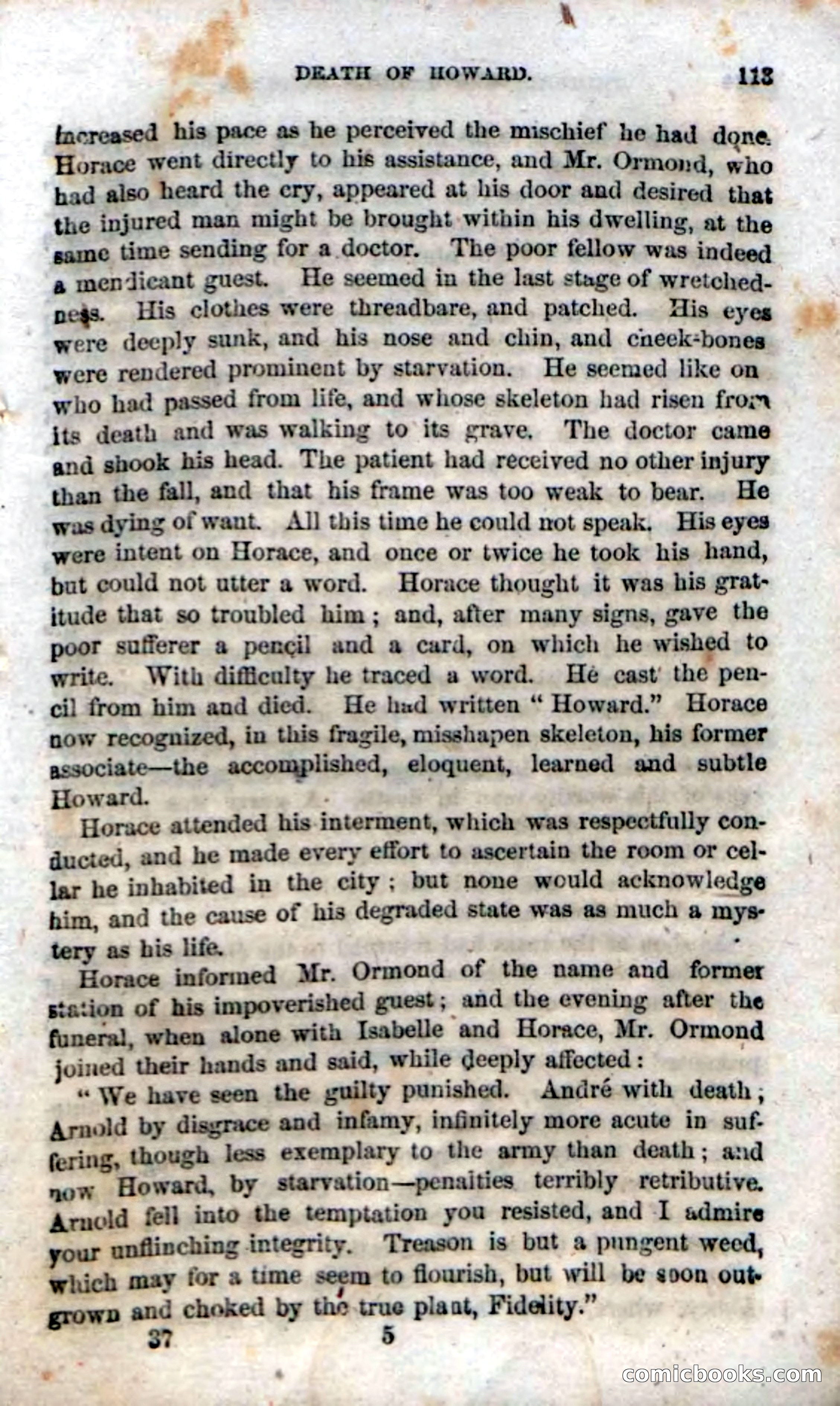
ee DEATH OF HOWARD. 118 rd increased his pace as he perceived the mischief he had done. Horace went directly to his assistance, and Mr. Ormond, who had also heard the ery, appeared at his door and desired that the injured man might be brought within his dwelling, at the same time sending for a doctor. The poor fellow was indeed a mendicant guest. He seemed in the last stage of wretched- His clothes were threadbare, and patched. His eyes = were deeply sunk, and his nose and chin, and cneek-bones were rendered prominent by starvation. He seemed like on who had passed from life, and whose skeleton had risen from its death and was walking to its grave, The doctor came and shook his head. The patient had received no other injury than the fall, and that his frame was too weak to bear. He was dying of want. All this time he could not speak, His eyes were intent on Horace, and once or twice he took his hand, but could not utter a word. Horace thought it was his grat- itude that so troubled him; and, after many signs, gave the poor sufferer a pencil and a card, on which he to write. With difficulty he traced a word. He cast’ the pen- - cil from him and died. He had written “ Howard.” Horace now recognized, in this fragile, misshapen skeleton, his former associate—the accomplished, eloquent, learned and subtle Howard. : ae Horace attended his interment, which was respectfully con- ducted, and he made every effort to ascertain the room or cel- lar he inhabited in the city; but none would acknowledge him, and the cause of his degraded state was as much a mys- tery as his life. ; ‘ Horace informed Mr. Ormond of the name and former station of his impoverished guest; and the evening after the funeral, when alone with Isabelle and Horace, Mr. Ormond joined their hands and said, while deeply affected : “ We have seen the — oa André with death ; Arnold by disgrace and i , infinitely more acute in suf- fering, though less exemplary to the army than death; and now Howard, by starvation—penaities terribly retributive. Arnold fell into the temptation you resisted, and I admire your unflinching integrity. Treason is but a pungent weed, which may for a time seem to flourish, but will be ¢o0n out growD and choked by —— plant, Fidelity.” 3? & ‘ conmiclooolkks.cOmn) -