
Pulp Fiction, 1862 · page 86 of 114
Beadle's Dime Novels No. 35: East and West — page 86: what you’re looking at
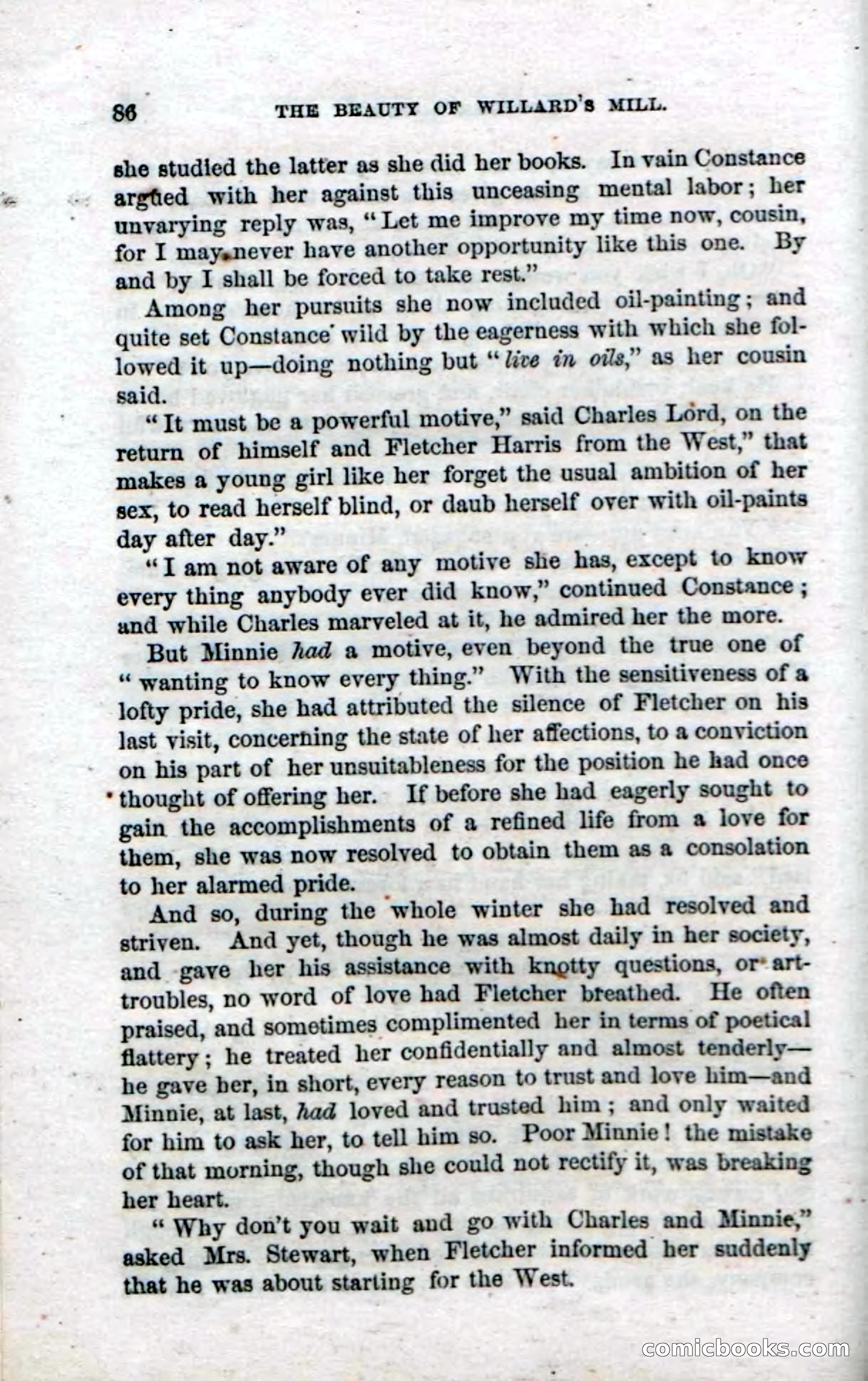
A restored page from Pulp Fiction, 1862. Page through the whole issue in the reader above.
📄 Transcribed text from this page (OCR, searchable)
Machine-transcribed from the original scan — historical spelling and the odd misread are preserved.
86 THE BEAUTY OF WILLARD’S MILL. she studied the latter as she did her books. In vain Constance argfied with her against this unceasing mental labor; her unvarying reply was, “ Let me improve my time now, cousin, for I maysnever have another opportunity like this one. By and by I shall be forced to take rest.” Among her pursuits she now included oil-painting ; and quite set Constance’ wild by the eagerness with which she fol- lowed it up—doing nothing but “live in oils,” as her cousin said. “Tt must be a powerful motive,” said Charles Lord, on the return of himself and Fletcher Harris from the West,” that makes a young girl like her forget the usual ambition of her sex, to read herself blind, or daub herself over with oil-paints day after day.” : “JT am not aware of any motive she has, except to know every thing anybody ever did know,” continued Constance ; und while Charles marveled at it, he admired her the more. But Minnie Aad a motive, even beyond the true one of “ wanting to know every thing.” With the sensitiveness of a lofty pride, she had attributed the silence of Fletcher on his last visit, concerning the state of her affections, to a conviction on his part of her unsuitableness for the position he had once ‘thought of offering her. If before she had eagerly sought to gain the accomplishments of a refined life from a love for them, she was now resolved to obtain them as a consolation to her alarmed pride. _ And so, during the whole winter she had resolved and striven. And yet, though he was almost daily in her society, and gave her his assistance with knotty questions, or* art- troubles, no word of love had Fletcher breathed. He often praised, and sometimes complimented her in terms of poetical flattery ; he treated her confidentially and almost tenderly— he gave her, in short, every reason to trust and love him—and Minnie, at last, had loved and trusted him; and only waited for him to ask her, to tell him so. Poor Minnie! the mistake of that morning, though she could not rectify it, was breaking her heart. “ Why don’t you wait and go with Charles and Minnie,” asked Mrs. Stewart, when Fletcher informed her suddenly that he was about starting for the West. comicloooks.comm j