
Pulp Fiction, 1874 · page 38 of 100
Beadle's Dime Novels No. 309: Mountain Ned — page 38: what you’re looking at
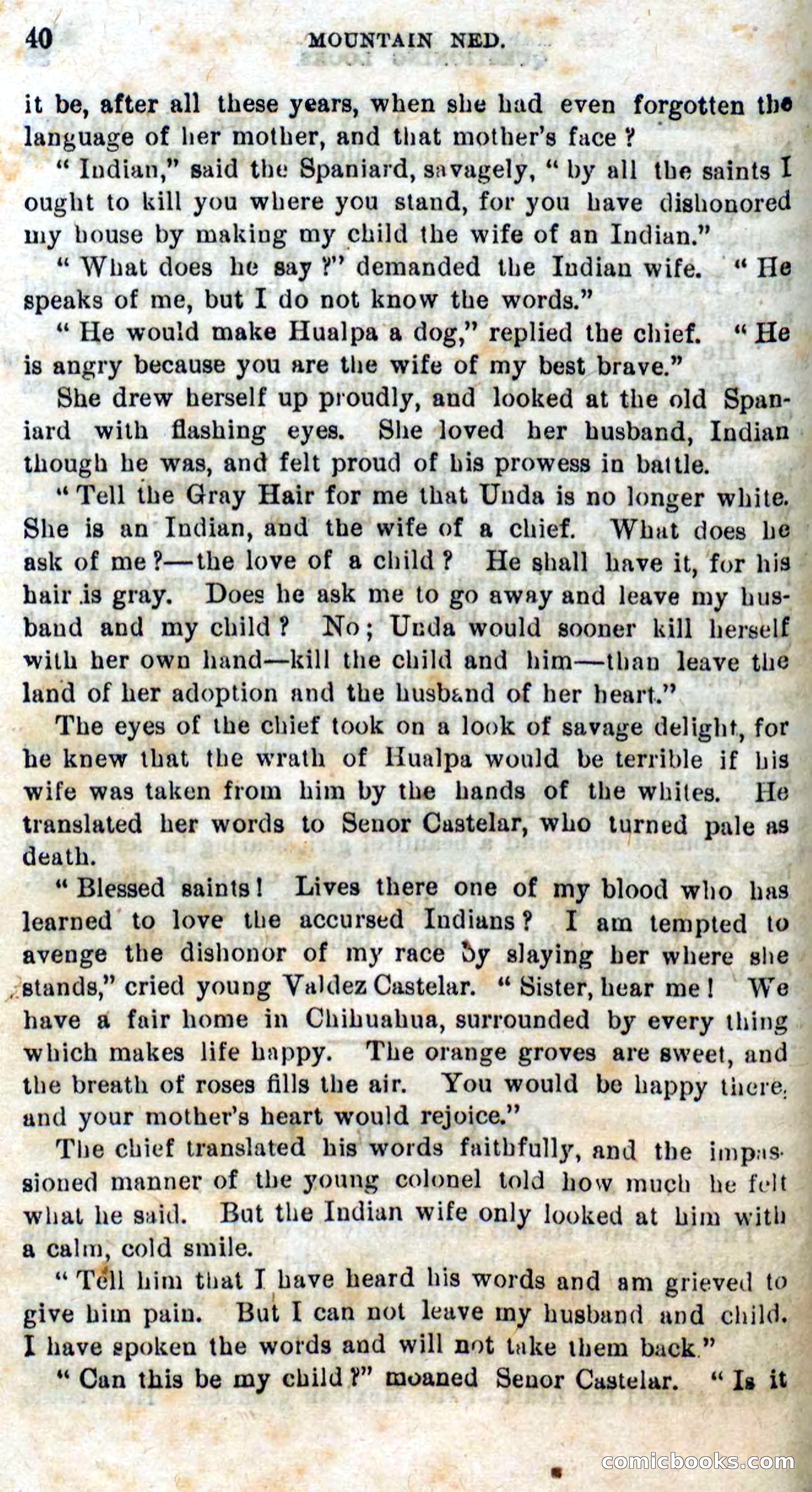
A restored page from Pulp Fiction, 1874. Page through the whole issue in the reader above.
📄 Transcribed text from this page (OCR, searchable)
Machine-transcribed from the original scan — historical spelling and the odd misread are preserved.
40 MOUNTAIN NED, o” it be, after all these years, when she had even forgotten the 9 language of her mother, and that mother’s face ? “ Indian,” said the Spdttiard’ savagely, “ by all the saints I Ought to kill you where you stand, for you have dishonored my bouse by making my child the wife of an Indian.” “What does he say ?’ demanded the Indian wife. “ He speaks of me, but I do not know the words.” “ He would make Hualpa a dog,” replied the chief. “ He is angry because you are the wife of my best brave.” She drew herself up proudly, and looked at the old Span- iard with flashing eyes. She loved her husband, Indian — though he was, and felt proud of bis prowess in battle. “Tell the Gray Hair for me that Unda is no longer white. She is an Indian, and the wife of a chief. What does he ask of me ?—the love of a child? He shall have it, for his hair is gray. Does he ask me to go away and leave my hus- ’ $ : band and my child? No; Unda would sooner kill herself : with her own hand—kill the child and him—tban leave the land of her adoption and the husband of her heart.” The eyes of the chief took on a look of savage delight, for he knew that the wrath of Hualpa would be terrible if his | wife was taken from him by the hands of the whites. He translated her words to Senor Castelar, who turned pale as_ death. “ Blessed saints! Lives there one of my blood who has learned to love the accursed Indians? I am tempted to- avenge the dishonor of my race dy slaying ber where she stands,” cried young Valdez Castelar. “ Sister, hear me! We Se have a fair home in Chihuahua, surrounded by every thing | which makes life happy. The orange groves are sweet, and — the breath of roses fills the air. You ieee be happy there, and your mother’s heart would rejoice.” The chief translated his words faithfully, and the impus: sioned manner of the young colonel told how much he felt — what he said. But the Indian wife only looked at him with — a calm, cold smile. , Tal him that I have heard his words and am grieved to give him pain. But I can not leave my husband and child. I have spoken the words and will not take them back.” fl “Can this be my child?” moaned Senor Cuastelar. “ Is it contdvocte kaa a