
Pulp Fiction, 1860 · page 86 of 130
Beadle's Dime Novels No. 3: Myra, the Child of Adoption — page 86: what you’re looking at
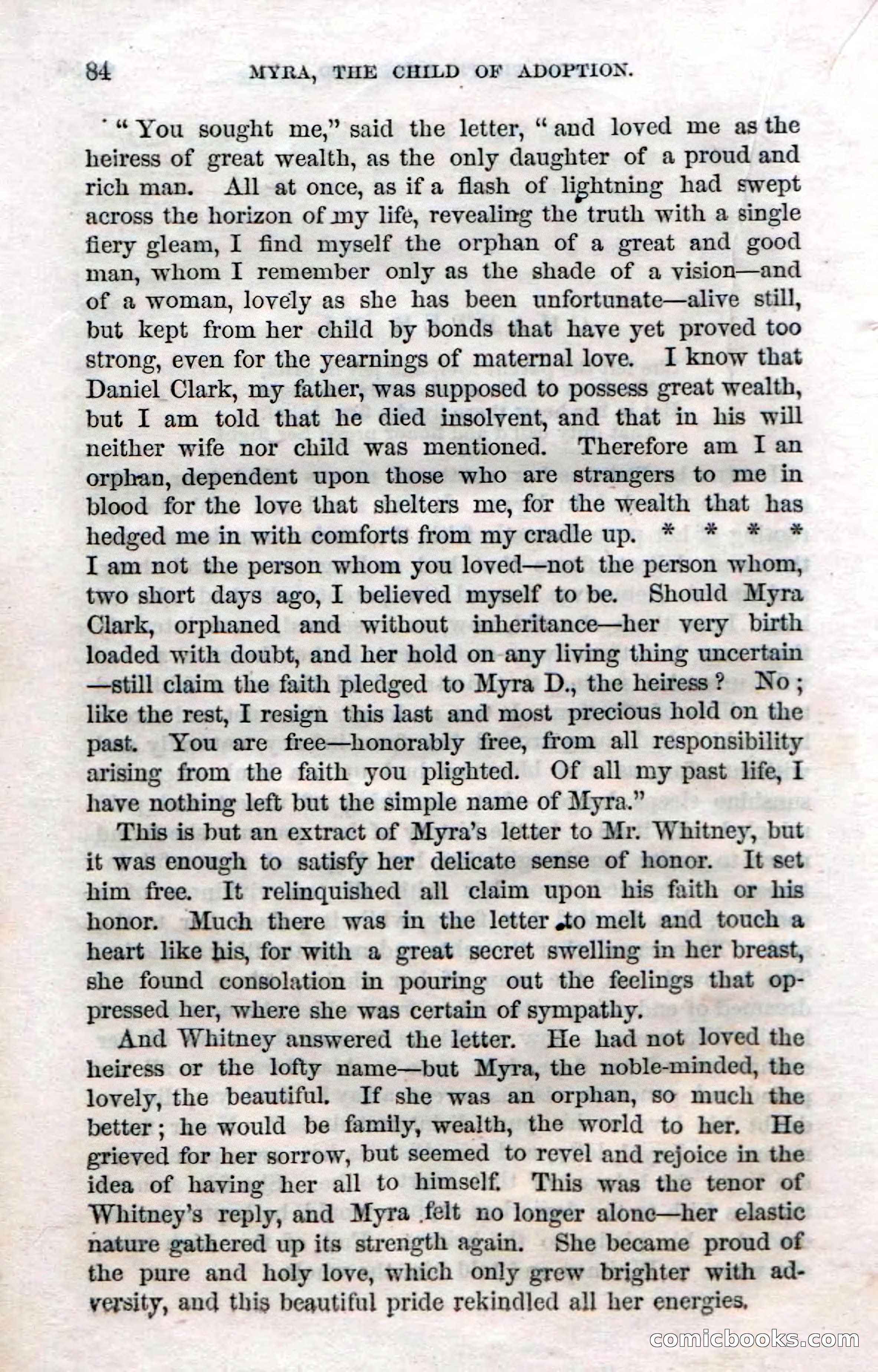
A restored page from Pulp Fiction, 1860. Page through the whole issue in the reader above.
📄 Transcribed text from this page (OCR, searchable)
Machine-transcribed from the original scan — historical spelling and the odd misread are preserved.
84 MYRA, THE CHILD OF ADOPTION. °“ You sought me,” said the letter, “and loyed me as the heiress of great wealth, as the only daughter of a proud and rich man. All at once, as ifa flash of lightning had swept across the horizon of my life, revealing the truth with a single fiery gleam, I find myself the orphan of a great and good man, whom I remember only as the shade of a vision—and of a woman, lovely as she has been unfortunate—alive still, but kept from her child by bonds that have yet proved too strong, even for the yearnings of maternal love. I know that Daniel Clark, my father, was supposed to possess great wealth, but I am told that he died insolyent, and that in his will neither wife nor child was mentioned. Therefore am I an orphan, dependent upon those who are strangers to me in blood for the love that shelters me, for the wealth that has hedged me in with comforts from my cradle up. * * * * I am not the person whom you loved—not the person whom, two short days ago, I believed myself to be. Should Myra Clark, orphaned and without inheritance—her very birth loaded with doubt, and her hold on any living thing uncertain —still claim the faith pledged to Myra D., the heiress? No; like the rest, I resign this last and most precious hold on the past. You are free—honorably free, from all responsibility arising from the faith you plighted. Of all my past life, I have nothing left but the simple name of Myra.” This is but an extract of Myra’s letter to Mr. Whitney, but it was enough to satisfy her delicate sense of honor. It set him free. It relinquished all claim upon his faith or his honor. Much there was in the letter to melt and touch a heart like his, for with a great secret swelling in her breast, she found consolation in pouring out the feelings that op- pressed her, where she was certain of sympathy. And Whitney answered the letter. He had not loved the heiress or the lofty name—but Myra, the noble-minded, the lovely, the beautiful. If she was an orphan, so much the better; he would be family, wealth, the world to her. He grieved for her sorrow, but seemed to revel and rejoice in the idea of having her all to himself. This was the tenor of Whitney’s reply, and Myra felt no longer alone—her elastic nature gathered up its strength again. She became proud of the pure and holy love, which only grew brighter with ad- versity, and this beautiful pride rekindled all her energies, commiclooks.corn