
Pulp Fiction, 1860 · page 80 of 130
Beadle's Dime Novels No. 3: Myra, the Child of Adoption — page 80: what you’re looking at
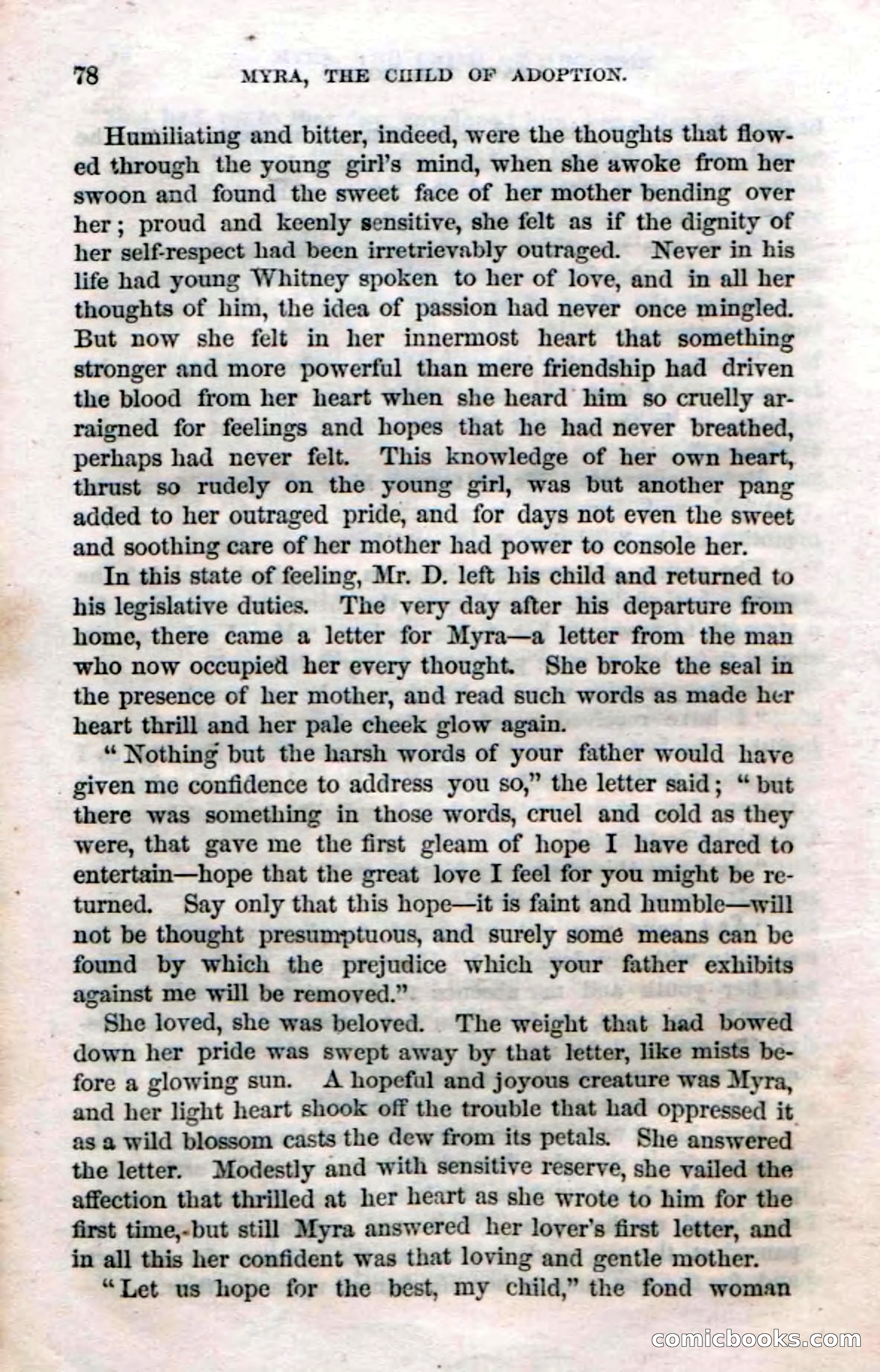
A restored page from Pulp Fiction, 1860. Page through the whole issue in the reader above.
📄 Transcribed text from this page (OCR, searchable)
Machine-transcribed from the original scan — historical spelling and the odd misread are preserved.
* 78 MYRA, THE CUILD OF ADOPTION. Humiliating and bitter, indeed, were the thoughts that flow- ed through the young girl’s mind, when she awoke from her swoon and found the sweet face of her mother bending over her; proud and keenly sensitive, she felt as if the dignity of her self-respect had been irretrievably outraged. Never in his life had young Whitney spoken to her of love, and in all her thoughts of him, the idea of passion had never once mingled. But now she felt in her innermost heart that something stronger and more powerful than mere friendship had driven the blood from her heart when she heard him so cruelly ar- raigned for feelings and hopes that he had never breathed, perhaps had never felt. This knowledge of her own heart, thrust so rudely on the young girl, was but another pang added to her outraged pride, and for days not even the sweet and soothing care of her mother had power to console her. In this state of feeling, Mr. D. left his child and returned to his legislative duties. The very day after his departure from home, there came a letter for Myra—a letter from the man who now occupieil her every thought. She broke the seal in the presence of her mother, and read such words as made her heart thrill and her pale cheek glow again. “ Nothing but the harsh words of your father would have given me confidence to address you so,” the letter said; “ but there was something in those words, cruel and cold as they were, that gave me the first gleam of hope I have dared to entertain—hope that the great love I feel for you might be re- turned, Say only that this hope—it is faint and humble—will not be thought presumptuous, and surely somé means can be found by which the prejudice which your father exhibits against me will be removed.” She loved, she was beloved. The weight that had bowed down her pride was swept away by that letter, like mists be- fore a glowing sun. A hopeful and joyous creature was Myra, and her light heart shook off the trouble that had oppressed it as a wild blossom casts the dew from its petals. She answered the letter. Modestly and with sensitive reserve, she vailed the affection that thrilled at her heart as she wrote to him for the first time,-but still Myra answered her lover's first letter, and in all this her confident was that loving and gentle mother. “Let us hope for the best, my child,” the fond woman cGonmmicloooks.acorn