
Pulp Fiction, 1860 · page 78 of 130
Beadle's Dime Novels No. 3: Myra, the Child of Adoption — page 78: what you’re looking at
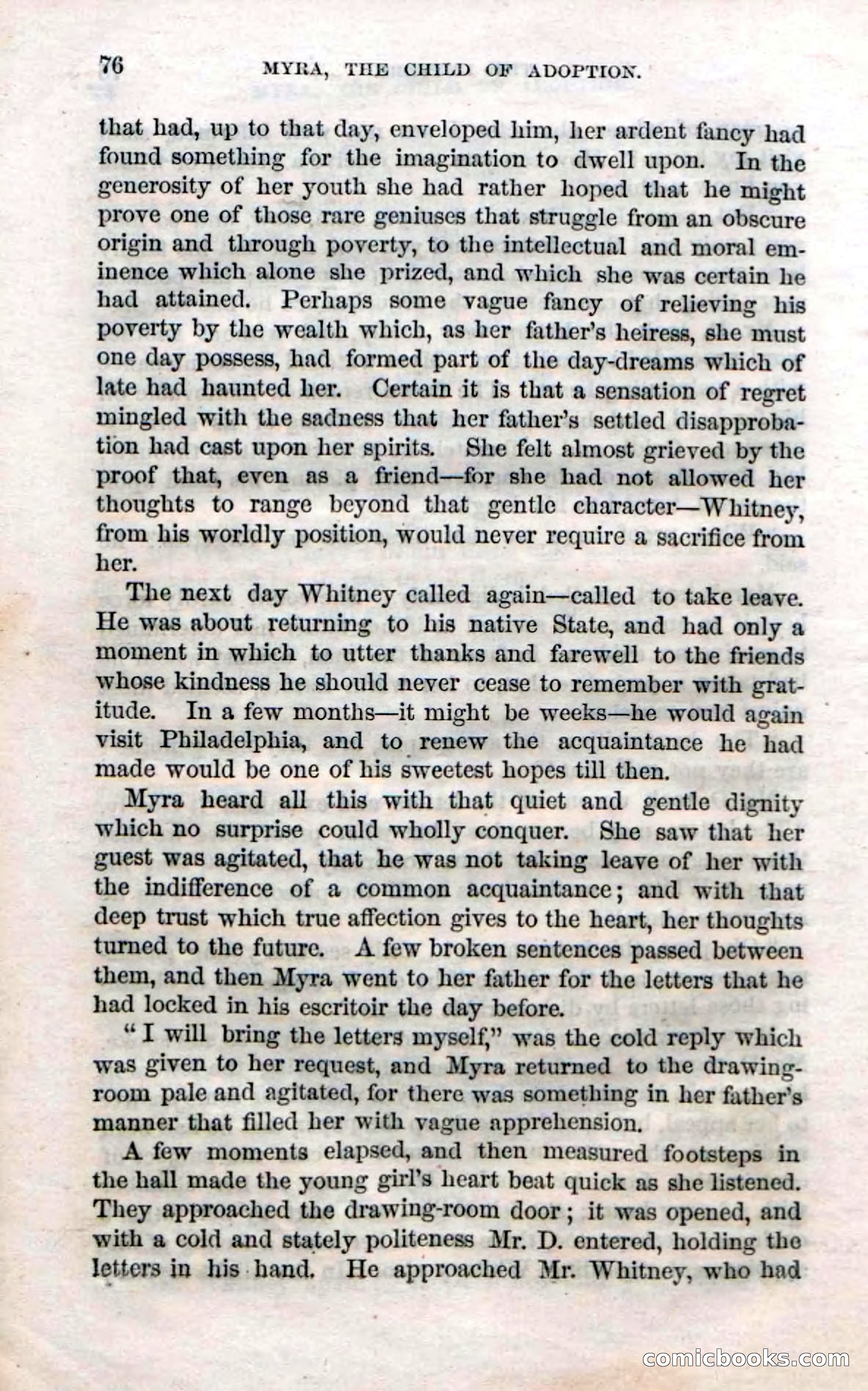
A restored page from Pulp Fiction, 1860. Page through the whole issue in the reader above.
📄 Transcribed text from this page (OCR, searchable)
Machine-transcribed from the original scan — historical spelling and the odd misread are preserved.
76 MYRA, THE CHILD OF ADOPTION. that had, up to that day, enveloped him, her ardent fancy had found something for the imagination to dwell upon. In the generosity of her youth she had rather hoped that he might prove one of those rare geniuses that struggle from an obscure origin and through poverty, to the intellectual and moral em- inence which alone she prized, and which she was certain he had attained. Perhaps some vague fancy of relieving his poverty by the wealth which, as her father’s heiress, she must one day possess, had formed part of the day-dreams which of late had haunted her. Certain it is that a sensation of regret mingled with the sadness that her father’s settled disapproba- tion had cast upon her spirits. She felt almost grieved by the proof that, even as a friend—for she had not allowed her thoughts to range beyond that gentle character—Whitney, from his worldly position, would never require a sacrifice from her. The next day Whitney called again—called to take leave. He was about returning to his native State, and had only a moment in which to utter thanks and farewell to the friends whose kindness he should never cease to remember with grat- itude. In a few months—it might be weeks—he would again visit Philadelphia, and to renew the acquaintance he had made would be one of his sweetest hopes till then. Myra heard all this with that quiet and gentle dignity which no surprise could wholly conquer. She saw that her guest was agitated, that he was not taking leave of her with the indifference of a common acquaintance; and with that deep trust which true affection gives to the heart, her thoughts turned to the future. A few broken sentences passed between them, and then Myra went to her father for the letters that he had locked in his escritoir the day before. “TI will bring the letters myself,” was the cold reply which was given to her request, and Myra returned to the drawing- room pale and agitated, for there was something in her father’s manner that filled her with vague apprehension, A few moments elapsed, and then measured footsteps in the hall made the young girl’s heart beat quick as she listened. They approached the drawing-room door; it was opened, and with a cold and stately politeness Mr, D. entered, holding the letters in his-hand, He approached Mr. Whitney, who had commicloooks.conn