
Pulp Fiction, 1860 · page 50 of 130
Beadle's Dime Novels No. 3: Myra, the Child of Adoption — page 50: what you’re looking at
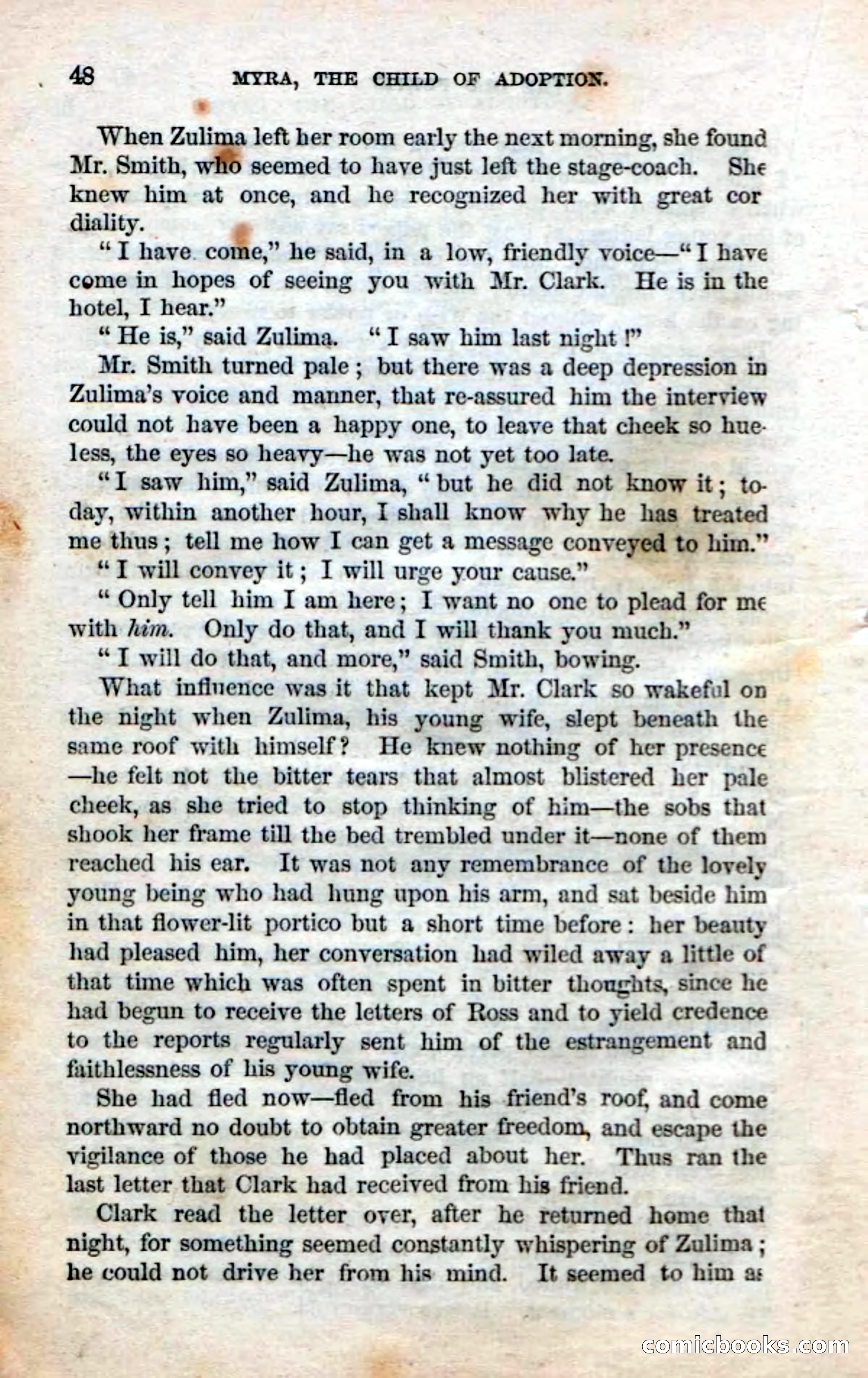
A restored page from Pulp Fiction, 1860. Page through the whole issue in the reader above.
📄 Transcribed text from this page (OCR, searchable)
Machine-transcribed from the original scan — historical spelling and the odd misread are preserved.
48 MYRA, THE CHILD OF ADOPTION. . When Zulima left her room early the next morning, she found Mr. Smith, seemed to haye just left the stage-coach. She knew him at once, and he recognized her with great cor diality. “T have. come,” he said, in a low, friendly voice—“I have come in hopes of seeing you with Mr. Clark. He is in the hotel, I hear.” “ He is,” said Zulima. “I saw him last night !” Mr. Smith turned pale ; but there was a deep depression in Zulima’s voice and manner, that re-assured him the interview could not have been a happy one, to leave that cheek so hue- less, the eyes so heayy—he was not yet too late. “I saw him,” said Zulima, “but he did not know it; to- day, within another hour, I shall know why he has treated me thus; tell me how I can get a message cony | 0 him.” “7 will convey it; I will urge your cause.” “ Only tell him L: am here ; T want no one to nlead for me with him. Only do that, and I will thank you much.” “I will do that, and more,” said Smith, bowing. What infinence was it that kept Mr. Clark so wakeful on the night when Zulima, his young wife, slept beneath the same roof with himself? He knew nothing of her presence —he felt not the bitter tears that almost blistered her pale cheek, as she tried to stop thinking of him—the sobs that shook her frame till the bed trembled under it—none of them reached his ear. It was not any remembrance of the lovely young being who had hung upon his arm, and sat beside him in that flower-lit portico but a short time before: her beauty had pleased him, her conversation had wiled away a little of that time which was often spent in bitter thoughts, since he had begun to receive the letters of Ross and to yield credence to the reports regularly sent him of the estrangement and faithlessness of his young wife. She had fled now—fled from his friend’s roof, and come northward no doubt to obtain greater freedom, and escape the vigilance of those he had placed about her. Thus ran the last letter that Clark had received from his friend. Clark read the letter over, after he returned home that night, for something seemed constantly whispering of Zulima ; he could not drive her from his mind. It seemed to him as comicloooks. corn