
Pulp Fiction, 1860 · page 21 of 130
Beadle's Dime Novels No. 3: Myra, the Child of Adoption — page 21: what you’re looking at
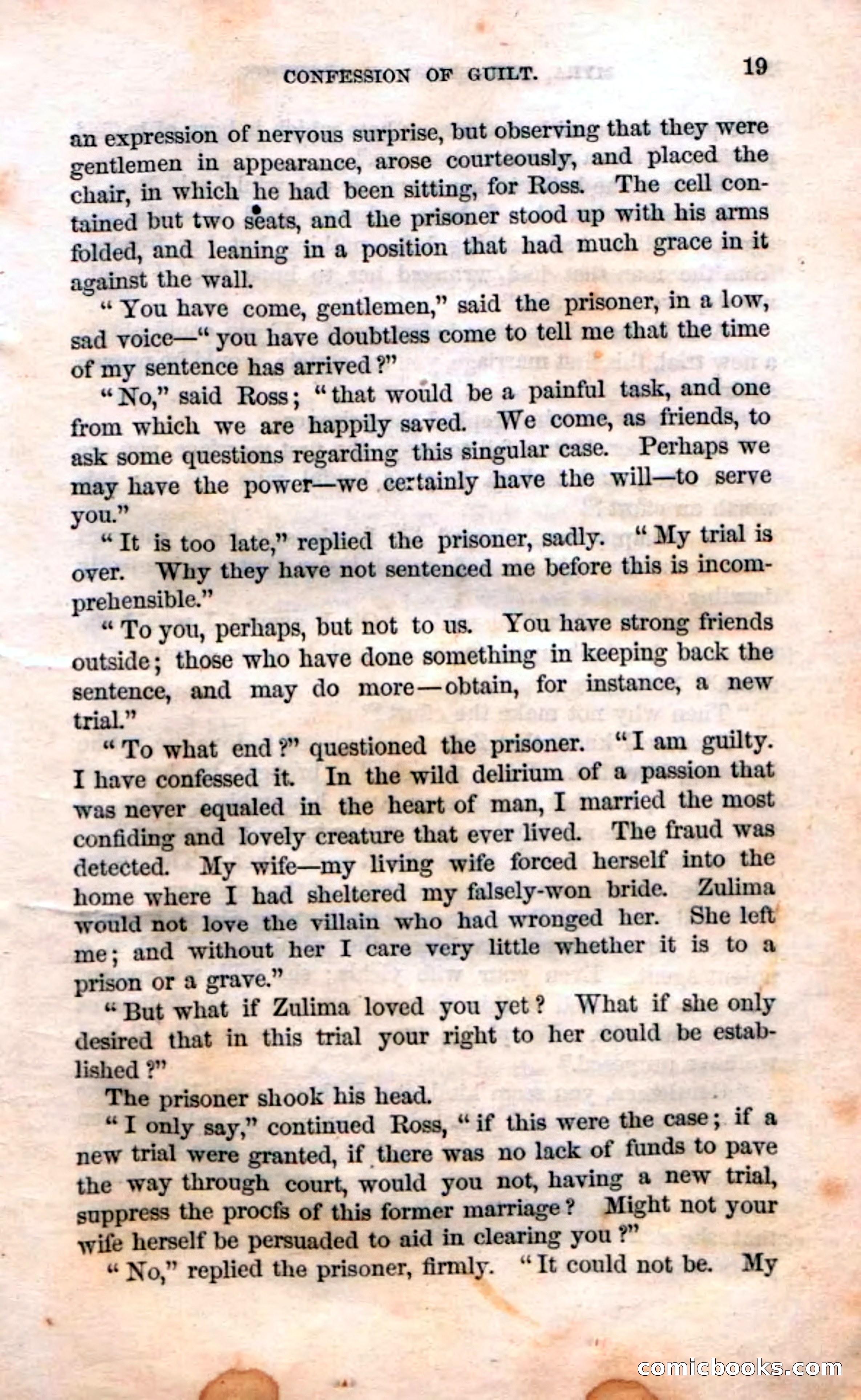
A restored page from Pulp Fiction, 1860. Page through the whole issue in the reader above.
📄 Transcribed text from this page (OCR, searchable)
Machine-transcribed from the original scan — historical spelling and the odd misread are preserved.
CONFESSION OF GUILT. 19 an expression of neryous surprise, but observing that they were gentlemen in appearance, arose courteously, and placed the chair, in which he had been sitting, for Ross. The cell con- tained but two stats, and the prisoner stood up with his arms folded, and leaning in a position that had much grace in it against the wall. “You have come, gentlemen,” said the prisoner, in a low, sad voice— you have doubtless come to tell me that the time of my sentence has arrived ?” : “No,” said Ross; “that would be a painful task, and one from which we are happily saved. We come, as friends, to ask some questions regarding this singular case. Perhaps we may have the power—we certainly have the will—to serve you.” “Tt is too late,” replied the prisoner, sadly. “ My trial is over. Why they have not sentenced me before this is incom- prehensible.” | “To you, perhaps, but not to us. You have strong friends outside; those who have done something in keeping back the sentence, and may do more—obtain, for instance, a new trial.” “To what end?” questioned the prisoner. “Iam guilty. I have confessed it. In the wild delirium of a passion that was neyer equaled in the heart of man, I married the most confiding and lovely creature that ever lived. The fraud was detected. My wife—my living wife forced herself into the home where I had sheltered my falsely-won bride. Zulima would not love the villain who had wronged her. She left me; and without her I care very little whether it is to a prison or a grave.” | “But what if Zulima loved you yet? What if she only desired that in this trial your right to her could be estab- lished ?” The prisoner shook his head. , “T only say,” continued Ross, “if this were the case; if a new trial were granted, if there was no lack of funds to pave the way through court, would you not, having a new trial, suppress the procfs of this former marriage? Might not your wife herself be persuaded to aid in clearing you ?” “ No,” replied the prisoner, eraly. “Tt could not be. My connichbooksacomn —_ - ."y