
Pulp Fiction, 1860 · page 19 of 130
Beadle's Dime Novels No. 3: Myra, the Child of Adoption — page 19: what you’re looking at
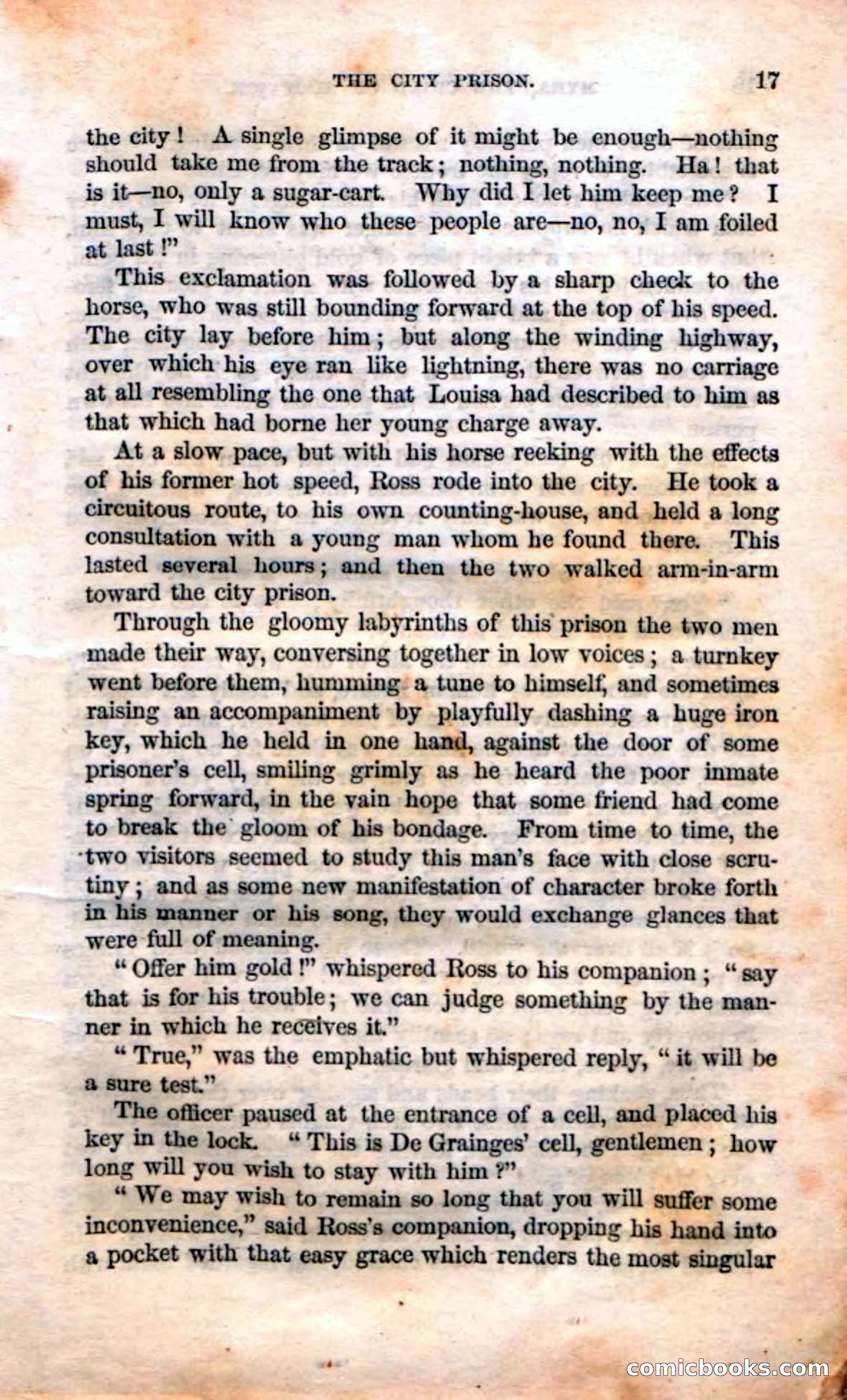
A restored page from Pulp Fiction, 1860. Page through the whole issue in the reader above.
📄 Transcribed text from this page (OCR, searchable)
Machine-transcribed from the original scan — historical spelling and the odd misread are preserved.
* THE CITY PRISON. 17 the city! A single glimpse of it might be enough—nothing should take me from the track; nothing, nothing. Ha! that is it—no, Only a sugar-cart. Why did I let him keep me? I must, I will know who these people are—no, no, I am foiled at last Y This exclamation was followed by a sharp check to the horse, who was still bounding forward at the top of his speed. The city lay before him; but along the winding highway, over which his eye ran like lightning, there was no carriage at all resembling the one that Louisa had described to him as that which had borne her young charge away. At a slow pace, but with his horse reeking with the effects of his former hot speed, Ross rode into the city. He took a circuitous route, to his own counting-house, and held a long consultation with a young man whom he found there. This lasted several hours; and then the two walked arm-in-arm toward the city prison. ee Through the gloomy labyrinths of this prison the two men made their way, conversing together in low voices; a turnkey went before them, humming: a tune to himself, and sometimes raising an accompaniment by playfully dashing a huge iron key, which he held in one hand, against the door of some prisoner’s cell, smiling grimly as he heard the poor inmate spring forward, in the vain hope that some friend had come to break the gloom of his bondage. From time to time, the ‘two visitors seemed to study this man’s face with close scru- tiny ; and as some new manifestation of character broke forth in manner or his song, they would exchange glances that were full of meaning. 2 “ Offer him gold !” whispered Ross to his companion ; “say that is for his trouble; we can judge something by the man- ner in which he recéives it.” “ True,” was the emphatic but whispered reply, “it will be & sure test.” The officer paused at the entrance of a cell, and placed his key in the lock. “This is De Grainges’ cell, gentlemen ; how long will you wish to stay with him ?” te “We may wish to remain so long that you will suffer some a pocket with that easy grace which renders the most singular ? | ~ pe aaaren 2rCOTN e _