
Pulp Fiction, 1860 · page 10 of 130
Beadle's Dime Novels No. 3: Myra, the Child of Adoption — page 10: what you’re looking at
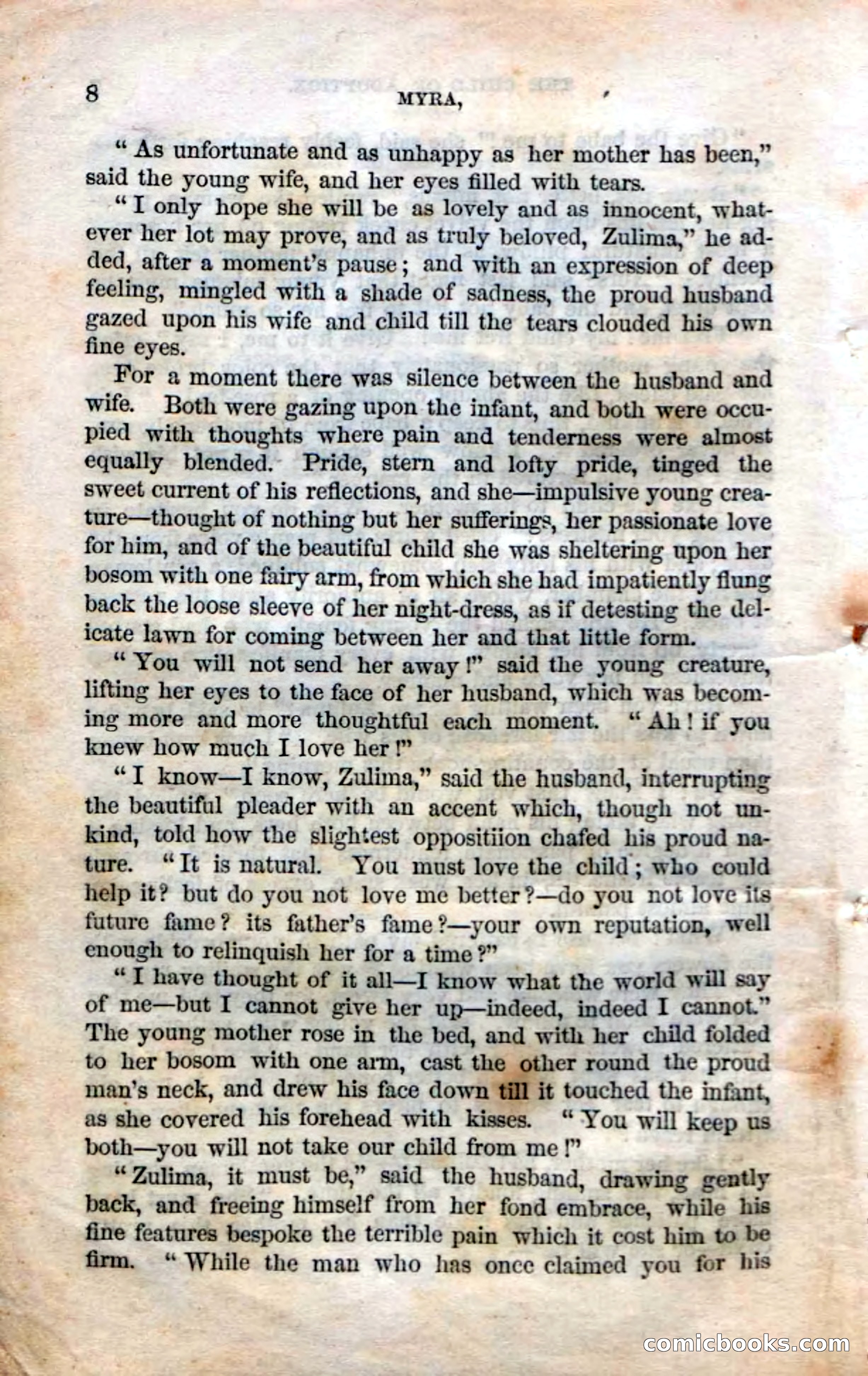
A restored page from Pulp Fiction, 1860. Page through the whole issue in the reader above.
📄 Transcribed text from this page (OCR, searchable)
Machine-transcribed from the original scan — historical spelling and the odd misread are preserved.
8 MYRA, ° “ As unfortunate and as unhappy as her mother has been,” said the young wife, and her eyes filled with tears. “TI only hope she will be as lovely and as innocent, what- ever her lot may prove, and as truly beloved, Zulima,” he ad- ded, after a moment’s pause; and with an expression of deep feeling, mingled with a shade of sadness, the proud husband gazed upon his wife and child till the tears clouded his own fine eyes. For a moment there was silence between the husband and wife. Both were gazing upon the infant, and both were occu- pied with thoughts where pain and tenderness were almost equally blended. Pride, stern and lofty pride, tinged the sweet current of his reflections, and she—impulsive young crea- ture—thought of nothing but her sufferings, her passionate love for him, and of the beautiful child she was sheltering upon her bosom with one fairy arm, from which she had impatiently flung back the loose sleeve of her night-dress, as if detesting the del- icate lawn for coming between her and that little form. “You will not send her away!” said the young creature, lifting her eyes to the face of her husband, which was becom- ing more and more thoughtful each moment. “Ah! if you knew how much I love her!” “I know—I know, Zulima,” said the husband, interrupting the beautiful pleader with an accent which, though not un- kind, told how the slightest oppositiion chafed his proud na- ture. “It is natural. You must love the child; who could help it? but do you not love me better ?—do you not love its future fame? its father’s fame?—your own reputation, well enough to relinquish her for a time ?” “T have thought of it all—I know what the world will say of me—but I cannot give her up—indeed, indeed I cannot.” The young mother rose in the bed, and with her child folded to her bosom with one arm, cast the other round the proud man’s neck, and drew his face down till it touched the infant, as she covered his forehead with kisses. “You will keep us both—you will not take our child from me !” P “Zulima, it must be,” said the husband, drawing gently back, and freeing himself from her fond embrace, while his fine features bespoke the terrible pain which it cost him to be frm. “ While the man who has once claimed you for his conniclooolks.Gcornn a