
Pulp Fiction, 1870 · page 94 of 98
Red Belt, the Tuscarora — page 94: what you’re looking at
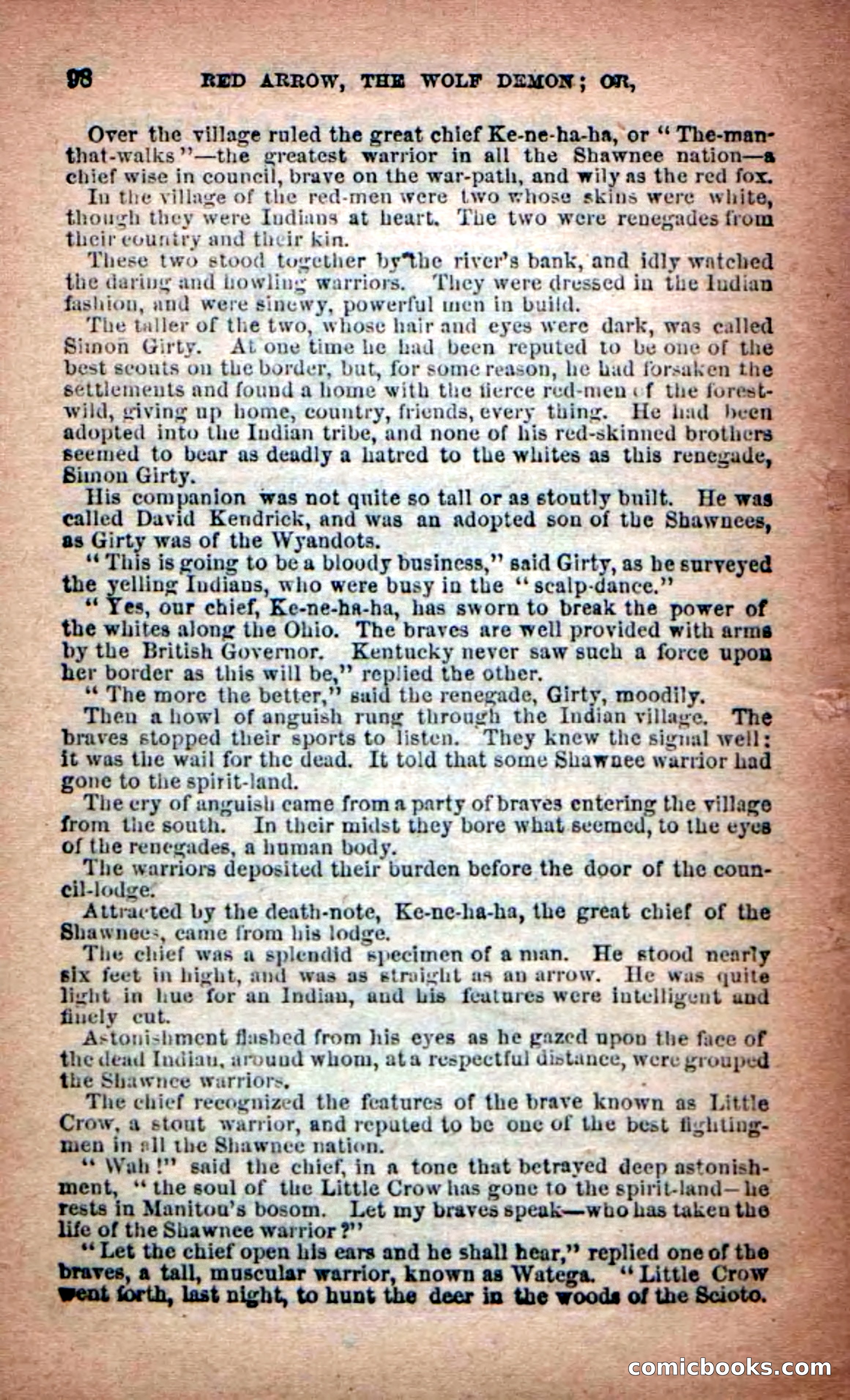
A restored page from Pulp Fiction, 1870. Page through the whole issue in the reader above.
📄 Transcribed text from this page (OCR, searchable)
Machine-transcribed from the original scan — historical spelling and the odd misread are preserved.
98 RED ARROW, THE WOLF DEMON; OR, Over the village ruled the great chief Ke-ne-ha-ha, or “‘ The-man- that-walks’’—the greatest warrior in all the Shawnee nation—as chief wise in council, brave on the war-path, and wily as the red fox, In the village of the red-men were two whose skins were white, though they were Indians at heart, The two were renegades from their eouniry and their kin. These two stood together bythe river’s bank, and idly watched the daripg and Lowling warriors. They were dressed in the Iudian fashion, and were sincwy, powerful men in build. The taller of the two, whose hair and eyes were dark, was called Siinon Girty. At one time he had been reputed to be one of the best scouts on the border, but, for some reason, he Lad forsaken the setticments and found a home with the tierce red-men cf the forest- wild, giving up home, country, friends, every thing. He had heen adopted into the Indian tribe, and none of his red-skinned brothers seemed to bear as deadly a hatred to the whites as this renegade, Biinon Girty. His companion was not quite so tall or as stoutly built. He was called David Kendrick, and was an adopted son of the Shawnees, as Girty was of the Wyandots. “‘ This is going to be a bloody business,” said Girty, as he surveyed the Sage Indians, who were busy in the ‘‘ scalp-dance.”” “Yes, our chief, Ke-ne-ha-ha, has sworn to break the power of the whites along the Ohio. The braves are well provided with arms by the British Governor. Kentucky never saw such a force upop her border as this will be,” replied the other. ‘* The more the better,” said the renegade, Girty, moodily. Then a howl of anguish rung through the Indian village, The braves stopped their sports to listen.. They knew the signal well; it was the wail for the dead. It told that some Shawnee warrior had gone to the spirit-land. The ery of anguisli came froma party of braves entering the village from the south. In their midst they bore what. seemed, to the eyes of the renegades, a human body. sieicts warriors deposited their burden before the door of the coun- “1 e&. Attracted by the death-note, Ke-ne-ha-ha, the great chief of the Shawnees, came from his lodge. The chief was a splendid specimen of aman. He stood nearly six feet in hight, and was as straight as an arrow. He was quite light in hue for an Indian, and bis features were intelligent and finely cut. Astonishment flushed from his eyes as he gazed upon the face of the dead Indiau, around whom, ata respectful distance, were grouped the Shawnee warriors, The chief recognized the features of the brave known as Little Crow, a stout warrior, and reputed to be one of the best fighting- men in #il the Shawnee nation. “Wah!” said the chief, in a tone that betrayed deep astonish- ment, * the soul of the Little Crow has gone to the spirit-land—he rests in Manitou’s bosom. Let my braves speak—who has taken the life of the Shawnee warrior ?”’ “Let the chief open his ears and he shall hear,” replied one of the a muscular warrior, known as Wa * Little Crow peut tieth le s tega. last night, to hunt the deer in the woods of the Scioto. comicbooks.com — rs a ~- ~ — . —