
Pulp Fiction, 1870 · page 61 of 98
Red Belt, the Tuscarora — page 61: what you’re looking at
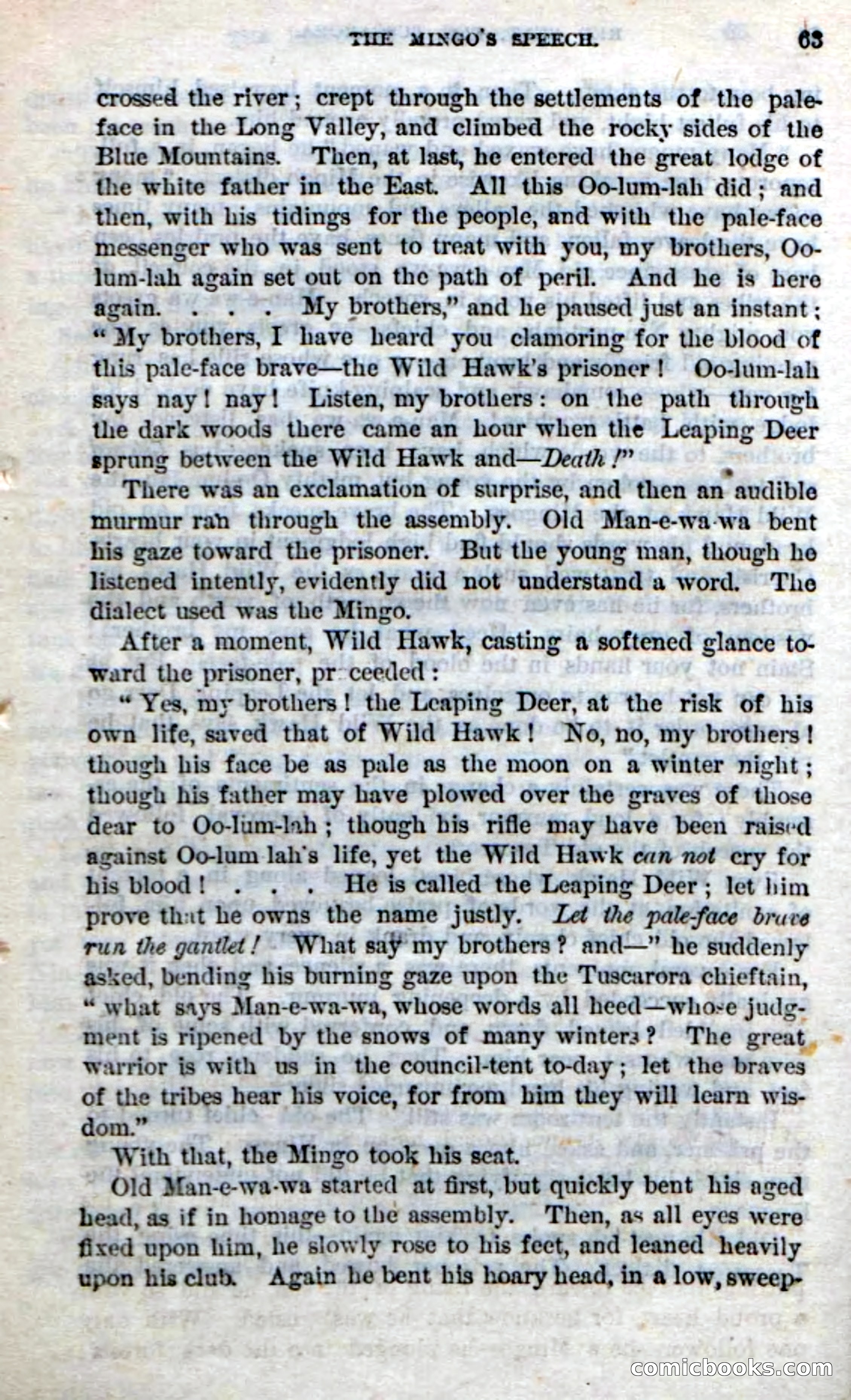
A restored page from Pulp Fiction, 1870. Page through the whole issue in the reader above.
📄 Transcribed text from this page (OCR, searchable)
Machine-transcribed from the original scan — historical spelling and the odd misread are preserved.
TIE MINGO’S SPEECH. 63 crossed the river; crept through the settlements of the pale- face in the Long Valley, and climbed the rocky sides of the Blue Mountains. Then, at last, he entered the great lodge of the white father in the East. All this Oo-lum-lah did; and then, with his tidings for the people, and with the pale-face messenger who was sent to treat with you, my brothers, Oo- lum-lah again set out on the path of peril. And he is here again. . . . My brothers,” and he paused just an instant; “My brothers, I have heard you clamoring for the blood of this pale-face brave—the Wild Hawk’s prisoner! Oo-lum-lah says nay! nay! Listen, my brothers: on the path throurh the dark woods there came an hour when the Leaping Deer sprung between the Wild Hawk and—Death /” There was an exclamation of surprise, and then an "andible murmur rah through the assembly. Old Man-e-wa-wa bent his gaze toward the prisoner. But the young man, though he listened intently, evidently did not understand a word. The dialect used was the Mingo After a moment, Wild Y Hawk, casting a softened glance to- ward the prisoner, pr-ceeded : “Yes, my brothers! the Leaping Deer, at the risk of his own life, saved that of Wild Hawk! No, no, my brothers! though his face be as pale as the moon on a winter night ; though his father may have plowed over the graves of those dear to Oo-lum-Inh ; though his rifle may have been raised against Oo-lum lah’s life, yet the Wild Hawk can not ery for his blood! . . . He is called the Leaping Deer; let him prove thxt he owns the name justly. Let the paleface bruve run the gantlet ! “What sa¥ my brothers ? and—” he suddenly eked, bending his burning gaze upon the Tuscarora chieftain, “what says Man-e-wa-wa, whose words all heed—who-re judg- ment is ripened by the snows of many winters? The great, » warrior is with us in the council-tent to-day; let the Shaves. of the tribes hear his voice, for from him they will learn wis- dom.” - With that, the Mingo took his scat. ~ Old Man-e-wa-wa started at first, but quickly bent his aged head, as if in homage to the assembly. Then, as all eyes were fixed upon him, he slowly rose to his feet, and leaned ‘heavily upon hisclub. Again he bent his hoary head, in a low, sweep- conicldbooks.conn