
Pulp Fiction, 1868 · page 62 of 116
Beadle's Dime Novels No. 142: The Sagamore of Saco — page 62: what you’re looking at
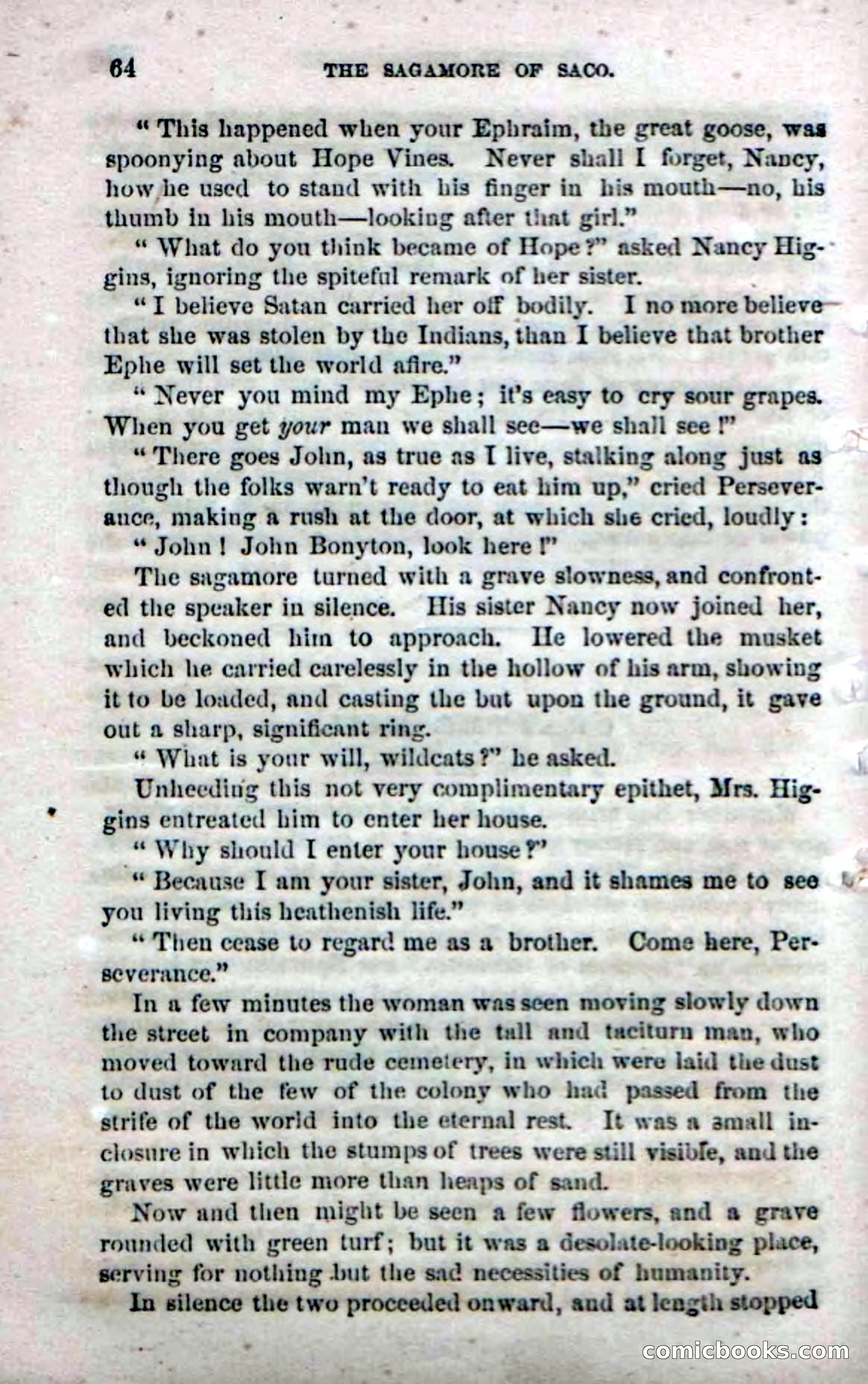
A restored page from Pulp Fiction, 1868. Page through the whole issue in the reader above.
📄 Transcribed text from this page (OCR, searchable)
Machine-transcribed from the original scan — historical spelling and the odd misread are preserved.
64 THE SAGAMORE OF SACO. “This happened when your Ephraim, the great goose, was spoonying about Hope Vines. Never shall I forget, Nancy, how he used to stand with his finger in his mouth—no, his thumb in his mouth—looking after that girl.” * What do you think became of Hope?” asked Nancy Hig-- gins, ignoring the spiteful remark of her sister. “T believe Satan carried her off bodily. I no more believe— that she was stolen by the Indians, than I believe that brother Ephe will set the world afire.” “Never you mind my Ephe; it’s easy to cry sour grapes. When you get your man we shall see—we shall see !” “There goes John, as true as I live, stalking along just as though the folks warn’t ready to eat him up,” cried Persever- ance, making a rush at the door, at which she cried, loudly: “ John ! John Bonyton, look here !” The sagamore turned with a grave slowness, and confront- ed the speaker in silence. His sister Nancy now joined her, and beckoned him to approach. Le lowered the musket which he carried carelessly in the hollow of his arm, showing it to be loaded, and casting the but upon the ground, it gave out a sharp, significant ring. “ What is your will, wildcats?” he asked. Unheeding this not very complimentary epithet, Mrs. Hig- gins entreated him to enter her house. “Why should [ enter your house ?” * Because I am your sister, John, and it shames me to see \~ you living this heathenish life.” “Then cease to regard me as a brother. Come here, Per- - severance.” In a few minutes the woman was seen moving slowly down the street in company with the tall and taciturn man, who moved toward the rude cemetery, in which were laid the dust to dust of the few of the colony who had passed from the strife of the world into the eternal rest. It was a amall in- closure in which the stumps of trees were still visible, and the graves were little more than heaps of sand. Now and then might be seen a few flowers, and a grave rounded with green turf; but it was a desolate-looking place, serving for nothing but the sad necessities of humanity. In silence ines eae and at length stopped > GOMIESOOKS: com