
Pulp Fiction, 1868 · page 44 of 116
Beadle's Dime Novels No. 142: The Sagamore of Saco — page 44: what you’re looking at
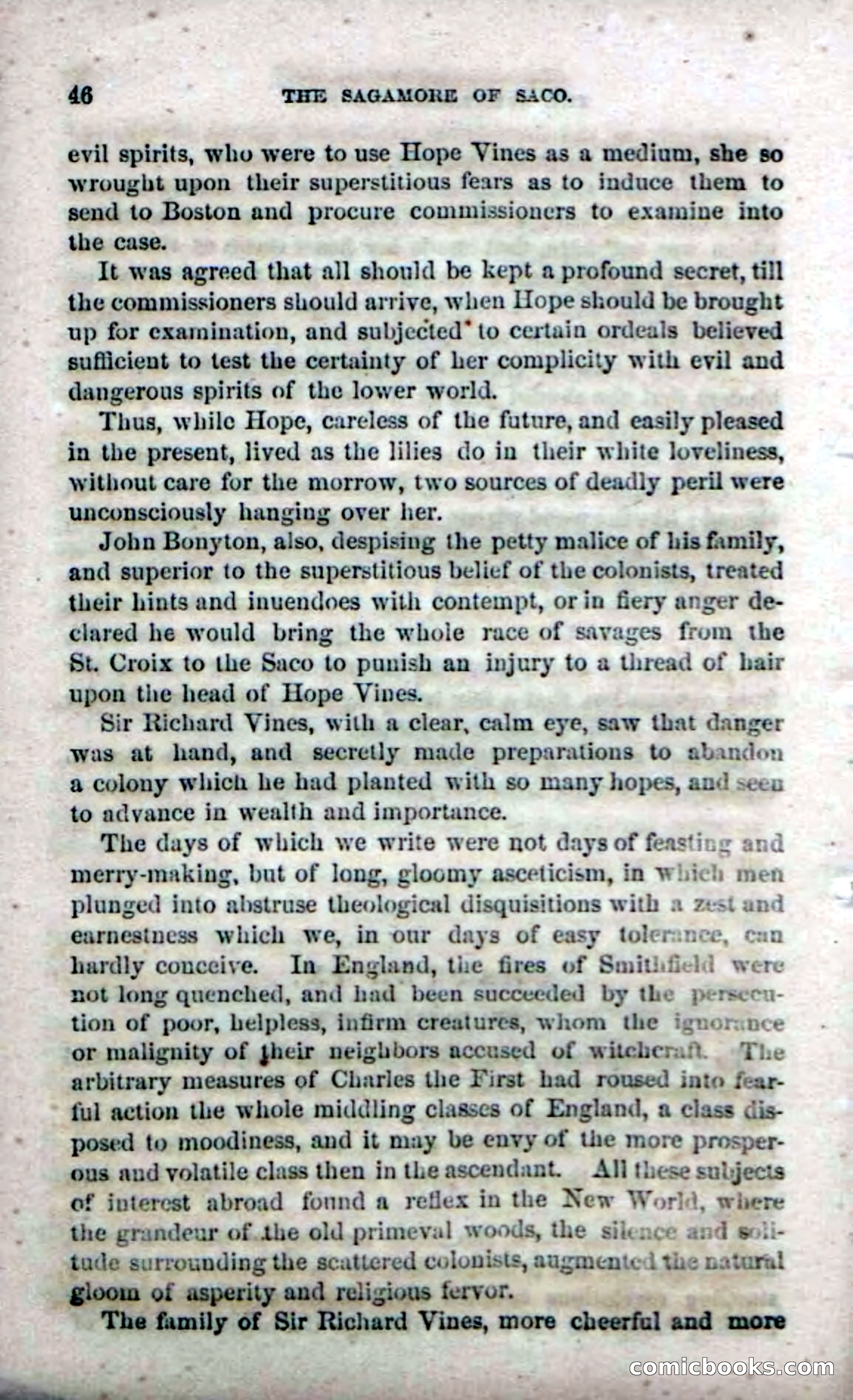
A restored page from Pulp Fiction, 1868. Page through the whole issue in the reader above.
📄 Transcribed text from this page (OCR, searchable)
Machine-transcribed from the original scan — historical spelling and the odd misread are preserved.
46 . THE SAGAMORE OF SACO. evil spirits, who were to use Hope Vines as a medium, she so wrought upon their superstitious fears as to induce them to send to Boston and procure commissioners to examine into the case. It was agreed that all should be kept a profound secret, till the commissioners should arrive, when Hope should be brought up for examination, and subjected" to certain ordeals believed sufficient to test the certainty of her complicity with evil and dangerous spirits of the lower world. Thus, while Hope, careless of the future, and easily pleased in the present, lived as the lilies do in their white loveliness, without care for the morrow, two sources of deadly peril were unconsciously hanging over her. John Bonyton, also, despising the petty malice of his family, and superior to the superstitious belief of the colonists, treated their hints and inuendoes with contempt, orin fiery anger de- clared he would bring the whole race of savages from the St. Croix to the Saco to punish an injury to a thread of hair upon the head of Hope Vines. Sir Richard Vines, with a clear, calm eye, saw that danger Was at hand, and secretly made preparations to abandon a colony which he had planted with so many hopes, and seeu to advance in wealth and importance. The days of which we write were not days of feasting and merry-making, but of long, gloomy asceticism, in Which men plunged into abstruse theological disquisitions with a zest and earnestness which we, in our days of easy tolerance, can hardly conceive. In England, the fires of Smitificl’ were not long quenched, and had been succeeded by the persecu- tion of poor, helpless, infirm creatures, whom the ignorsnce or malignity of gheir neighbors accused of witehcran. The arbitrary measures of Charles the First had roused into fear- ~ ful action the whole middling classes of England, a class dis- posed to moodiness, and it may be envy of the more prosper- ous and volatile class then inthe ascendant. All these subjects of interest abroad found a reflex in the New World, where the grandeur of.the old primeval woods, the silence and soli- ee oon scattered colonists, augmented the natural 4 ee FELIS AO fervor. Pe 4 Commicloooks.comn oe - . a - 2 i. __ _- =. ihn ™ ~~ —