
Pulp Fiction, 1868 · page 23 of 116
Beadle's Dime Novels No. 142: The Sagamore of Saco — page 23: what you’re looking at
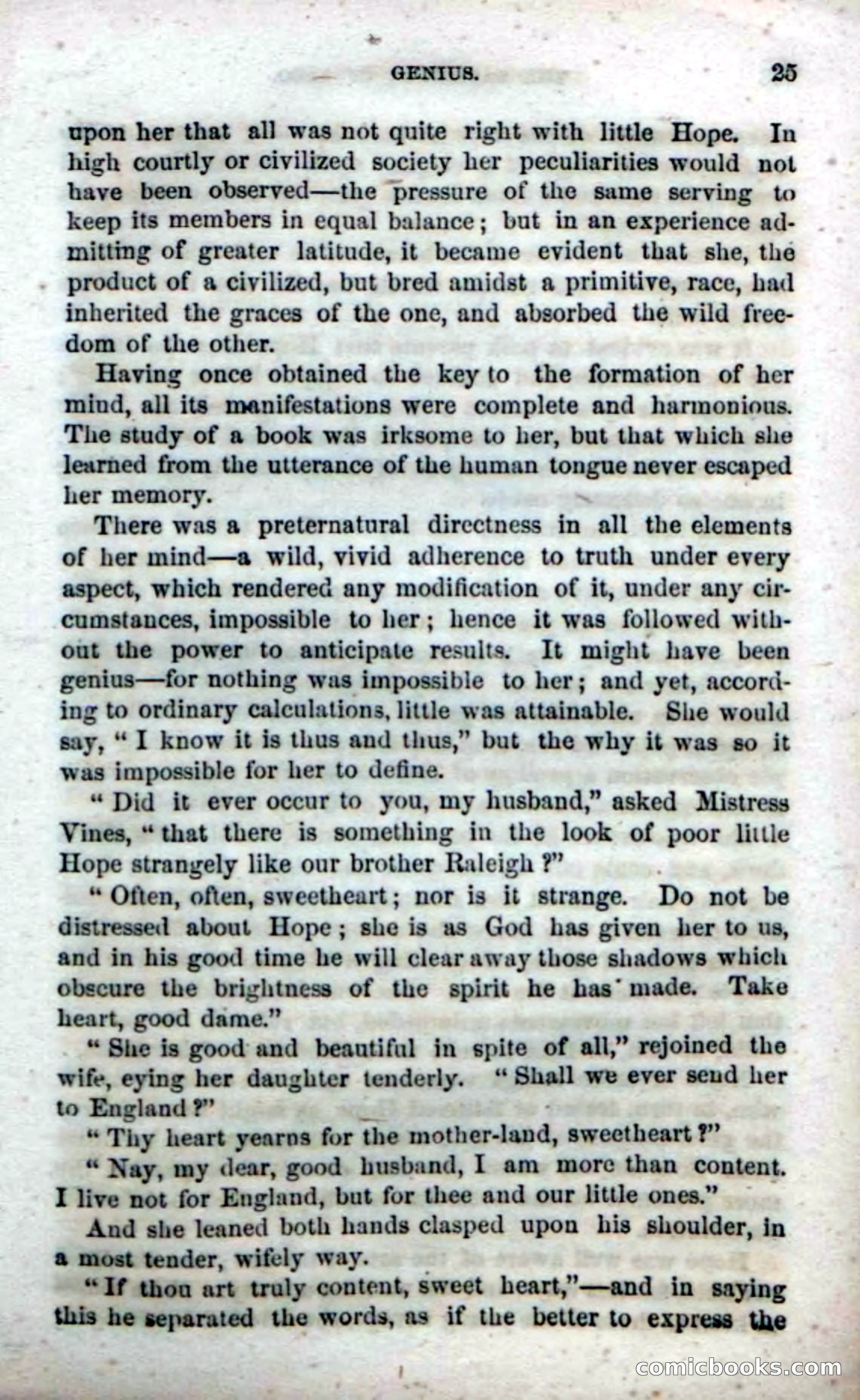
A restored page from Pulp Fiction, 1868. Page through the whole issue in the reader above.
📄 Transcribed text from this page (OCR, searchable)
Machine-transcribed from the original scan — historical spelling and the odd misread are preserved.
- 4 GENIUS. 25 upon her that all was not quite right with little Hope. In high courtly or civilized society her peculiarities would not have been observed—the pressure of the same serving to keep its members in equal balance; but in an experience ad- mitting of greater latitude, it became evident that she, the . product of a civilized, but bred amidst a primitive, race, had inherited the graces of the one, and absorbed the wild free- dom of the other. Having once obtained the key to the formation of her mind, all its manifestations were complete and harmonious. The study of a book was irksome to her, but that which she learned from the utterance of the human ongee never escaped her memory. There was a preternatural directness in. all the elements of her mind—a wild, vivid adherence to truth under every aspect, which rendered any modification of it, under any cir- cumstances, impossible to her; hence it was followed with- out the power to anticipate results. It might have been genius—for nothing was impossible to her; and yet, accord- ing to ordinary calculations, little was attainable. She would say, “ I know it is thus and thus,” but the why it was so it was impossible for her to define. “Did it ever occur to you, my husband,” asked Mistress Vines, “that there is something in the look of poor little Hope strangely like our brother Raleigh ?” “ Often, often, sweetheart; nor is it strange. Do not be distressed about Hope; she is as God has given her to us, and in his good time he will clear away those shadows which obscure the brightness of the spirit he has’ made. Take heart, good dame.” “ She is good and beautiful in spite of all,” rejoined the wife, eying her daughter tenderly. “ Shall we ever send her to England ?” “Thy heart yearns for the mother-land, sweetheart ?” “ Nay, my dear, good husband, I am more than content. I live not for England, but for thee and our little ones.” And she leaned both hands clasped upon his shoulder, in & most tender, wifely way. “If thon art truly content, sweet heart,’—and in saying this he separated the words, as if the better to express the COMCEIOOX<S.COM P