
Pulp Fiction, 1861 · page 87 of 116
Beadle's Dime Novels No. 14 — page 87: what you’re looking at
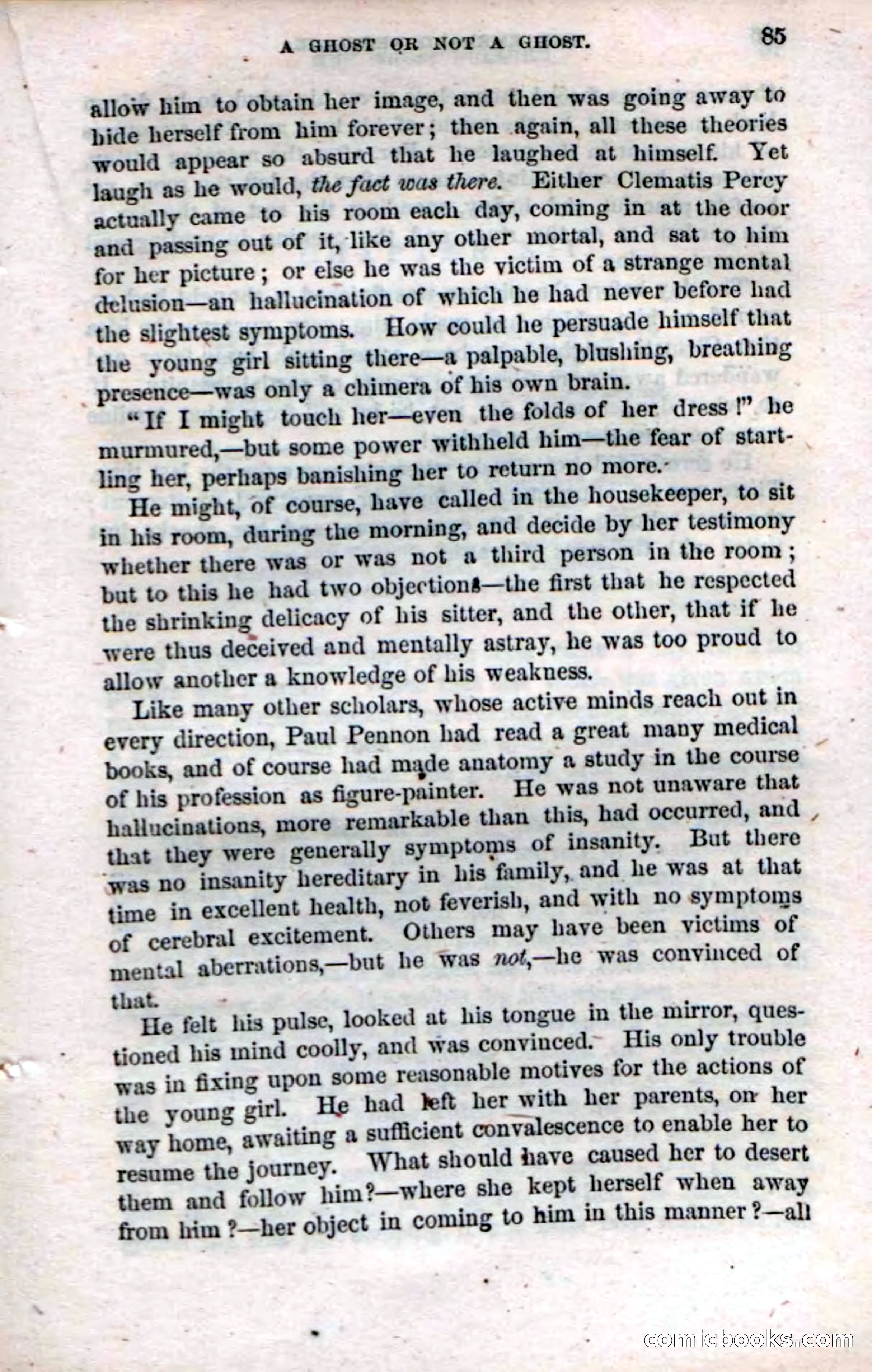
A restored page from Pulp Fiction, 1861. Page through the whole issue in the reader above.
📄 Transcribed text from this page (OCR, searchable)
Machine-transcribed from the original scan — historical spelling and the odd misread are preserved.
A GHOST QR NOT A GHOST. 85 allow him to obtain her image, and then was going away to pide herself from him forever; then again, all these theories would appear so absurd that he laughed at himself. Yet laugh as he would, the fact was there. Either Clematis Percy actually came to his room each day, coming in at the door and passing out of it, like any other mortal, and sat to him for her picture ; or else he was the victim of a strange mental delusion—an hallucination of which he had never before had the slightest symptoms. How could he persuade himself that the young girl sitting there—a palpable, blushing, breathing presence—was only a chimera of his own brain. “Tf I might touch her—even the folds of her dress !” he murmured,—but some power withheld him—the fear of start- ling her, perhaps banishing her to return no more. He might, of course, have called in the housekeeper, to sit in his room, during the morning, and decide by her testimony whether there was or was not a third person in the room ; but to this he had two objections—the first that he respected the shrinking delicacy of his sitter, and the other, that if he were thus deceived and mentally astray, he was too proud to allow another a knowledge of his weakuess. Like many other scholars, whose active minds reach out in every direction, Paul Pennon had read a great many medical books, and of course had made anatomy a study in the course of his profession as figure-painter. He was not unaware that hallucinations, more remarkable than this, had occurred, and that they were generally symptoms of insanity. But there ‘was no insanity hereditary in his family, and he was at that time in excellent health, not feverish, and with no symptoms of cerebral excitement. Others may haye been victims of mental aberrations,—but he was not,—he was convinced of that. . He felt his pulse, looked at his tongue in the mirror, ques- tioned his mind coolly, and was convinced. His only trouble was in fixing upon some reasonable motives for the actions of the young girl He had left her with her parents, on her way home, awaiting a sufficient convalescence to enable her to resume the journey. What should have caused her to desert them and follow him?—where she kept herself when away from him ?—her object in coming to him in this manner ?—all comiclbooks.com ~