
Pulp Fiction, 1861 · page 23 of 116
Beadle's Dime Novels No. 14 — page 23: what you’re looking at
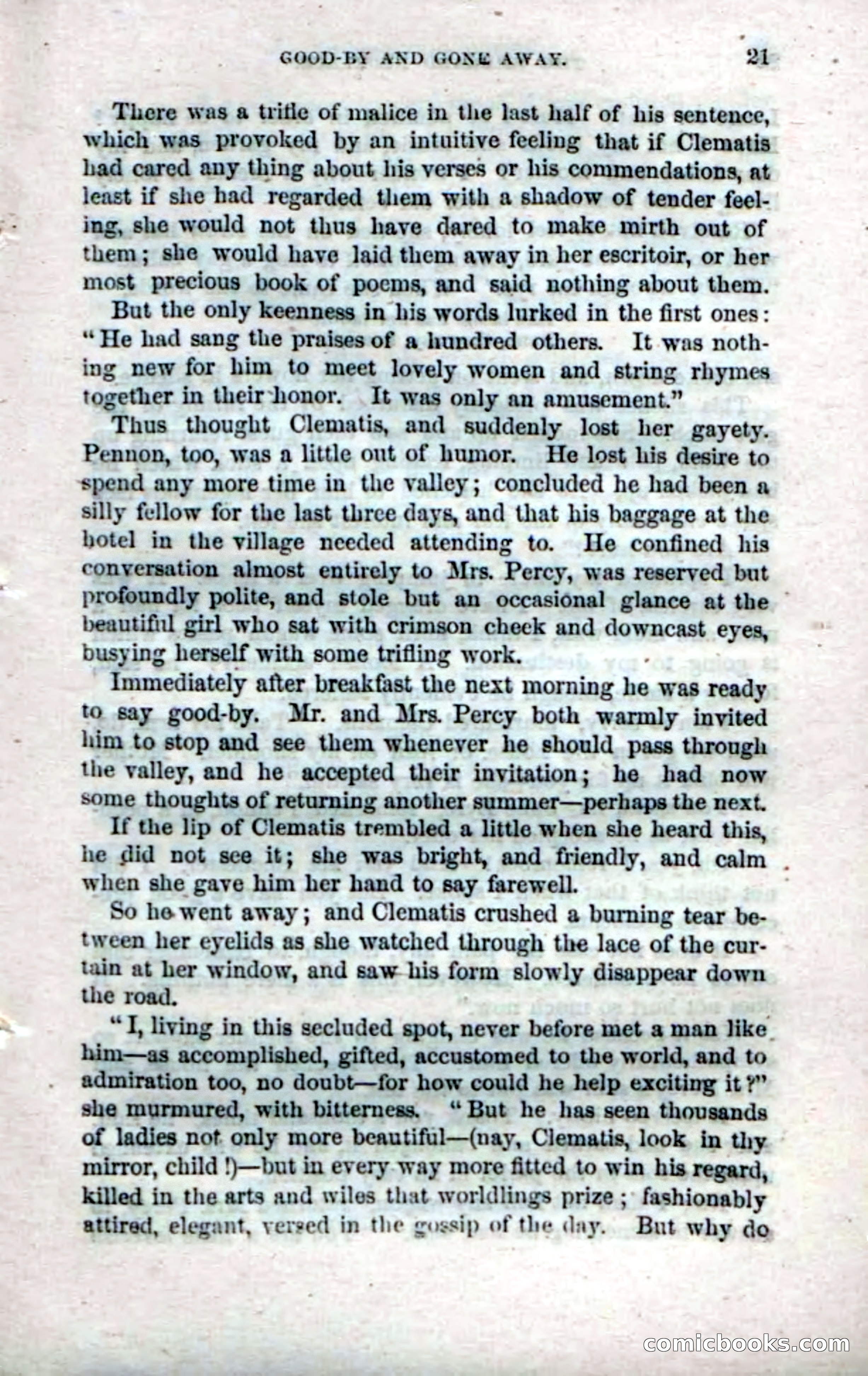
A restored page from Pulp Fiction, 1861. Page through the whole issue in the reader above.
📄 Transcribed text from this page (OCR, searchable)
Machine-transcribed from the original scan — historical spelling and the odd misread are preserved.
GOOD-BY AND GONE AWAY. 21 There was a trifle of malice in the last half of his sentence, which was provoked by an intuitive feeling that if Clematis had cared any thing about his verses or his commendations, at least if she had regarded them with a shadow of tender feel- ing, she would not thus have dared to make mirth out of them; she would have laid them away in her escritoir, or her most precious book of poems, and said nothing about them. But the only keenness in his words lurked in the first ones: “He had sang the praises of a hundred others. It was noth- ing new for him to meet lovely women and string rhymes together in theirthonor. It was only an amusement.” Thus thought Clematis, and suddenly lost her gayety. Pennon, too, was a little out of humor. He lost his desire to spend any more time in the valley; concluded he had been a silly fellow for the last three days, and that his baggage at the hotel in the village needed attending to. He confined his conversation almost entirely to Mrs. Percy, was reserved but profoundly polite, and stole but an occasional glance at the © beautiful girl who sat with crimson cheek and downcast eyes, busying herself with some trifling work. Immediately after breakfast the next morning he was ready to say good-by. Mr. and Mrs. Percy both warmly invited him to stop and see them whenever he should pass through the valley, and he accepted their invitation; he had now some thoughts of returning another summer—perhaps the next. If the lip of Clematis trembled a little when she heard this, he did not see it; she was bright, and friendly, and calm . when she gave him her hand to say farewell. ; So he went away; and Clematis crushed a burning tear be- tween her eyelids as she watched through the lace of the cur- tain at her window, and saw his form slowly disappear down the road. “I, living in this secluded spot, never before met a man like him—as accomplished, gifted, accustomed to the world, and to admiration too, no doubt—for how could he help exciting it?” she murmured, with bitterness. “But he has seen thousands of ladies not only more beautiful—(nay, Clematis, look in thy mirror, child !}—but in every-way more fitted to win his regard, killed in the arts and wiles that worldlings prize ; fashionably attired, elegant, versed in the gossip of the day. But why do comlclbooks.corn