
Pulp Fiction, 1867 · page 33 of 92
Beadle's Dime Novels No. 135: The Cherokee Chief — page 33: what you’re looking at
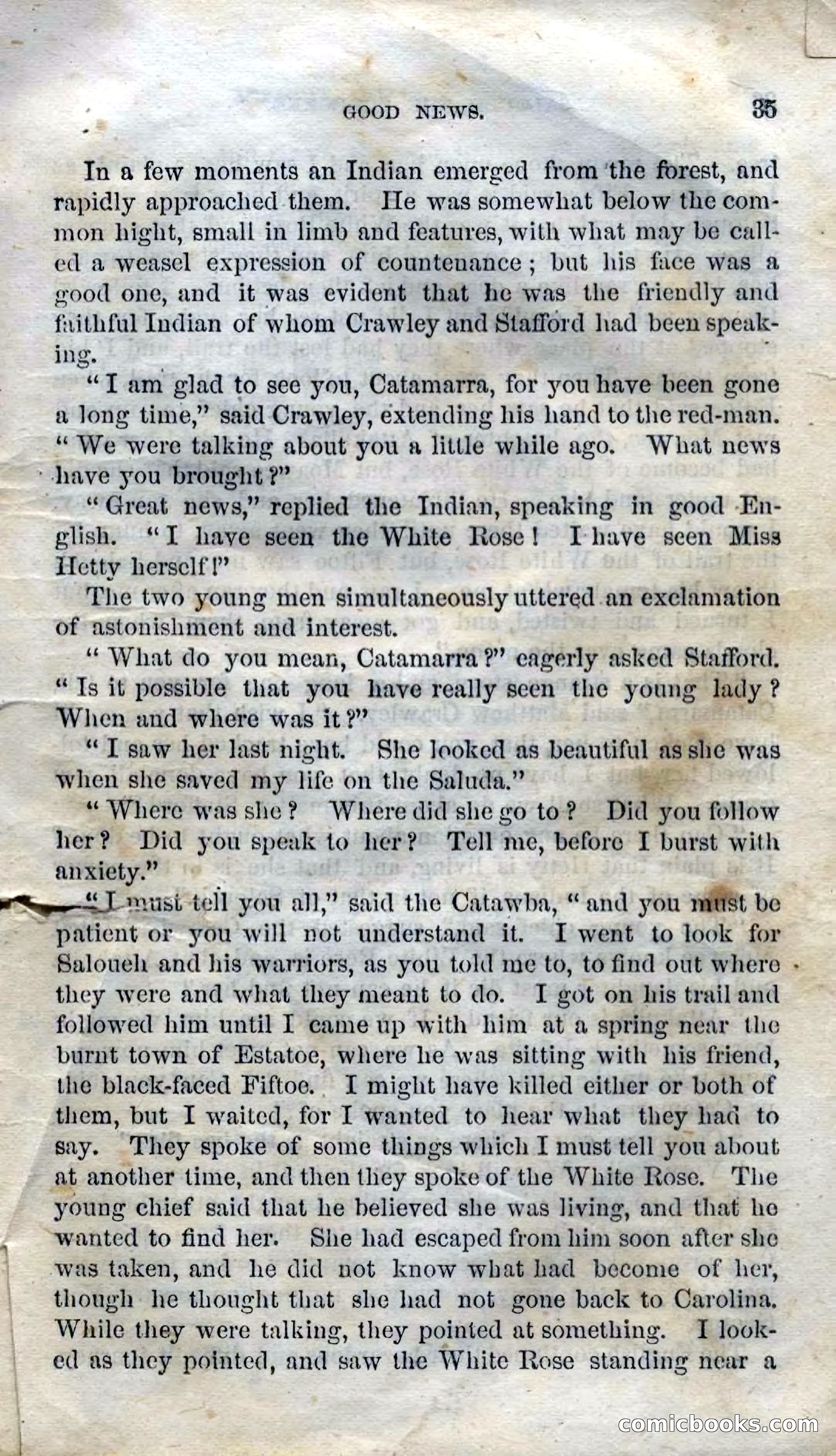
A restored page from Pulp Fiction, 1867. Page through the whole issue in the reader above.
📄 Transcribed text from this page (OCR, searchable)
Machine-transcribed from the original scan — historical spelling and the odd misread are preserved.
+ GOOD NEWS. oo In a few moments an Indian emerged from ‘the forest, and rapidly approached them. He was somewhat below the com- mon hight, small in limb and features, with what may be call- ed a weasel expression of countenance; but his face was a good one, and it was evident that he was the friendly and faithful Indian of whom Crawley — Stafford had been speak- ing. “Tam glad to see you, Outaraaita, for you have been gone a long time,” said Crawley, extending his hand to the red-man. “We were talking about you a little while ago. What news ‘have you brought ?” “Great news,” replied the Indian, speaking in good -En- glish. “I haye seen the White Rose! Ihave seen Miss ifetty herself!” es, The two young men simultaneously uttered an exclamation of astonishment and interest. “What do you mean, Catamarra ?” eagerly asked Stafford. “Ts it possible that you have really seen the young lady ? When and where was it ?” “ T saw her last night. She leoked as beautiful as she was when she saved my life on the Saluda.” “Where was she? Where did she go to? Did you follow her? Did you speak to her? Tell me, before I burst with anxiety.” Cg Si tell you all,” said the Catawba, “and you vill be ~ patient or you will Hot understand it. I went to look for Saloueh and his warriors, as you told me to, to find out where they were and what they meant to do. I got on his trail and followed him until I came up with him at a spring near the burnt town of Estatoe, where he was sitting with his friend, the black-faced Fiftoe.. I might have killed either or both of them, but I waited, for I Wanted to hear what they had to say. They spoke of some things which I must tell you about at another time, and then they spoke of the White Rose. The young chief said that he believed she was living, and that he wanted to find her. She had escaped from him soon after she was taken, and he did not know what had become of her, though he thought that she had not gone back to Carolina, While they were talking, they pointed at something. I look- ed as they pointed, and saw the White Rose standing near a conmiclooolks. conn