
Pulp Fiction, 1867 · page 15 of 92
Beadle's Dime Novels No. 135: The Cherokee Chief — page 15: what you’re looking at
A restored page from Pulp Fiction, 1867. Page through the whole issue in the reader above.
📄 Transcribed text from this page (OCR, searchable)
Machine-transcribed from the original scan — historical spelling and the odd misread are preserved.
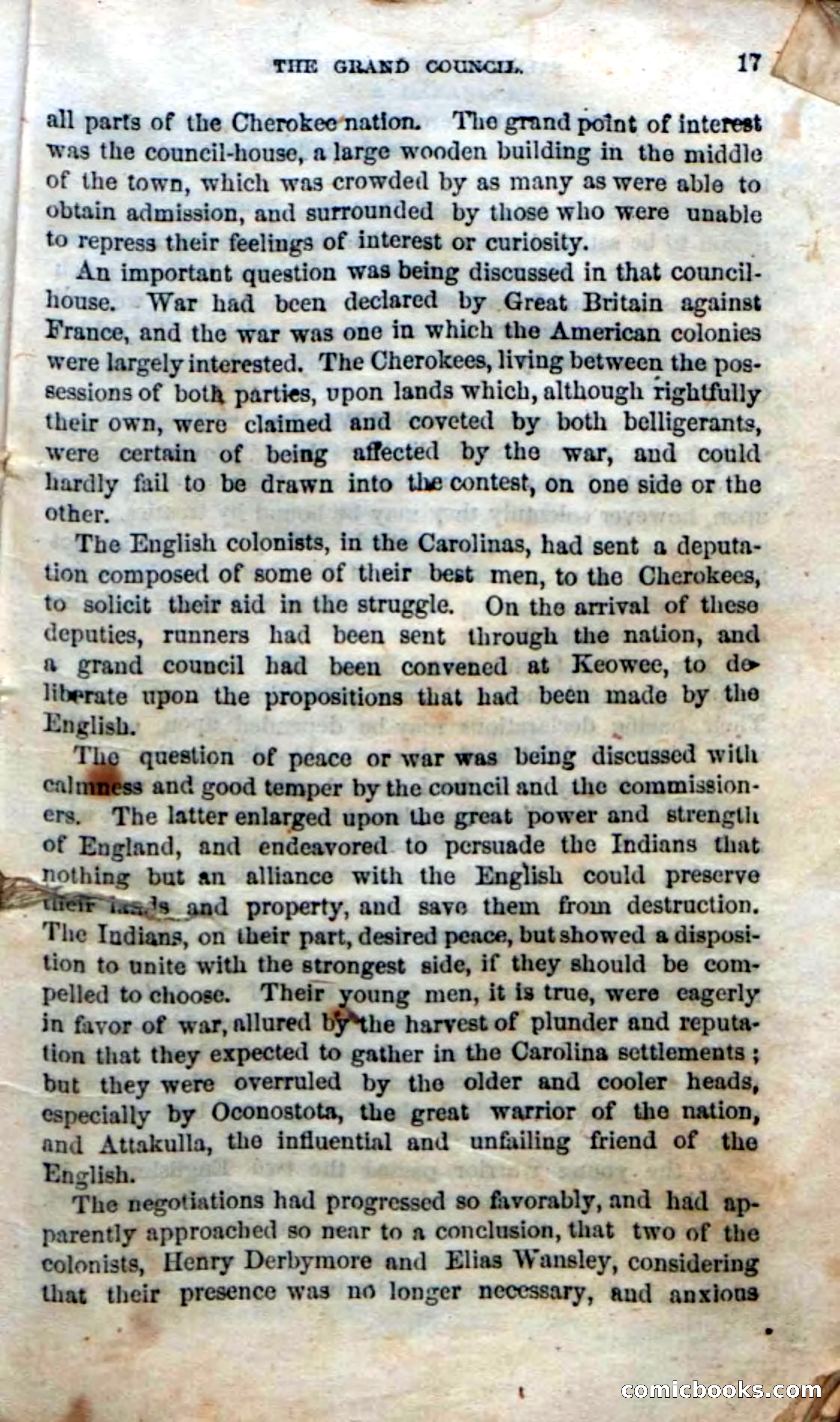
THE GRAND COUNCIL. 17 ki - all parts of the Cherokeenation. The grand point of interest was the council-house, a large wooden building in the middle of the town, which was crowded by as many as were able to obtain admission, and surrounded by those who were unable to repress their feelings of interest or curiosity. An important question was being discussed in that council- house. _War had been declared by Great Britain against France, and the war was one in which the American colonies were largely interested. The Cherokees, living between the pos- sessions of both parties, upon lands which, although rightfully their own, were claimed and coveted by both belligerants, ‘ were certain of being affected by the war, and could | hardly fail to be drawn into the contest, on one side or the other. The English colonists, in the Carolinas, had sent a deputa- tion composed of some of their best men, to the to solicit their aid in the struggle. On the arrival of these deputies, runners had been sent through the nation, and & grand council had been convened at Keowee, to do seetate Upon: the propuuisions:tixt had been made by the English. question of peace or war was being discussed with cal and good temper by the council and the commission- ers. The latter enlarged upon the great power and strength of England, and endeavored to persuade the Indians that nothing but an alliance with the English could preserve property, and save them from destruction. The Tudians, on their part, desired peace, butshowed a disposi- tion to unite with the strongest side, if they should be com- pelled to choose. Their men, it is true, were eagerly in favor of war, allured e harvest of plunder and reputa- tion that Mestaabented toignther intheSitedlien settheldaiins but they were overruled by the older and cooler heads, by Oconostota, the great warrior of the nation, and Attakulla, the influential and = friend of parently approached so near to a conclusion, that two of colonists, Henry Derbymore and Elias Wansley, that eS tod aaa - : ‘- “. = comicbooks.com . bee