
Pulp Fiction, 1867 · page 85 of 96
Beadle's Dime Novels No. 131 — page 85: what you’re looking at
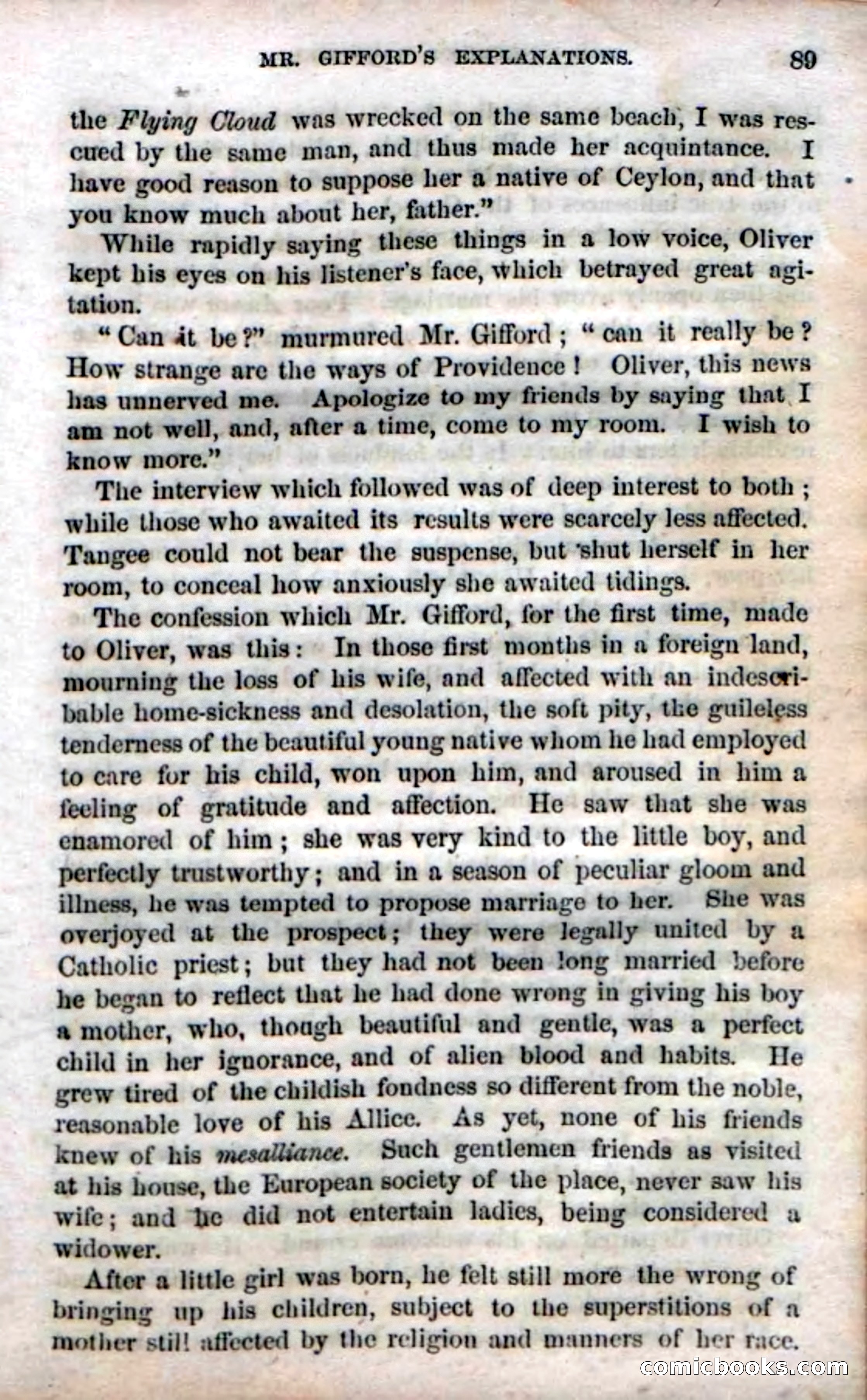
A restored page from Pulp Fiction, 1867. Page through the whole issue in the reader above.
📄 Transcribed text from this page (OCR, searchable)
Machine-transcribed from the original scan — historical spelling and the odd misread are preserved.
MR. GIFFORD’S EXPLANATIONS. 89 the Flying Cloud was wrecked on the same beach, I was res- cued by the same man, and thus made her acquintance. [I have good reason to suppose her a native of Ceylon, and that - you know much about her, father.” While rapidly saying these things in a low voice, Oliver kept his eyes on his listener's face, which betrayed great agi- tation. “Can 4t be?’ murmured Mr. Gifford; “can it really be ? How strange are the ways of Providence! Oliver, this news has unnerved me. Apologize to my friends by saying that I am not well, and, after a time, come to my room. I wish to know more.” The interview which followed was of deep interest to both ; while those who awaited its results were scarcely less affected. Tangee could not bear the suspense, but ‘shut herself in her room, to conceal how anxiously she awaited tidings. The confession which Mr. Gifford, for the first time, made to Oliver, was this: In those first months in a foreign land, mourning the loss of his wife, and affected with an indeseri- bable home-sickness and desolation, the soft pity, the guileless tenderness of the beautiful young native whom he had employed to care fur his child, won upon him, and aroused in him a feeling of gratitude and affection. He saw that she was enamored of him; she was very kind to the little boy, and perfectly trustworthy; and in a season of peculiar gloom and illness, he was tempted to propose marriage to her. She was overjoyed at the prospect; they were Jegally united by a Catholic priest; but they had not been long married before he began to reflect that he had done wrong in giving his boy a mother, who, thoagh beautiful and gentle, was a perfect child in her ignorance, and of alien blood and habits. He grew tired of the childish fondness so different from the noble, reasonable love of his Allice. As yet, none of his friends knew of his mesalliance. Such gentlemen friends as visited at his house, the European society of the place, never saw his wife; and ‘ue did not entertain ladies, being considered a widower. After a little girl was born, he felt still more the wrong of bringing up his children, subject to the superstitions of a mother stil! affected by the religion and manners of ber race. comnmiclooolkks.Ccomn ~