
Pulp Fiction, 1867 · page 20 of 96
Beadle's Dime Novels No. 131 — page 20: what you’re looking at
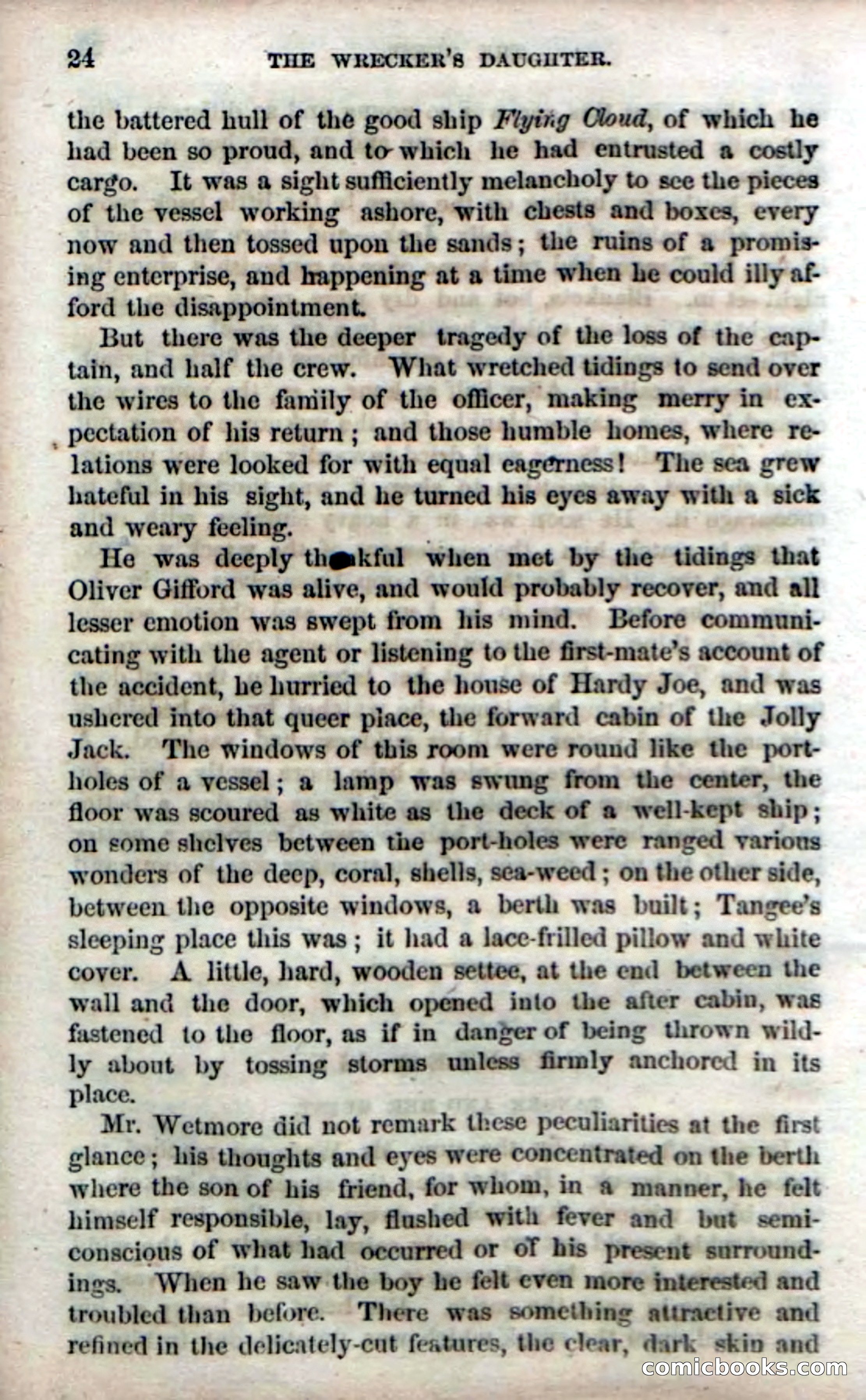
A restored page from Pulp Fiction, 1867. Page through the whole issue in the reader above.
📄 Transcribed text from this page (OCR, searchable)
Machine-transcribed from the original scan — historical spelling and the odd misread are preserved.
24 THE WRECKER’S DAUGITER. the battered hull of the good ship Fiyiig Oloud, of which he had been so proud, and to which he had entrusted a costly cargo. It was a sight sufficiently melancholy to sce the pieces of the vessel working ashore, with chests and boxes, every now and then tossed upon the sands; the ruins of a promis- ing enterprise, and happening at a time when he could illy af- ford the disappointment. But there was the deeper tragedy of the loss of the cap- tain, and half the crew. What wretched tidings to send over the wires to the faniily of the officer, making merry in ex- _ pectation of his return ; and those humble homes, where re- lations were looked for with equal eagerness! The sea grew hateful in his sight, and he turned his eyes away with a sick and weary feeling. He was deeply thgkful when met by the tidings that Oliver Gifford was alive, and would probably recover, and all lesser emotion was swept from his mind. Before communi- cating with the agent or listening to the first-mate’s account of the accident, he hurried to the house of Hardy Joe, and was ushered into that queer place, the forward cabin of the Jolly Jack. The windows of this room were round like the port- holes of a vessel; a lamp was swung from the center, the floor ‘was scoured as white as the deck of a well-kept ship; on some shelves between the port-holes were ranged various wonders of the deep, coral, shells, sea-weed ; on the other side, between the opposite windows, a berth was built; Tangee’s sleeping place this was; it had a lace-frilled pillow and white coyer. A little, hard, wooden settee, at the end between the wall and the door, which opened into the after cabin, was fastened to the floor, as if in danger of being thrown wild- ly about by tossing storms unless firmly anchored in its place. Mr. Wetmore did not remark these peculiarities at the first glance; his thoughts and eyes were Concentrated on the berth where the son of his friend, for whom, in a manner, he felt himself responsible, lay, flushed with fever and but semi- conscious of what had occurred or of his present surround- ings. When he saw the boy he felt even more interested and troubled than before. There was something attractive and refined in the delicately-cut features, the clear, dark skin and comilebooksre COL