
Pulp Fiction, 1867 · page 14 of 100
Beadle's Dime Novels No. 119: Blackeyes — page 14: what you’re looking at
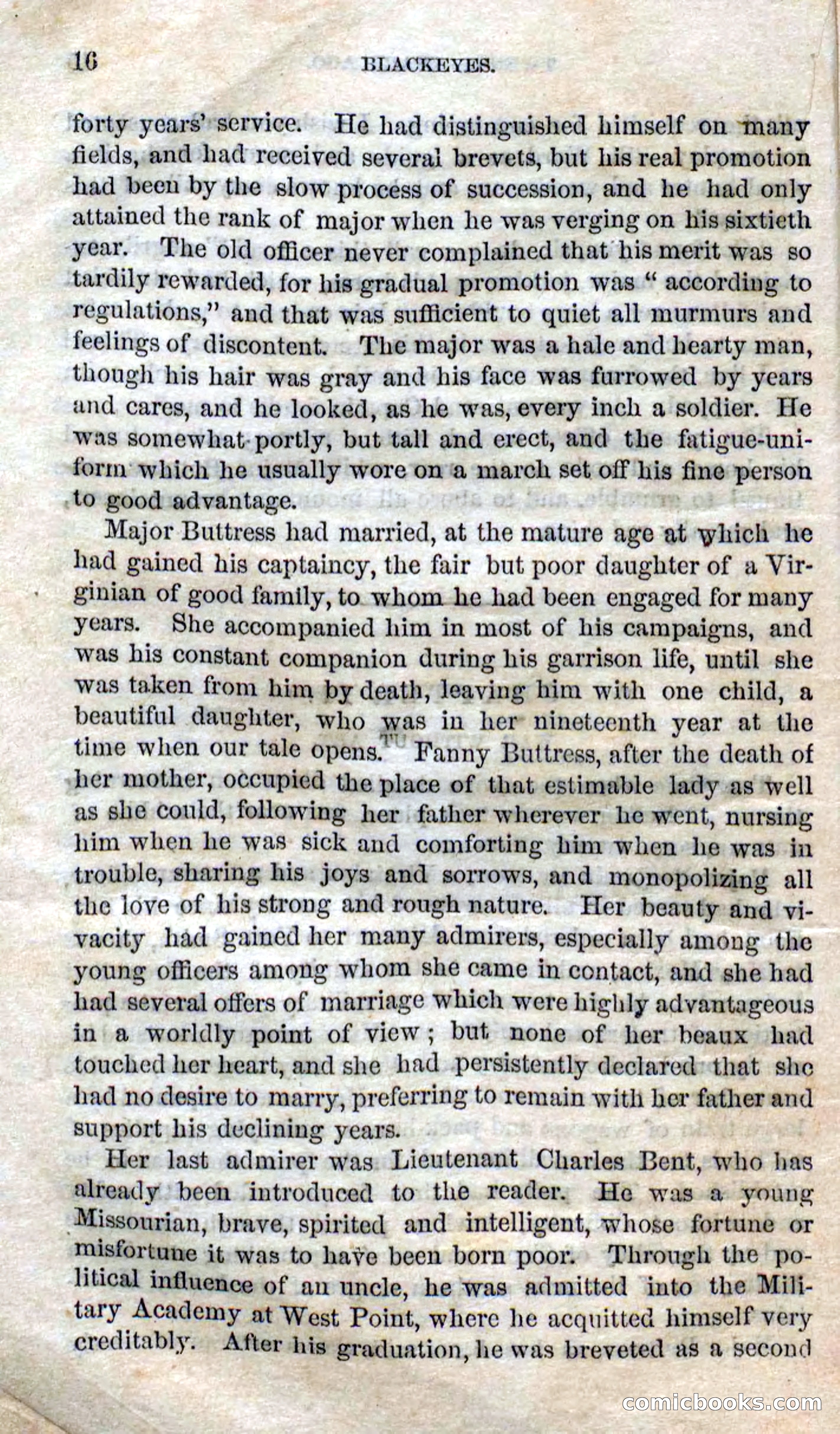
A restored page from Pulp Fiction, 1867. Page through the whole issue in the reader above.
📄 Transcribed text from this page (OCR, searchable)
Machine-transcribed from the original scan — historical spelling and the odd misread are preserved.
16 BLACKEYES. forty years’service. He had distinguished himself on many fields, and had received several brevets, but his real promotion had been by the slow process of succession, and he had only attained the rank of major when he was verging on his sixtieth ‘year. The old officer never complained that his merit was so tardily rewarded, for his gradual promotion was “ according to regulations,” and that was sufficient to quiet all murmurs and feelings of discontent. The major was a hale and hearty man, though his hair was gray and his face was furrowed by years and cares, and he looked, as he was, every inch a soldier. He was somewhat: portly, but tall and erect, and the fatigue-uni- form which he usually wore on ‘a march set off his fine person to good advantage. mo 4 Major Buttress had married, at the mature age at which he had gained his captaincy, the fair but poor daughter of a Vir- ginian of good family, to. whom-he had been engaged for many years. She accompanied him in most of his campaigns, and was his constant companion during his garrison life, until she was taken from him by death, leaving him with one child, a beautiful daughter, who was in her nineteenth year at the time when our tale opens.” Fanny Buttress, after the death of her mother, occupied the place of that estimable lady as well as she could, following her father wherever he went, nursing him when he was sick and comforting him when he was in trouble, sharing his joys and sorrows, and monopolizing all the love of his strong and rough nature. Her beauty and vi- vacity had gained her many admirers, especially among the young officers among whom she came in contact, and she had had several offers of marriage which were highly advantageous in a worldly point of view; but mone of her beaux had touched her heart, and she had persistently declared: that she had no desire to marry, preferring to remain with her father and support his declining years. | | Her last admirer was. Lieutenant Charles Bent, who ha already been introduced to the reader. He was a young Missourian, brave, spirited and intelligent, whose fortune or misfortune it was to have been born poor. ‘Through the po- litical influence of an uncle, he was admitted into the Mili- tary Academy at West Point, where he acquitted himself very creditably. After his graduation, he was breyeted as a second Cconmiclooolks. corn)