
Pulp Fiction, 1867 · page 96 of 100
Beadle's Dime Novels No. 127: Bald Eagle — page 96: what you’re looking at
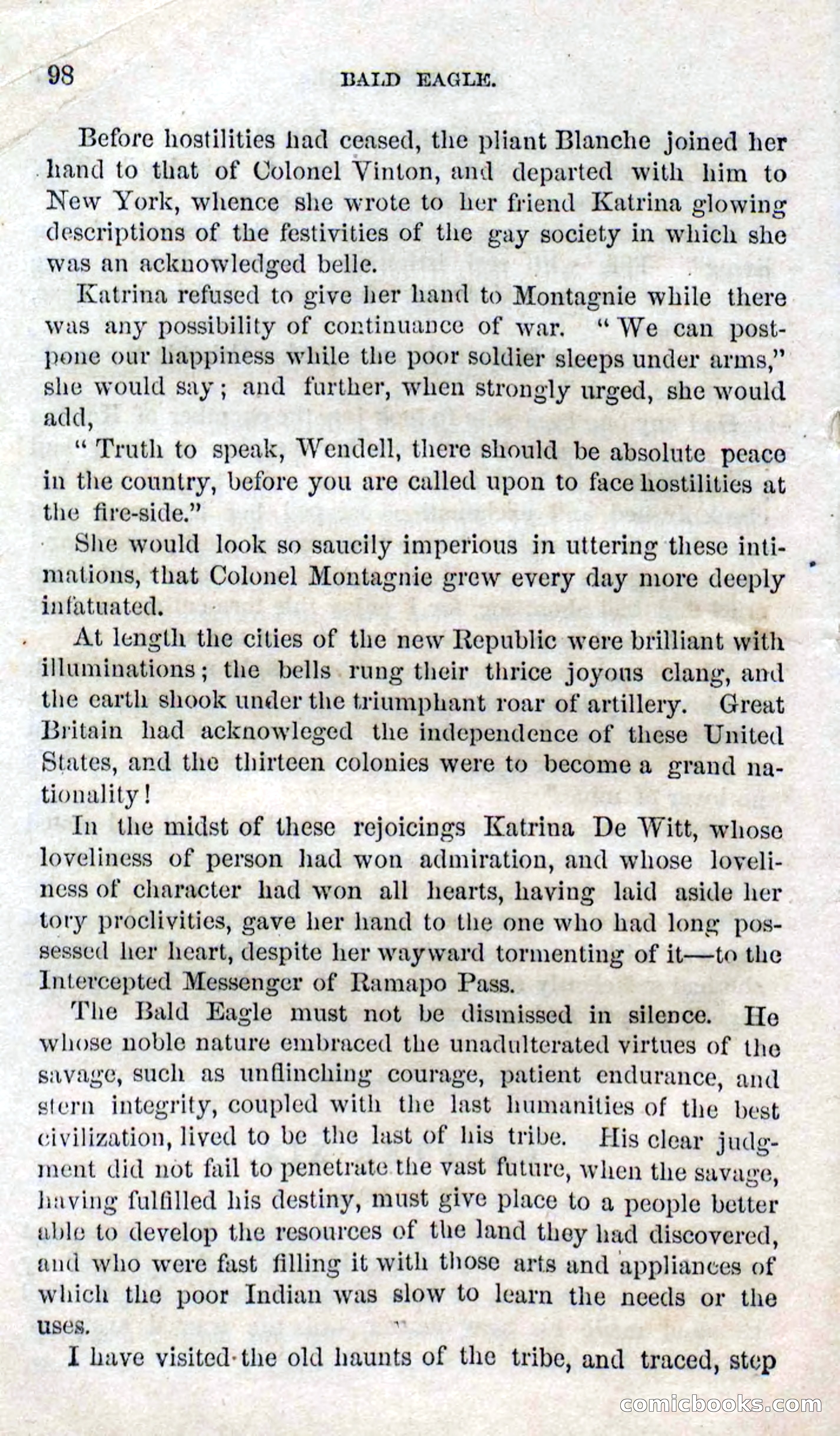
A restored page from Pulp Fiction, 1867. Page through the whole issue in the reader above.
📄 Transcribed text from this page (OCR, searchable)
Machine-transcribed from the original scan — historical spelling and the odd misread are preserved.
98 BALD EAGLE. Before hostilities had ceased, the pliant Blanche joined her -hand to that of Colonel Vinton, and departed with him to New York, whence she wrote to her friend Katrina glowing descriptions of the festivities of the gay society in which she was an acknowledged belle. Katrina refused to give her hand to Montagnie while there was any possibility of continuance of war. “ We can post- pone our happiness while the poor soldier sleeps under arms,” she would say; and further, when strongly urged, she would add, | “Truth to speak, Wendell, there should be absolute peace in the country, before you are called upon to face hostilities at the fire-side.” She would look so saucily imperious in uttering these inti- mations, that Colonel Montagnie grew every day more deeply infatuated, | At length the cities of the new Republic were brilliant with illuminations; the bells. rung their thrice joyous clang, and the earth shook under the triumphant roar of artillery. Great Britain had acknowleged the independence of these United States, and the thirteen colonies were to become a grand na- tionality ! In the midst of these rejoicings Katrina De Witt, whose loveliness of person had won admiration, and whose loveli- ness of character had won all hearts, haying laid aside her tory proclivities, gave her hand to the one who had long pos- sessed her heart, despite her wayward tormenting of it—to the Intercepted Messenger of Ramapo Pass. The Bald Eagle must not be dismissed in silence. He whose noble nature embraced the unadulterated virtues of the savage, such as unflinching courage, patient endurance, and stern integrity, coupled with the last humanities of the best civilization, lived to be the last of his tribe. His clear judg- ment did not fail to penetrate the vast future, when the savage, having fulfilled his destiny, must give place to a people batter able to develop the resources of the land they had discovered, and who were fast filling it with those arts and appliances of which the poor Indian was oye to learn the needs or the uses, I have visited-the old haunts of the tribe, and traced, step connicloooks.com