
Pulp Fiction, 1867 · page 65 of 100
Beadle's Dime Novels No. 127: Bald Eagle — page 65: what you’re looking at
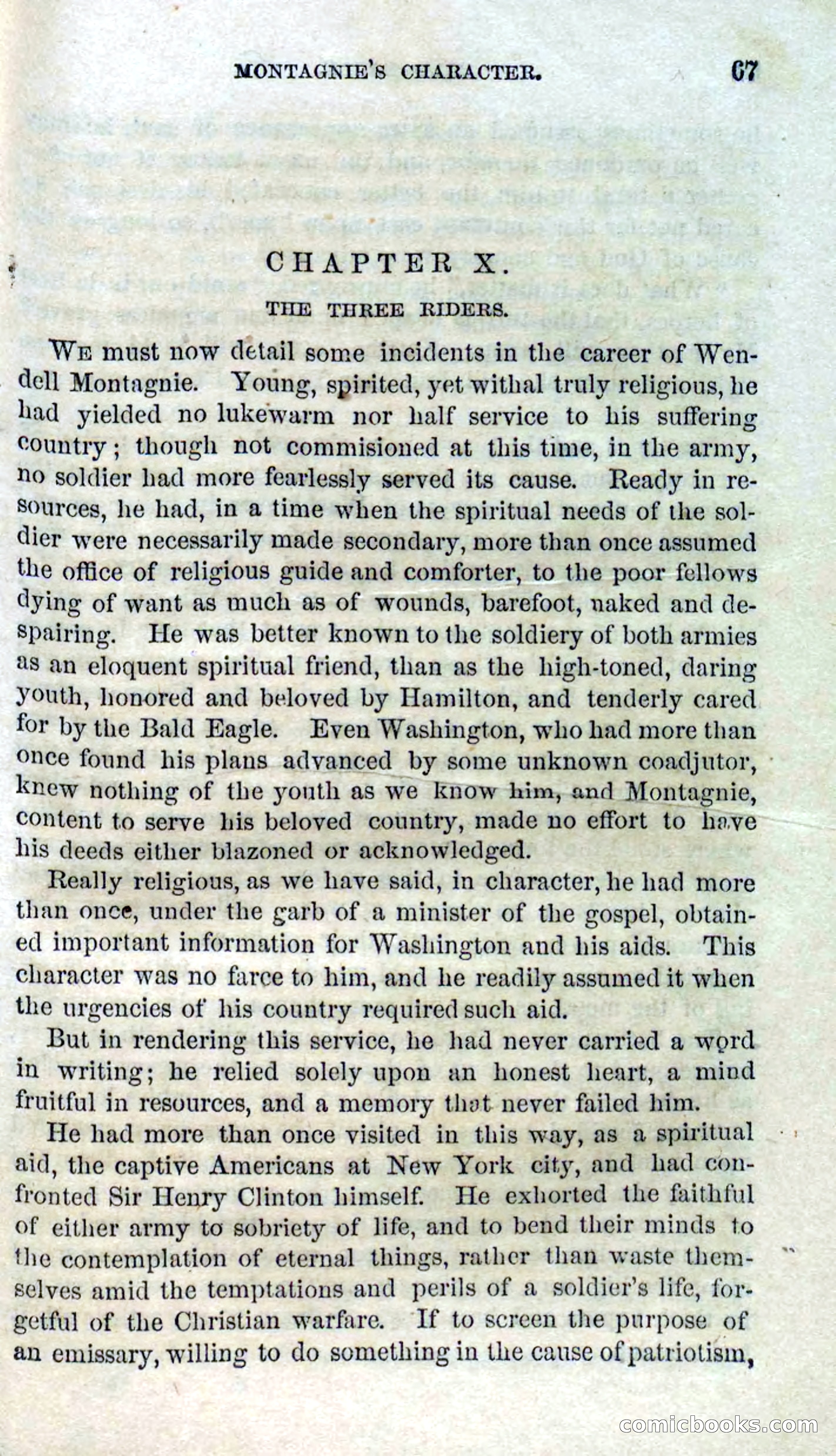
A restored page from Pulp Fiction, 1867. Page through the whole issue in the reader above.
📄 Transcribed text from this page (OCR, searchable)
Machine-transcribed from the original scan — historical spelling and the odd misread are preserved.
MONTAGNIE’S CHARACTER. 67 CHAPTER X. THE THREE RIDERS. We must now detail some incidents in the career of Wen- dell Montagnie. Young, spirited, yet withal truly religious, he had yielded no lukewarm nor half service to his suffering Country ; though not commisioned at this time, in the army, no soldier had more fearlessly served its cause. Ready in re- Sources, he had, in a time when the spiritual needs of the sol- dier were necessarily made secondary, more than once assumed the office of religious guide and comforter, to the poor fellows dying of want as much as of wounds, barefoot, naked and de- Spairing. He was better known to the soldiery of both armies as an eloquent spiritual friend, than as the high-toned, daring youth, honored and beloved by Hamilton, and tenderly cared for by the Bald Eagle. Even Washington, who had more than Once found his plans advanced by some unknown coadjutor, - knew nothing of the youth as we know him, and Montagnie, content to serve his beloved country, made no effort to have his deeds either blazoned or acknowledged. Really religious, as we have said, in character, he had more than once, under the garb of a minister of the gospel, obtain- ed important information for Washington and his aids. This character was no farce to him, and he readily assumed it when the urgencies of his country required such aid. But in rendering this service, he had never carried a word in writing; he relied solely upon an honest heart, a mind fruitful in resources, and a memory thet never failed him. He had more than once visited in this way, as a spiritual aid, the captive Americans at New York city, and had con- fronted Sir Henry Clinton himself. He exhorted the faithful of either army to sobriety of life, and to bend their minds to the contemplation of eternal things, rather than waste them- selves amid the temptations and perils of a soldier’s life, for- getful of the Christian warfare. If to screen the purpose of an emissary, willing to do something in the cause of patriotism, connmicloooks.comn