
Pulp Fiction, 1867 · page 43 of 100
Beadle's Dime Novels No. 115: The Sons of Liberty — page 43: what you’re looking at
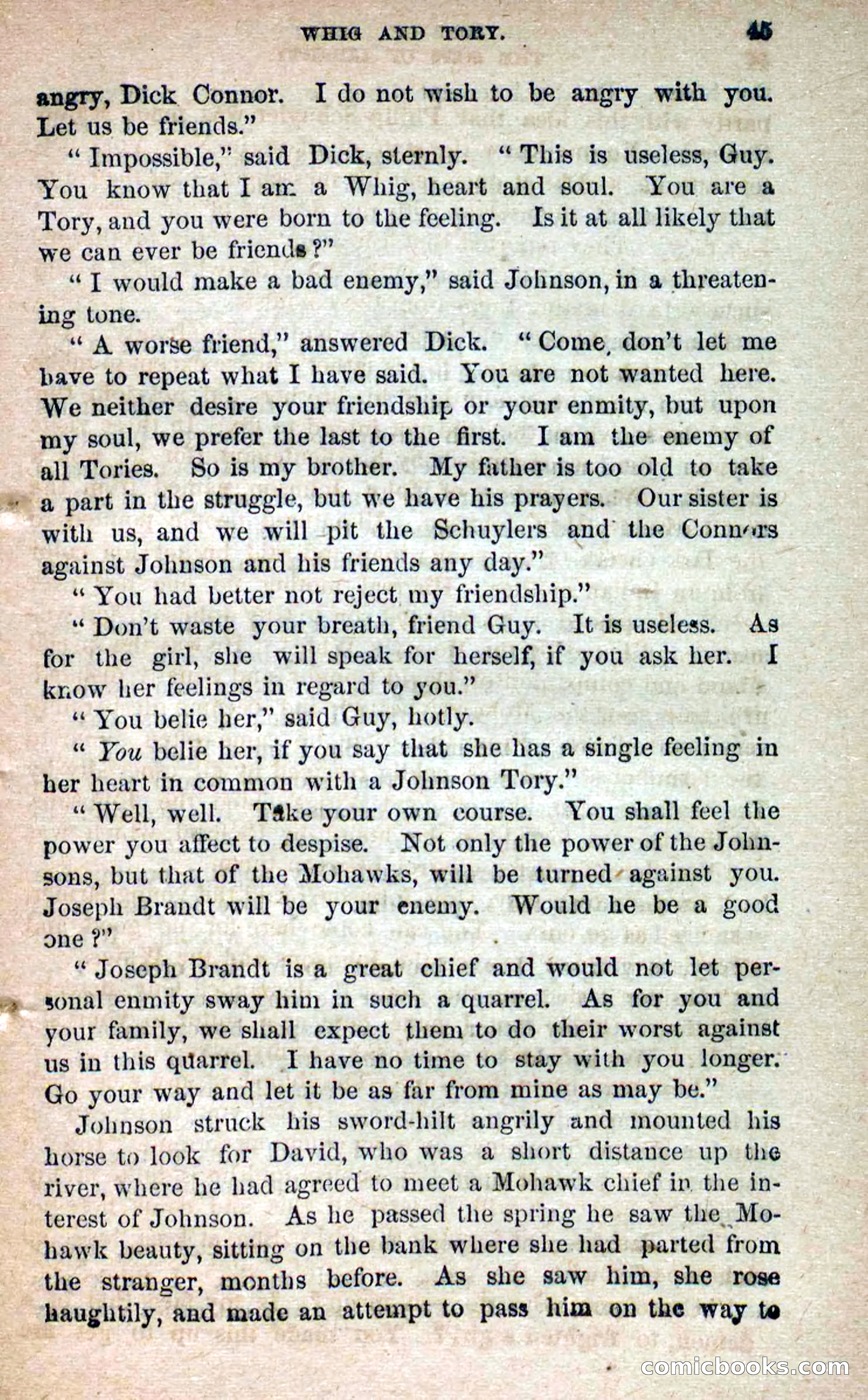
A restored page from Pulp Fiction, 1867. Page through the whole issue in the reader above.
📄 Transcribed text from this page (OCR, searchable)
Machine-transcribed from the original scan — historical spelling and the odd misread are preserved.
WHIG AND TORY. _ a angry, Dick Connor. I do not wish to be angry with you. Let us be friends.” " “Impossible,” said Dick, sternly. “ This is useless, Guy. You know that Iam a Whig, heart and soul. You are a Tory, and you were born to the feeling. Isit at all likely that we can ever be friends ?” “JT would make a bad enemy,” said Johnson, in a threaten- ing tone. “A worse friend,’ answered Dick. “Come, don’t let me bave to repeat what I have said. You are not wanted here. We neither desire your friendship or your enmity, but upon my soul, we prefer the last to the first. Iam the enemy of all Tories. So is my brother. My father is too old to take » a part in the struggle, but we have his prayers. Our sister is with us, and we will pit the Schuylers and the Conners against Johnson and his friends any day.” “ You had better not reject my friendship.” : “Don’t waste your breath, friend Guy. It is useless. As for the girl, she will speak for herself, if you ask her. I know her feelings in regard to you.” J “ You belie her,” said Guy, hotly. | “ You belie her, if you say that she has . single feeling in her heart in common with a Johnson Tory.” “Well, well. T&ke'your own course. You shall feel the power you affect to despise. Not only the power of the John- sons, but that of the Mohawks, will be turned’against you. Joseph Brandt will be your enemy. “Would he be a ' Goa one ?” “ Joseph Brandt isa great chief anid would not let per- sonal enmity sway him in such a quarrel. As for you and your family, we shall expect them ‘to do their worst against us in this quarrel. I have no time to stay with you longer. Go your way and let it be as far from mine as may be.” Johnson struck his sword-hilt angrily and mounted his horse to look for David, who was a short distance up the river, where he had agreed to meet a Mohawk chief in, the in- terest of Johnson. As he passed the spring he saw the Mo- hawk beauty, sitting on the bank where she had parted from the stranger, months before. As she saw him, she rose haughtily, and made an attempt to pass him on the way te commiclOolkks.COhn