
Pulp Fiction, 1867 · page 12 of 100
Beadle's Dime Novels No. 115: The Sons of Liberty — page 12: what you’re looking at
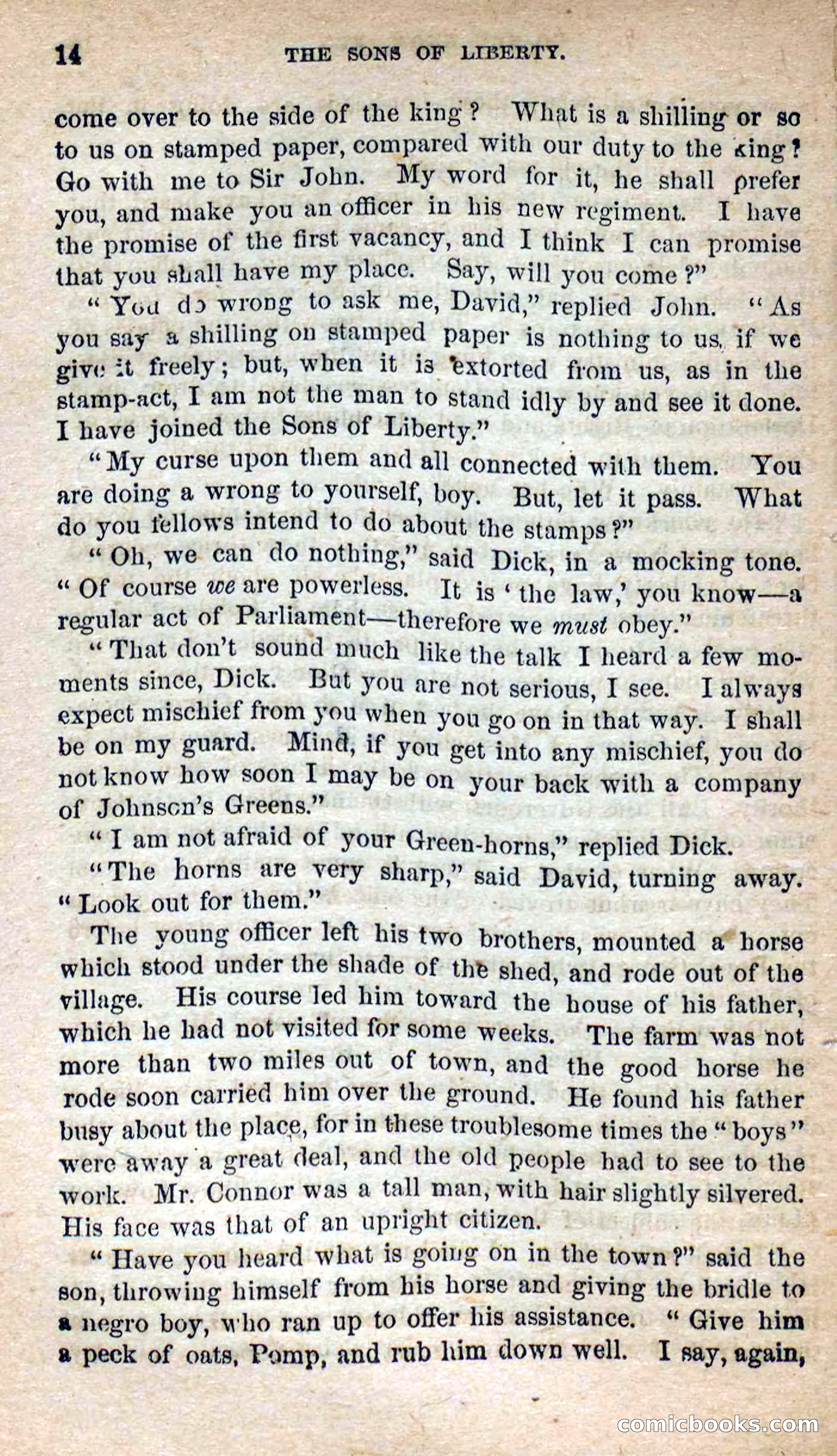
A restored page from Pulp Fiction, 1867. Page through the whole issue in the reader above.
📄 Transcribed text from this page (OCR, searchable)
Machine-transcribed from the original scan — historical spelling and the odd misread are preserved.
- *~- - 14 ; THE SONS OF LIBERTY. come over to the side of the king? What isa shilling or so to us on stamped paper, compared With our duty to the «ing? Go with me to Sir John. My word for it, he shall prefer you, and make you an officer in his new regiment. I have the promise of the first vacancy, and I think I can promise that you shall have my place. Say, will you come ” “You do wrong to ask me, David,” replied John. ‘As you say 4 shilling on stamped paper is nothing to us, if we give it freely; but, when it is xtorted from us, as in the stamp-act, I am not the man to stand idly by and see it done. I have joined the Sons of Liberty.” | “My curse upon them and all connected with them. You are doing a wrong to yourself, boy. But, let it pass. What do you fellows intend to do about the stamps 2” “Oh, we can do nothing,” said Dick, in a mocking tone. “ Of course we are powerless, It is ‘the law) you know—a regular act of Parliament—therefore we must obey.” “That don’t sound much like the talk T heard a few mo- ments since, Dick. But you are not serious, I see. I always expect mischief from you when you go on in that way. I shall be on my guard. Mind; if you get into any mischief, you do not know how soon I may be on your back with a company of Johnscn’s Greens.” “J am not afraid of your Green-horns,” replied Dick. “The horns are very sharp,” said David, turning away. “ Took out for them.” | . The young officer left his two brothers, mounted a horse which stood under the shade of the shed, and rode out of the village. His course led him toward the house of his father, — which he had not visited for some weeks. The farm was not more than two miles out of town, and the good horse he rode soon carried him over the ground. He found his father busy about the place, for in these troublesome times the “boys” were away a great deal, and the old people had to see to the work. Mr. Connor was a tall man, with hair slightly silyered. His face was that of an upright citizen. fsa “ Have you heard what is goiug on in the town?” said the son, throwing himself from his horse and giving the bridle to a negro boy, who ran up to offer his assistance. “ Give him a peck of oats, Pomp, and rub him down well. TI say, again, a" CORNICMOOOKSsCOm)