
Pulp Fiction, 1860 · page 30 of 134
Beadle's Dime Novels, No. 11 — page 30: what you’re looking at
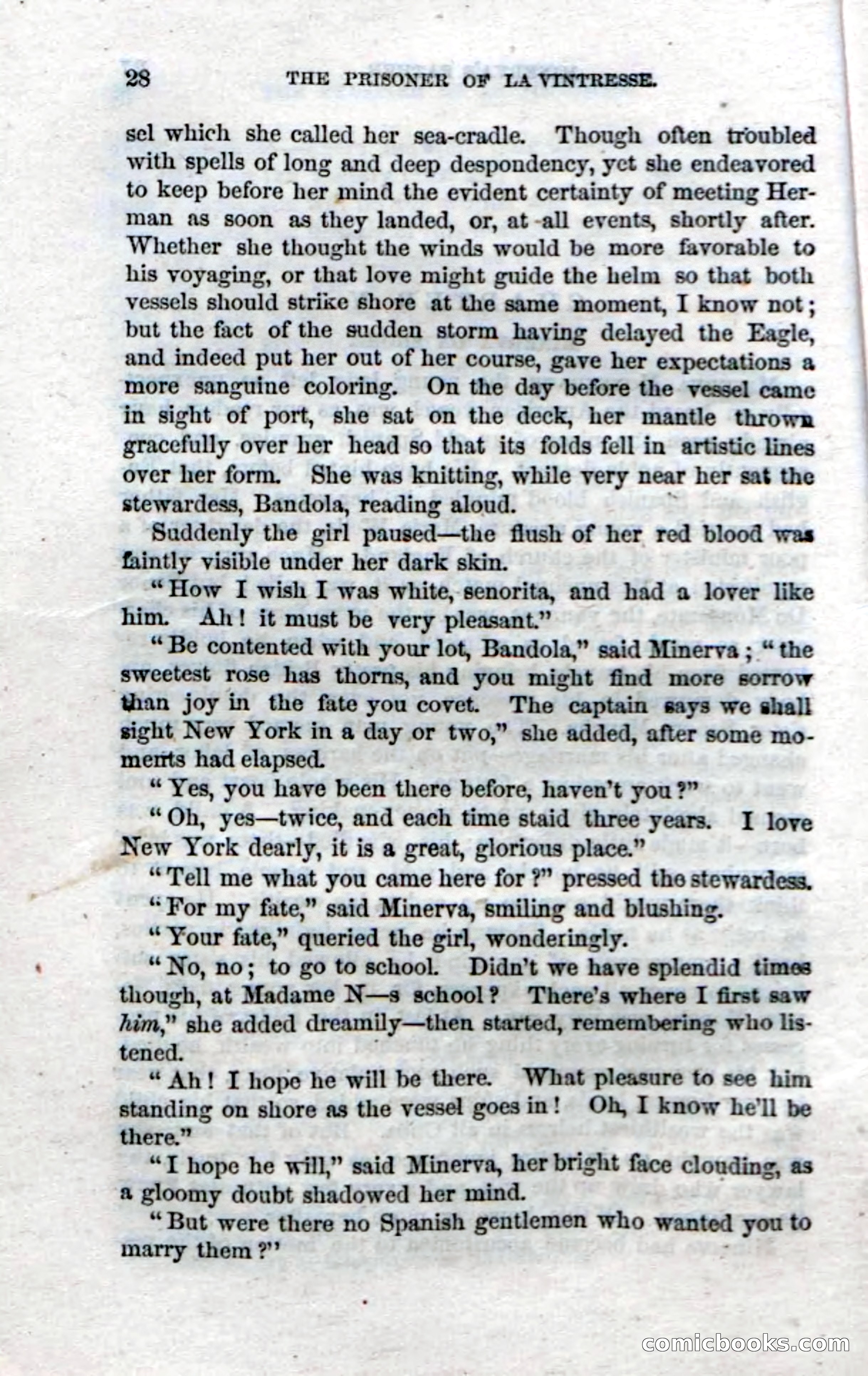
A restored page from Pulp Fiction, 1860. Page through the whole issue in the reader above.
📄 Transcribed text from this page (OCR, searchable)
Machine-transcribed from the original scan — historical spelling and the odd misread are preserved.
28 THE PRISONER OF LA VINTRESSE. sel which she called her sea-cradle. Though often troubled with spells of long and deep despondency, yet she endeavored to keep before her mind the evident certainty of meeting Her- man as soon as they landed, or, at-all events, shortly after. Whether she thought the winds would be more favorable to his voyaging, or that love might guide the helm so that both vessels should strike shore at the same moment, I know not; but the fact of the sudden storm haying delayed the Eagle, and indeed put her out of her course, gave her expectations a more sanguine coloring. On the day before the vessel came in sight of port, she sat on the deck, her mantle thrown gracefully over her head so that its folds fell in artistic lines over her form. She was knitting, while very near her sat the stewardess, Bandola, reading aloud. Suddenly the girl paused—the flush of her red blood was faintly visible under her dark skin. “How I wish I was white, senorita, and had a lover like him. Ah! it must be very pleasant.” “Be contented with your lot, Bandola,” said Minerva ; “the sweetest rose has thorns, and you might find more sorrow ‘than joy in the fate you covet. The captain says we shall sight New York in a day or two,” she added, after some mo- ments had elapsed. “Yes, you have been there before, haven’t you ?” “Oh, yes—twice, and each time staid three years. I love New York dearly, it is a great, glorious place.” “Tell me what you came here for ?” pressed the stewardess. “For my fate,” said Minerva, smiling and blushing. “Your fate,” queried the girl, wonderingly. “No, no; to go to school. Didn’t we have splendid times though, at Madame N—s school? There’s where I first saw him,” she added dreamily—then started, remembering who lis- tened. “ Ah! I hope he will be there. What pleasure to see him standing on shore as the vessel goes in! Oh, I know he'll be there.” “TI hope he will,” said Minerva, her bright face clouding, as a gloomy doubt shadowed her mind. “But were there no Spanish gentlemen who wanted you to marry them ?”” comlcbooks.corm