
Pulp Fiction, 1882 · page 5 of 16
Beadle's Boys Library No. 54 — page 5: what you’re looking at
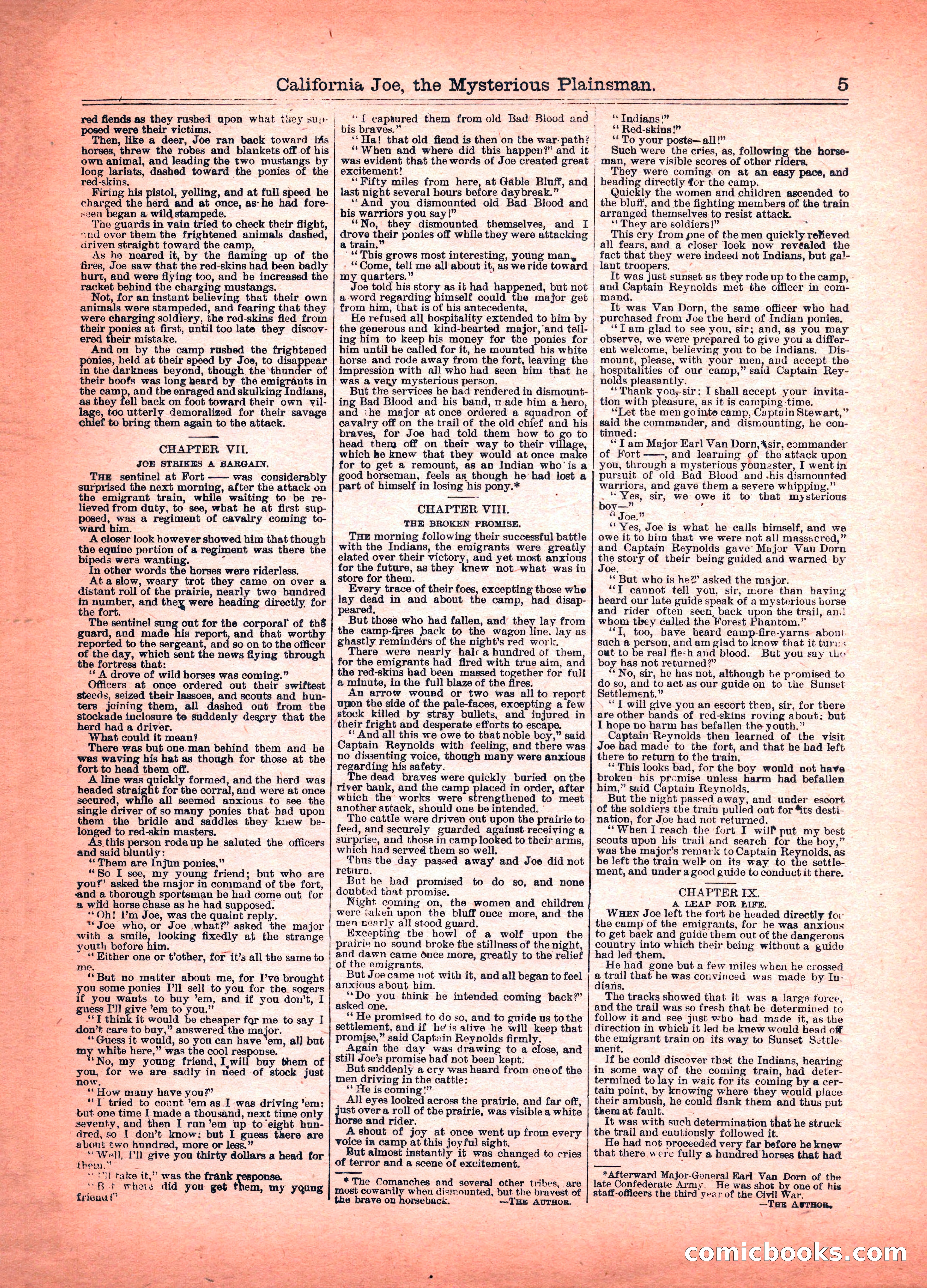
A restored page from Pulp Fiction, 1882. Page through the whole issue in the reader above.
📄 Transcribed text from this page (OCR, searchable)
Machine-transcribed from the original scan — historical spelling and the odd misread are preserved.
red fiends as they rushed upon what they sup- posed were their victims. = Then, like a deer, Joe ran back toward bis horses, threw the robes and blankets off of his own animal, and leading the two mustangs by long lariats, dashed toward the ponies of the red-skins. : Firing his pistol, yelling, and at full speed he charged the herd and at once, as-he had fore- -2en began a wild stampede. The guards in vain tried to check their flight, - ~nd over them the frightened animals dashed, driven straight toward the camp, — As he neared it, by the flaming up of the fires, Joe saw that the red-skins had been badly hurt, and were flying too, and be increased the racket behind the charging mustangs. Not, for an instant believing that their own animals were stampeded, and fearing that they were charging soldiery, the red-skins fled from their ponies at first, until too late they discov- ered their mistake. And on by the camp rushed the frightened ponies, held at their speed by Joe, to disappear in the darkness beyond, though the thunder of their hoofs was long heard by the emigrants in the camp, and the enraged and skulking Indians, as they fell back on foot toward their own vil- lage, too utterly demoralized for their savage chief to bring them again to the attack. CHAPTER VIL JCE STRIKES A BARGAIN, THE sentinel at Fort —— was considerably surprised the next morning, after the attack on _ the emigrant train, while waiting to be re- lieved from duty, to see, what he at first sup- posed, was a regiment of cavalry coming to- ward him. A closer look however showed him that though the equine portion of a regiment was there the bipeds were wanting. : In other words the horses were riderless. At aslow, weary trot they came on over a distant roll of the prairie, nearly two bundred in number, and they were heading directly, for the fort. The sentinel sung out for the corporal’ of thé guard, and made his report, and that worthy reported to the sergeant, and so on to the officer of the day, which sent the news flying through the fortress that: “A drove of wild horses was coming.” Officers at once ordered out their swiftest steeds, seized their lassoes, and scouts and hun- ters joining them, all dashed out from the stockade inclosure te suddenly desgry that the herd had a driver. What could it mean? There was but one man behind them and he was waving his hat as though for those at the fort to head them off. A line was quickly formed, and the herd was headed straight for the corral, and were at once secured, while all seemed anxious to see the single driver of so many ponies that had upon them the bridle and saddles they kuew be- longed to red-skin masters. _ As this person rode up he saluted the officers and said bluntly: “Them are Injun ponies,” “So I see, my young friend; but who are you?” asked the major in command of the fort, and a thorough sportsman he had come out for a wild horse chase as he had supposed. **Oh! Ym Joe, was the quaint reply. “Joe who, or Joe what?” asked the major with a smile, looking fixedly at the strange youth before him. = ‘“‘ Kither one or t’other, for it’s all the same to me, *‘But no matter about me, for I’ve brought you some ponies I’ll sell to you for the sogers if you wants to buy ’em, and if you don’t, I uess P’]] give ’em to you.” “‘T think it would be cheaper far me to say I don’t care to buy,” answered the major. = “Guess it would, so you can have ’em, al] but my white here,” was the cool r mse. ‘No, my young friend, Iwill buy them of you, for we are sadly in need of stock just now. : ““How many have you?” ‘I tried to count ’em as I was driving ’em: but one time I made a thousand, next time only seventy, and then I run’em up to eight bun- _dred,so I don’t know: but I guess there are about two hundred, more or less.” oe: ell, I'll give you thirty dollars a head for thein.* = *!"! take it,” was the frank nse. 3 “6B t whee did you get them, my yqung frienat” California Joe, the Mysterious Plainsman. “{ eaptured them from old Bad Blood and bis braves.” : ‘* Ha! that old fiend is then on the war- path? ‘When and where did this happen?” and it was evident that the words of Joe created great | excitement! ‘‘FWifty miles from here, at Gable Bluff, and last night several hours before daybreak.” ‘*And you dismounted old Bad Blood and his warriors you say!” ‘No, they dismounted themselves, and I drove their ponies off while they were attacking a train.” “This grows most interesting, young man, - “Come, tell me all about it, as we ride toward my quarters.” Joe told his tory as it had happened, but not | a word regarding himself could the major get from him, that is of his antecedents. He refused all hospitality extended to him by the generous and kind-hearted major, and tell- ing him to keep his money for the ponies for him until be called for it, he mounted his white horse and rode away from the fort, leaving the impression with all who had seen him that he was @ very mysterious person. But the services he had rendered in dismount- ing Bad Blood and his band, made him a hero, and the major at once ordered a squadron of cavalry off on the trail of the old chief and his braves, for Joe had told them how to go to head them off on their way to their village, which he knew that they would at once make for to get a remount, as an Indian who’'is a good horseman, feels as though he had lost a part of himself in losing his pony.* CHAPTER VIII. THE BROKEN PROMISE. THE morning following their successful battle with the Indians, the emigrants were greatly elated over their victory, and yet most anxious for the future, as they knew not what was in store for them. Every trace of their foes, excepting those whe lay dead in and about the camp, had disap- ared. But those who had fallen, and hey. lay from the camp-fjres back to the wagon line, lay as ghastly reminders of the night’s red work. There were nearly hali a hundred of them, for the emigrants had fired with true aim, and the red-skins had been massed together for full a minute, in the full blaze of the fires. An arrow wound or two was all to report uyzon the side of the pale-faces, excepting a few stock killed by stray bullets, and injured in their fright and desperate efforts to escape. - * And all this we owe to tbat noble boy,” said Captain Reynolds with feeling, and there was no dissenting voice, though many were anxious regarding his safety. The dead braves were quickly buried on the river bank, and the camp placed in order, after which the works were strengthened to meet another attack, should one be intended. The cattle were driven out upon the prairie to feed, and securely guarded against receiving a surprise, and those in camp looked to their arms, which had served them so well. Thus the day passed away and Joe did not return. But he had promised to do so, and none doubted that promise. Night coming on, the women and children were talen upon the bluff once more, and the men cearly all stood guard, Excepting the howl of a wolf upon the prairie no sound broke the stillness of the night, and dawn came once more, greatly to the relief of the emigrants. But Joe came not with it, and all began to feel anxious about him. ‘““Do you think he intended coming back?” asked one. ** He promised to do so, and to guide us to the settlement, and if heis alive he will keep that promise,” said Captain Reynolds firmly. Again the day was drawing to a close, and still Joe’s promise bad not been kept. But suddenly a cry was heard from one of the men driving in the cattle: ‘* He is coming!” All eyes looked across the prairie, and far off, boa over a roll of the prairie, was visible a white orse and rider. A shout of joy at once went up from every voice in camp at this joyful sight. But almost instantly it was changed to cries of terror and a scene of excitement. * The Comanches and several other tribes, are most cowardly when dismounted, but the bravest of the brave on horseback. ~—THE AUTHOR. | “ Indians!” ‘** Red-skins!” **To your s— all!” Such were the cries, as, following the horse- man, were visible scores of other riders. They were coming on at an easy pace, and heading directly for the camp. Quickly the women and children ascended to the bluff, and the fighting members of the train arranged themselves to resist attack. ‘‘They are soldiers!” : This cry from pne of the men quickly retieved all fears, and a closer look now revéaled the fact that they were indeed not Indians, but gal- lant troopers. ~ It was just sunset as they rode up to the camp, and Captain Reynolds met the officer in com- mand. It was Van Dorn, the same officer who had purchased from Joe the herd of Indian ponies. ““T am glad to see you, sir; and, as you may observe, we were prepared to give you a differ- ent welcome, believing you to be Indians. Dis- mount, please, with your men, and accept the hospitalities of our camp,” said Captain Rey- nolds pleasantly. “‘Thank youy,-sir; I shall accept your invita- tion with pleasure, as it is camping time, ‘“‘Let the men gointe camp, Captain Stewart,” said the commander, and dismounting, he con- tinued: ‘‘T am Major Earl Van Dorn,%sir, commander of Fort ——, and learning of the attack upon you, through a mysterious youngster, I went in pursuit of old Bad Blood and -his dismounted warriors, and gave them a severe whipping.” . ‘Yes, sir, we owe it to that mysterious boy—” , cé Joe,” ‘Yes, Joe is what he calls himself, and we owe it to him that we were not all massacred,” and Captain Reynolds gave’ Major Van Dorn - story of their being guided and warned by oe. ‘But who is he?’ asked the major. “‘T cannot tell you, sir, more than having heard our late guide speak of a mysterious borse and rider often seen, back upon the trail, and whom tbey called the Forest Phantom.” “I, too, bave heard camp-fire-yarns about. such a person, and am glad to know that it tur::s out to be real fle-h and blood. But you say thw boy has not returned?” ** No, sir, he has not, although he promised to do so, and to act as our guide on to the Sunset Settlement.” “‘T will give you an escort then, sir, for there are other bands of red-skins roving about: but I hope no harm has befallen the youth.” Captain Reynolds then learned of the visit Joe had made to the fort, and that he had left there to return to the train. ‘This looks bad, for the boy would not have broken his prcmise unless harm had befallen him,” said Captain Reynolds, But the night passed away, and under escort of the soldiers the train pulled out for “its desti- nation, for Joe had not returned. “When I reach the fort I will put my best scouts upon his trail and search for the boy,” was the major’s remark to Captain Reynolds, as he left the train welk on its way to the settle- ment, and under a good guide to conduct it there. CHAPTER IX. A LEAP FOR BIFE. WHEN Joe left the fort he headed directly fo: the camp of the emigrants, for he was anxious to get back and guide them out of the dangerous country into which their being without a guide had led them, He had gone but a few miles when he crossed a trail that he was convinced was made by In- dians, The tracks showed that it was a larga force, and the trail was so fresh that he determined to follow it and see just who had made it, as the direction in which it led he knew would head off the emigrant train on its way to Sunset Settle- ment. If be could discover that the Indians, hearing in some way of the coming train, had deter- termined to lay in wait for its coming by a cer- tain point, by knowing where they would place their ambush, he could flank them and thus put them at fault. . It was with such determination that he struck the trail and cautiously followed it. He had not proceeded very far before he knew ~ that there were fully a hundred horses that had *Afterward Major-General Earl Van Dorn of the late Confederate Army. He was shot by one of his staff-officers the third year of the Civil War. —TaE AUTHOR.