
Pulp Fiction, 1882 · page 13 of 16
Beadle's Boys Library No. 54 — page 13: what you’re looking at
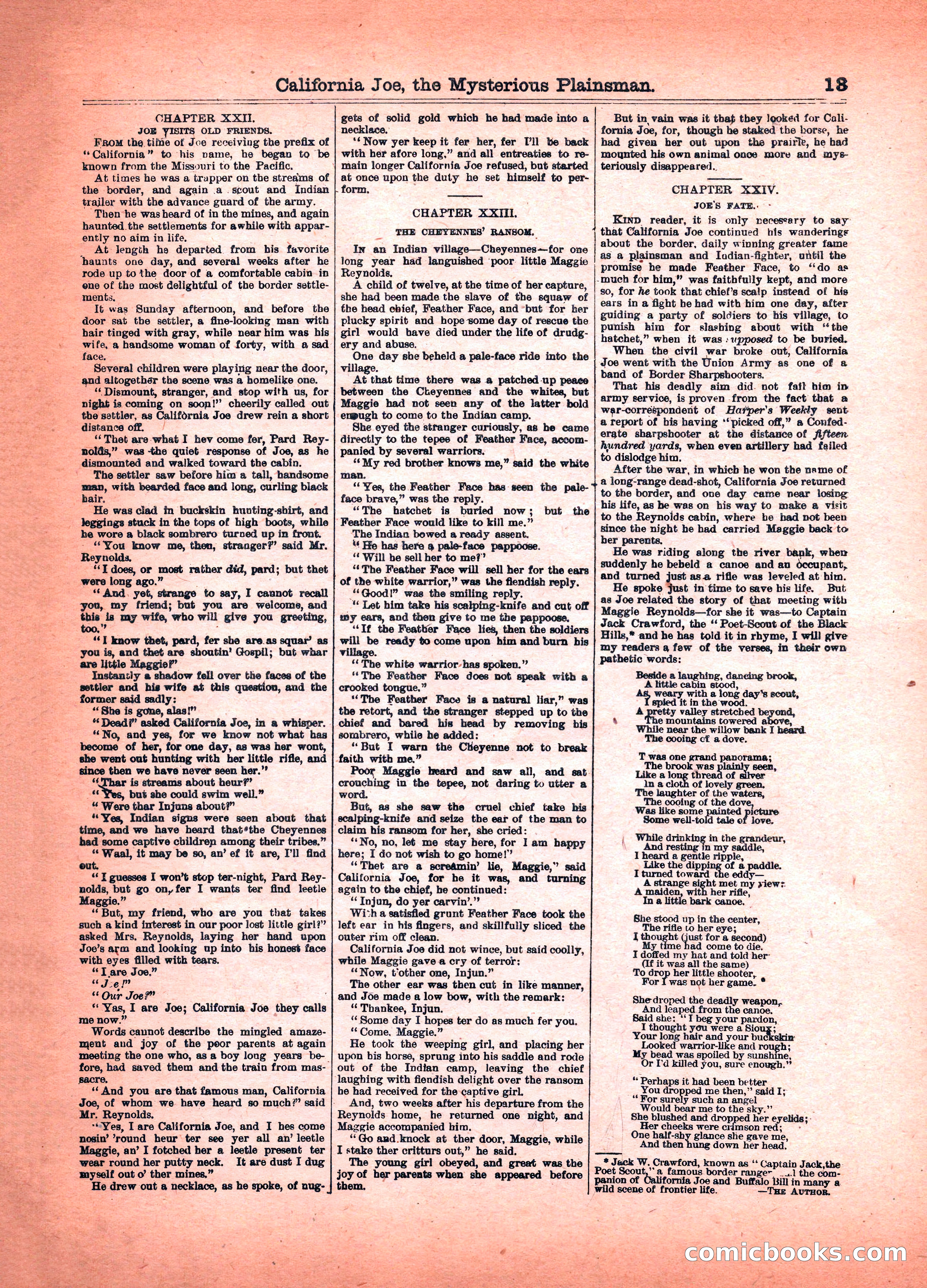
A restored page from Pulp Fiction, 1882. Page through the whole issue in the reader above.
📄 Transcribed text from this page (OCR, searchable)
Machine-transcribed from the original scan — historical spelling and the odd misread are preserved.
CHAPTER XXII. JOE VISITS OLD FRIENDS. known from the Missouri to the Pacific. - trajler with the advance guard of the army. eee ss ently no aim in life. ee ea Ge Sap shar ae It was Sunday afternoon, and before the _ —sodtovcorr sat the settler, a fine-looking man with _ -—s*hair tinged with gray, while near him was his wife, a handsome woman of forty, with a sad face. Several children were playing near the door, nd altogether the scene was a homelike one. a distance off. | - dismounted and walked toward the cabin. _ hair. hes 5 =, he wore a black sombrero turced up in front. ee aoa - “You know me, then, stranger?’ said Mr. segs Reynolds, Si I 3 <a ‘*T does, or most rather did, pard; but thet sere long ago.” ~ you, my friend; but you are welcome, and roa is my wife, "who will give you greeting, are little Maggie?’ Teg SB Instansly a shadow fell over the faces of the Sie settler and his wife at this question, and the _—s—sformerr said sadly: ease a “She is gone, alas!” ee “Dead?” asked California Joe, in a whisper. ——secome of her, for one day, as was her wont, ~~———saghe went ont hunting with her little rifle, and Bet ey: since then we have never seen her.” Te, 2 ea is streams about heur?’ ge a coe but she could swim well,” $y Ms “Were thar Injuns about?” “Yes, Indian signs were seen about that ie time, and we have heard that*the Cheyennes Site Os had some captive children among their tribes.” ~_-—s* Waal, it may be so, an’ ef it are, I'll find re eat, 7a ‘*T guesses I won’t stop ter-night, Pard Rey- 5 nolds, but go on, fer I wants ter find leetle os Maggie,” Mises ‘But, my friend, who are you that takes such a kind interest in our poor lost little girl?” asked Mrs. Reynolds, laying her hand upon Joe’s arm and looking up into his honest face with oyes filled with tears. s I are Joe.” Spit Sed Our Joe” eee. Yas, I are Joe; California Joe they calls 5 sme now.” ——————s Words cannot describe the mingled amaze- ment and joy of the peor parents at again : | = SS toe! fs meeting the one who, as a boy long years be- fore, had saved them and the train from mas- sacre, ss And you are that famous man, California Pas Mr. Reynolds. ae __**¥es, Tare California Joe, and I hes come & Seog agin? ‘round heur ter see yer all an’ leetle ; _ Maggie, an’ I fotched her a leetle present ter rites =: ‘wear round her putty neck. It are dust I dug ss gayself out o’ ther mines,” eee He drew out a necklace, as he spoke, of nug- ; From the tifie of Joe receiving the prefix of “California” to his pame, he began to be At times he was a trapper on the streams of the border, and again a scout and Indian Then he was heard of in the mines, and again haunted the settlements for awhile with appar- At length he departed from his favorite RP Sg, oe: haunts one day, and several weeks after he _———s rode up to the door of a comfortable cabin in one of the most delightful of the border settle- “‘ Dismount, stranger, and stop with us, for night is coming on soon!” cheerily called out ~ the settler, as California Joe drew rein a short ae et ‘‘Thet are what I hev come fer, Pard Rey- _ polds,” was -the quiet response of Joe, as he ‘The settler saw before him a tall, handsome man, with bearded face and long, curling black . ORE eo He was clad in buckskin huvting-sbirt, and 2 leggings stuck in the tops of high boots, while Secasuhy: “ And. yet, strange to say, I cannot recall a ies af = ae know thet, pard, fer she are.as squar’ as f ‘ you is, and thet are shoutin’ Gospil; but whar “No, and yes, for we know not what has of whom we have heard so much?” said |- California Joe, the Mysterious Plainsman. gets of solid gold which he had made into a necklace. ‘* Now yer keep it fer her, fer [ll be back with her afore long,” and all entreaties to re- {| main longer California Joe refused, but started at once upon the duty he set himself to per- form, CHAPTER XXIII, THE CHEYENNES’ RANSOM, In an Indian village—Cheyennes—for one long year had languished ‘poor. little Maggie Reynolds, A child of twelve, at the time of her capture, she had been made the slave of the squaw of the head ebief, Feather Face, and “but for her plucky spirit and hope some day of rescue the girl would bave died under the life of drudg- ery and abuse. — One day she beheld a pale-face ride into the village. At that time there was a patched -up peace between the Cheyennes and the whites, but Maggie had not seen any of the latter bold empugh to come to the Indian camp. She eyed the stranger curiously, as he came directly to the tepee of Feather Face, accom- panied by several warriors. ‘My red brother knows ” said the white y me, man. ‘‘Yes, the Feather Face has seen the pale- face brave,” was the reply. “The hatchet is buried now; ‘Feather Face would like to kill me. ” The Indian bowed a ready assent. \“« He has here 4 pale-face pappoose. ‘* Will be sell her to me?” “‘The Feather Face will sell her for the ears of the white warrior,” was the fiendish reply. “Good!” was the ‘smiling reply. “ Let him take his scalping-knife and cut off wy ears, and then give to me the pappoose, “Tf the Feather Face lies, then the soldiers will be ready to come upon him and burn his village. ‘The white warrior-has spoken.” ‘*The Feather Face does not speak with a crooked tongue.” ‘The Feather Face is a natural liar,” was the retort, and the stranger stepped up to the chief and bared his head by removing his sonabrero, while he added: ‘But I warn the Cleyenne not to break faith with me.” Poor Maggie heard and saw ail, crouching in the tepee, not daring ‘to utter a word. But, as she saw the cruel chief take his ecalping-knife and seize the ear of the man to claim his ransom for her, she cried: ‘*No, no, let me stay ‘here, for Iam happy here; I do not wish to go home!” “‘Thet are a screAmin’ lie, Maggie,” said California Joe, for he it was, and turning again to the chief, be continued: “Tnjun, do yer carvin’.” With a satisfled grunt Feather Face took the left ear in his fingers, and skillfully sliced the outer rim off clean. California Joe did not wince, but said coolly, while Maggie gave a cry of terror: “Now, t’other one, Injun.” The other ear was then cut in like manner, and Joe made a low bow, with the remark: “'Thankee, Injun. “ Some day I hopes ter do as much fer you, ‘“Come, Maggie.” _ He took the weeping girl, and placing her upon bis horse, sprung into his saddle and rode out of the Indian camp, leaving the chief ‘laughing with fiendish delight over the ransom he had received for the captive girL And, two weeks after his departure from the Reynolds home, he returned one night, and Maggie accompanied him. “Go and.knock at ther door, Maggie, while I stake ther critturs out,” he said. The young girl obeyed, and great was the joy of her parents when she appeared before them, but the and sat. wild scene of frontier life. nt = yy sees 2b a> ee ~ ie ‘ tt Sa Pree a Se aa = “4 fox = aoe - = or: = hy Bias An a ae “¥™ A mag : ee ne < & ~ 18 ee But i in, vain was it thaf they looked for Cali- fornia Joe, for, though he staked the horse, he had given ber out upon the prairie, be ‘had mounted his own animal once more and mys- teriously disappeared., CHAPTER XXIV. JOE'S ¥FATE.. Kinp_ reader, it is only necessary to say that California Joe continued his wanderings about the border, daily winning greater fame as a plainsman and I[odian-fighter, ontil the promise he made Feather Face, to ‘‘do as -much for him,” was faithfully kept, and more so, for he took that chief’s scalp instead of his ears in a fight he had with him one day, after guiding a party of soldiers to his village, to punish him for slashing about with “the hatchet,” when it was :upposed to be buried. When the civil war broke out, California Joe went with the Union Army as one of a band of Border Sharpshooters. © That his deadly aim did- not fafl him in armny service, is proven from the fact that a war-correspondent of Harper's Weekly sent. a report of bis having ‘‘ picked off,” a Confed- erate sharpshooter at the distance of fifteen hundred yards, when even artillery had feiled to dislodge him. After the war, in which he won the name of a long-range dead-shot, California Joe returned to the border, and one day came near losing his life, as he was on his way to make a visit to the Reynolds cabin, where be bad not been since the night he had carried Maggie back to | ber parents, He was riding along the river bank, wher suddenly he bebeld a canoe and au dccupant, and turned just asa rifle was leveled at him. He spoke just in fime to save his life. But as Joe related the story of that meeting with Maggie Reynolds—for she it was—to Captain Jack Crawford, the ‘‘ Poet-Scout of the Black Hills,* and he has told it in rhyme, I will give my readers a few of the verses, in their own pathetic words: Beside a la hing, dancing brook, A little cabin 6 pe Pave t, 2 weary with a lo ecou ‘pied it in the’ -wotd: a retty valley stretched be LY e mountains towered a neer the willow bank T heard. The cooing cf a dove. T The brook was ap dames e broo pee P ainly seen, “7 abies x1 h web hig a of lov The laughter of the wetihe The cooing of the — Was like some ed pitare: Some well- told tale of love. While drin in the grandeur, And resting in my saddle, I heard a gentile ripple, Like the dipping of aps nddle. I ype toward t A! e ed , range 8 met m yiew: A maiden wit her et my Ina li iittie bi bark canoe. She stood up in the sone The rifle to her eye; I py Gus ust for a second) ad come to die. af dotted my hat and told her: (If it was all the same) To oe her little shooter, For I was not her game. . She droped the deadly weapon And leaped from the pe ~ Said she: ‘‘I beg your pardon, I thought you were a Sio Your long hair and your ie, Oe Looked warrior-like and rough; My _ was spoiled by sunshine, Or I'd killed you, sure enovgh.” at Perhaps it had been better You dropped me then,” said I; “For surely such an angel Would bear me to the sky.” She blushed and Cropne - a e relids ; Her cheeks were c One a then h glance aig pee me, And then hung down her head, * Jack W. Crawford, known as “ Captai Jack, Poet Scout,” a famous border rangey 1 the ee: nion of fornia Joe and Buffalo Bill in many a Tne AUTHOR.