
Pulp Fiction, 1868 · page 9 of 97
Ballou's Monthly Magazine, Vol. XXVII, No. 1 — page 9: what you’re looking at
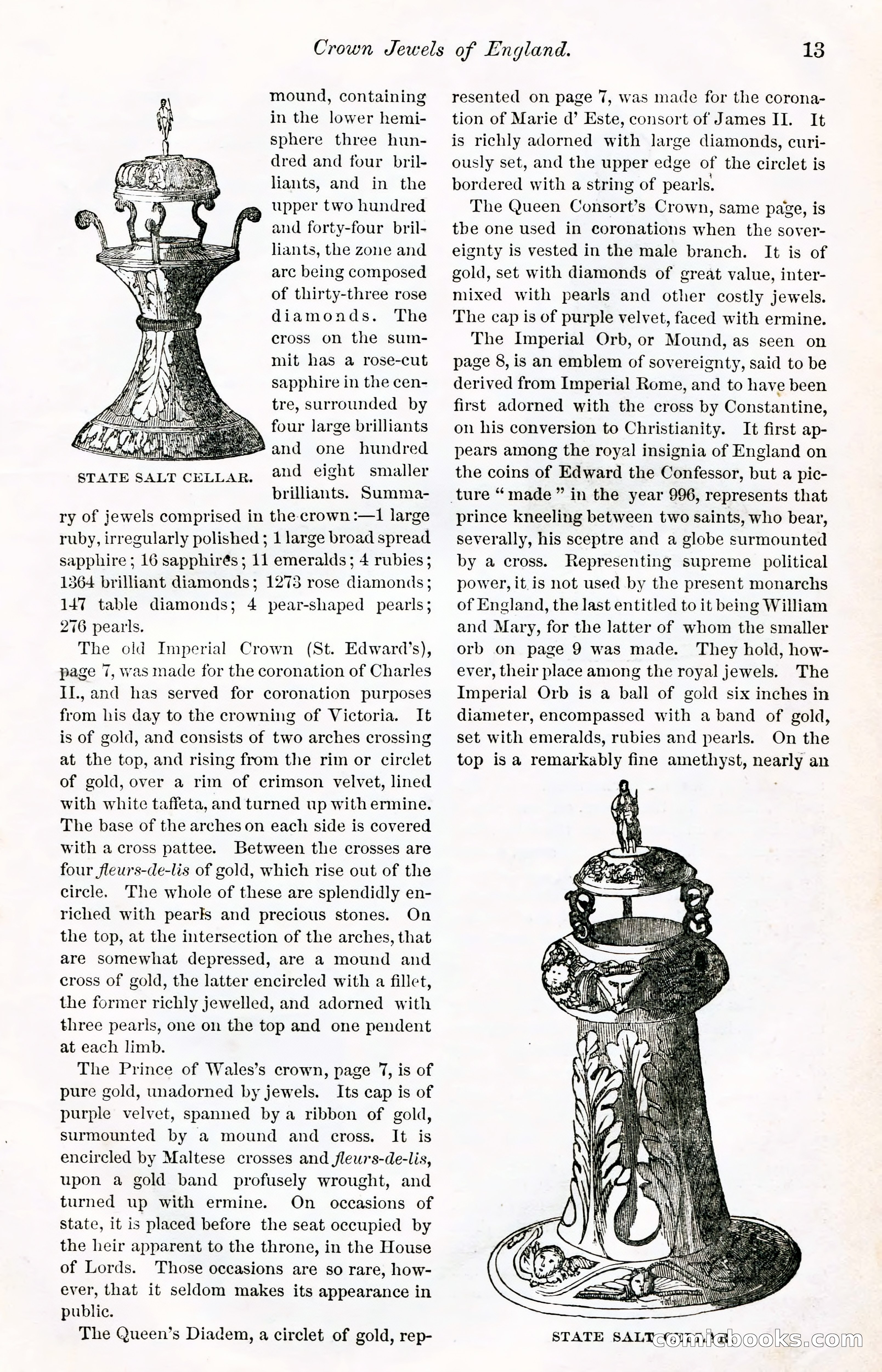
A restored page from Pulp Fiction, 1868. Page through the whole issue in the reader above.
📄 Transcribed text from this page (OCR, searchable)
Machine-transcribed from the original scan — historical spelling and the odd misread are preserved.
Crown Jewels of England. mound, containing in the lower hemi- sphere three hun- dred and four bril- liants, and in the upper two hundred and forty-four bril- liants, the zone and arc being composed of thirty-three rose diamonds. The cross on the sum- mit has a rose-cut sapphire in the cen- tre, surrounded by four large brilliants and one hundred and eight smaller brilliants. Summa- ry of jewels comprised in the crown :—1 large ruby, irregularly polished ; 1 large broad spread sapphire ; 16 sapphirés; 11 emeralds; 4 rubies; 1364 brilliant diamonds; 1273 rose diamonds; 147 table diamonds; 4 pear-shaped pearls; 276 pearls. The old Imperial Crown (St. Edward’s), page 7, was made for the coronation of Charles II., and has served for coronation purposes from his day to the crowning of Victoria. It is of gold, and consists of two arches crossing at the top, and rising from the rim or circlet of gold, over a rim of crimson velvet, lined with white taffeta, and turned up with ermine. The base of the arches on each side is covered with across pattee. Between the crosses are four fleurs-de-lis of gold, which rise out of the circle. The whole of these are splendidly en- riched with pearls and precious stones. On the top, at the intersection of the arches, that are somewhat depressed, are a mound and cross of gold, the latter encircled with a fillet, the former richly jewelled, and adorned with three pearls, one on the top and one pendent at each limb. The Prince of Wales’s crown, page 7, is of pure gold, unadorned by jewels. Its cap is of purple velvet, spanned bya ribbon of gold, surmounted by a mound and cross. It is encircled by Maltese crosses and fleurs-de-lis, upon a gold band profusely wrought, and turned up with ermine. On occasions of state, it is placed before the seat occupied by the heir apparent to the throne, in the House of Lords. Those occasions are so rare, how- ever, that it seldom makes its appearance in public. The Queen’s Diadem, a circlet of gold, rep- STATE SALT CELLAR. 13 resented on page 7, was made for the corona- tion of Marie d’ Este, consort of James II. It is richly adorned with large diamonds, curi- ously set, and the upper edge of the circlet is bordered with a string of pearls. The Queen Consort’s Crown, same page, is the one used in coronations when the sover- eignty is vested in the male branch. It is of gold, set with diamonds of great value, inter- mixed with pearls and other costly jewels. The cap is of purple velvet, faced with ermine. The Imperial Orb, or Mound, as seen on page 8, is an emblem of sovereignty, said to be derived from Imperial Rome, and to have been first adorned with the cross by Constantine, on his conversion to Christianity. It first ap- pears among the royal insignia of England on the coins of Edward the Confessor, but a pic- ture “made” in the year 996, represents that prince kneeling between two saints, who bear, severally, his sceptre and a globe surmounted by a cross. Representing supreme political power, it.is not used by the present monarchs of England, the last entitled to it being William and Mary, for the latter of whom the smaller orb on page 9 was made. They hold, how- ever, their place among the royal jewels. The Imperial Orb is a ball of gold six inches in diameter, encompassed with a band of gold, set with emeralds, rubies and pearls. On the top isa remarkably fine amethyst, nearly an STATE SALTQOIRNIGOOOKS CO