
Pulp Fiction, 1868 · page 69 of 97
Ballou's Monthly Magazine, Vol. XXVII, No. 1 — page 69: what you’re looking at
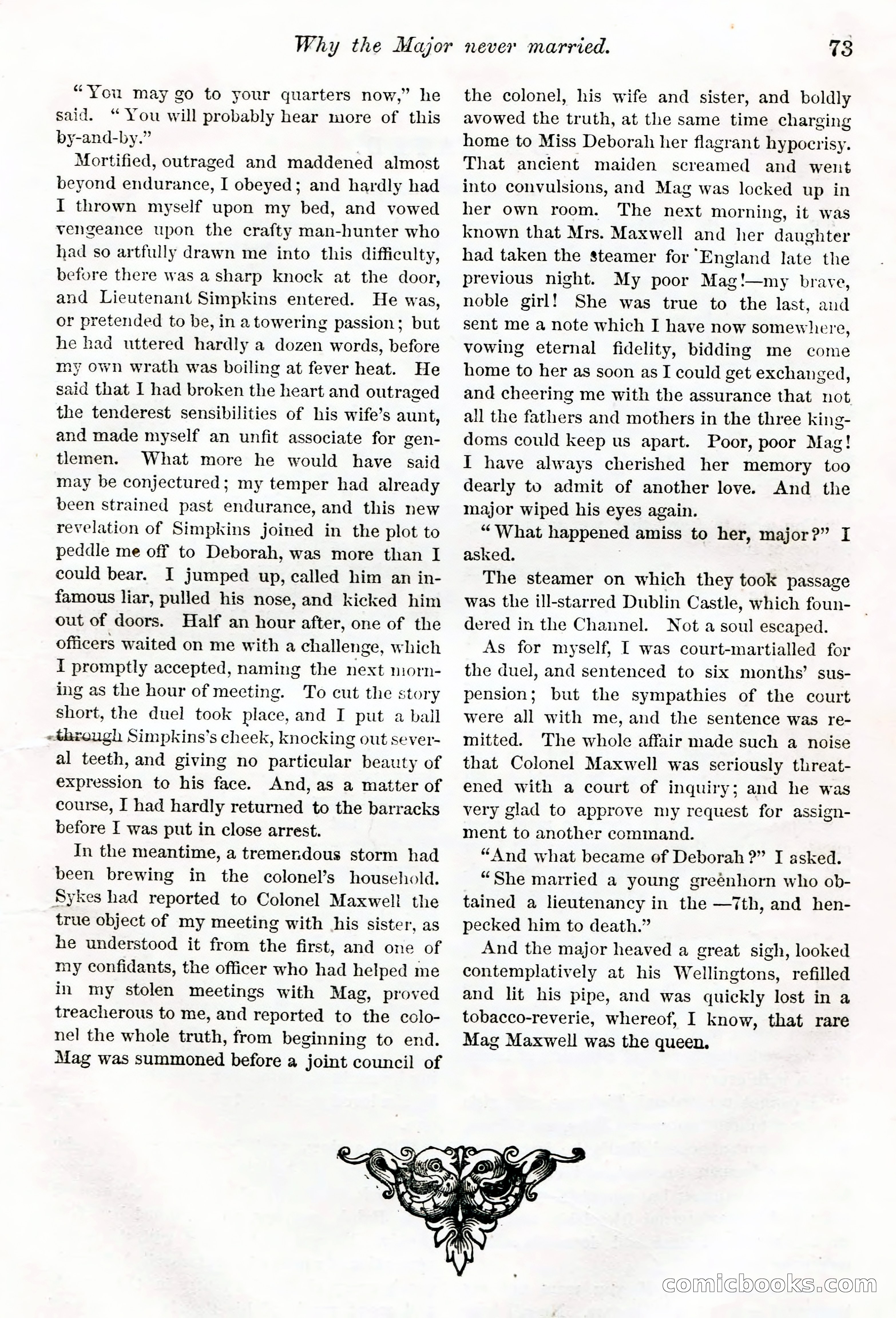
A restored page from Pulp Fiction, 1868. Page through the whole issue in the reader above.
📄 Transcribed text from this page (OCR, searchable)
Machine-transcribed from the original scan — historical spelling and the odd misread are preserved.
Why the Major never married. “You may go to your quarters now,” he said. “ You will probably hear more of this by-and-by.” Mortified, outraged and maddened almost beyond endurance, I obeyed; and hardly had I thrown myself upon my bed, and vowed vengeance upon the crafty man-hunter who had so artfully drawn me into this difficulty, before there was a sharp knock at the door, and Lieutenant Simpkins entered. He was, or pretended to be, in atowering passion; but he had uttered hardly a dozen words, before my own wrath was boiling at fever heat. He said that I had broken the heart and outraged the tenderest sensibilities of his wife’s aunt, and made myself an unfit associate for gen- tlemen. What more he would have said may be conjectured; my temper had already been strained past endurance, and this new revelation of Simpkins joined in the plot to peddle me off to Deborah, was more than I could bear. I jumped up, called him an in- famous liar, pulled his nose, and kicked him out of doors. Half an hour after, one of the officers waited on me with a challenge, which I promptly accepted, naming the next morn- ing as the hour of mecting. To cut the story short, the duel took place, and I put a ball -thzough Simpkins’s cheek, knocking out sever- al teeth, and giving no particular beauty of expression to his face. And, as a matter of course, I had hardly returned to the barracks before I was put in close arrest. In the meantime, a tremendous storm had been brewing in the colonel’s household. Sykes had reported to Colonel Maxwell the true object of my meeting with his sister, as he understood it from the first, and one of my confidants, the officer who had helped me in my stolen meetings with Mag, proved treacherous to me, and reported to the colo- nel the whole truth, from beginning to end. Mag was summoned before a joint council of 73 the colonel, his wife and sister, and boldly avowed the truth, at the same time charging home to Miss Deborah her flagrant hypocrisy. That ancient maiden screamed and went into convulsions, and Mag was locked up in her own room. The next morning, it was known that Mrs. Maxwell and her daughter had taken the steamer for England late the previous night. My poor Mag!—my brave, noble girl! She was true to the last, and sent me a note which I have now somewhere, vowing eternal fidelity, bidding me come home to her as soon as I could get exchanged, and cheering me with the assurance that not all the fathers and mothers in the three king- doms could keep us apart. Poor, poor Mag! I have always cherished her memory too dearly to admit of another love. And the major wiped his eyes again. “What happened amiss to her, major?” I asked. The steamer on which they took passage was the ill-starred Dublin Castle, which foun- dered in the Channel. Not a soul escaped. As for myself, I was court-martialled for the duel, and sentenced to six months’ sus- pension; but the sympathies of the court were all with me, and the sentence was re- mitted. The whole affair made such a noise that Colonel Maxwell was seriously threat- ened with a court of inquiry; and he was very glad to approve my request for assign- ment to another command. “And what became of Deborah ?” I asked. “She married a young greénhorn who ob- tained a lieutenancy in the —7th, and hen- pecked him to death.” And the major heaved a great sigh, looked contemplatively at his Wellingtons, refilled and lit his pipe, and was quickly lost in a tobacco-reverie, whereof, I know, that rare Mag Maxwell was the queen. conmcloooks Coin