
Pulp Fiction, 1868 · page 6 of 97
Ballou's Monthly Magazine, Vol. XXVII, No. 1 — page 6: what you’re looking at
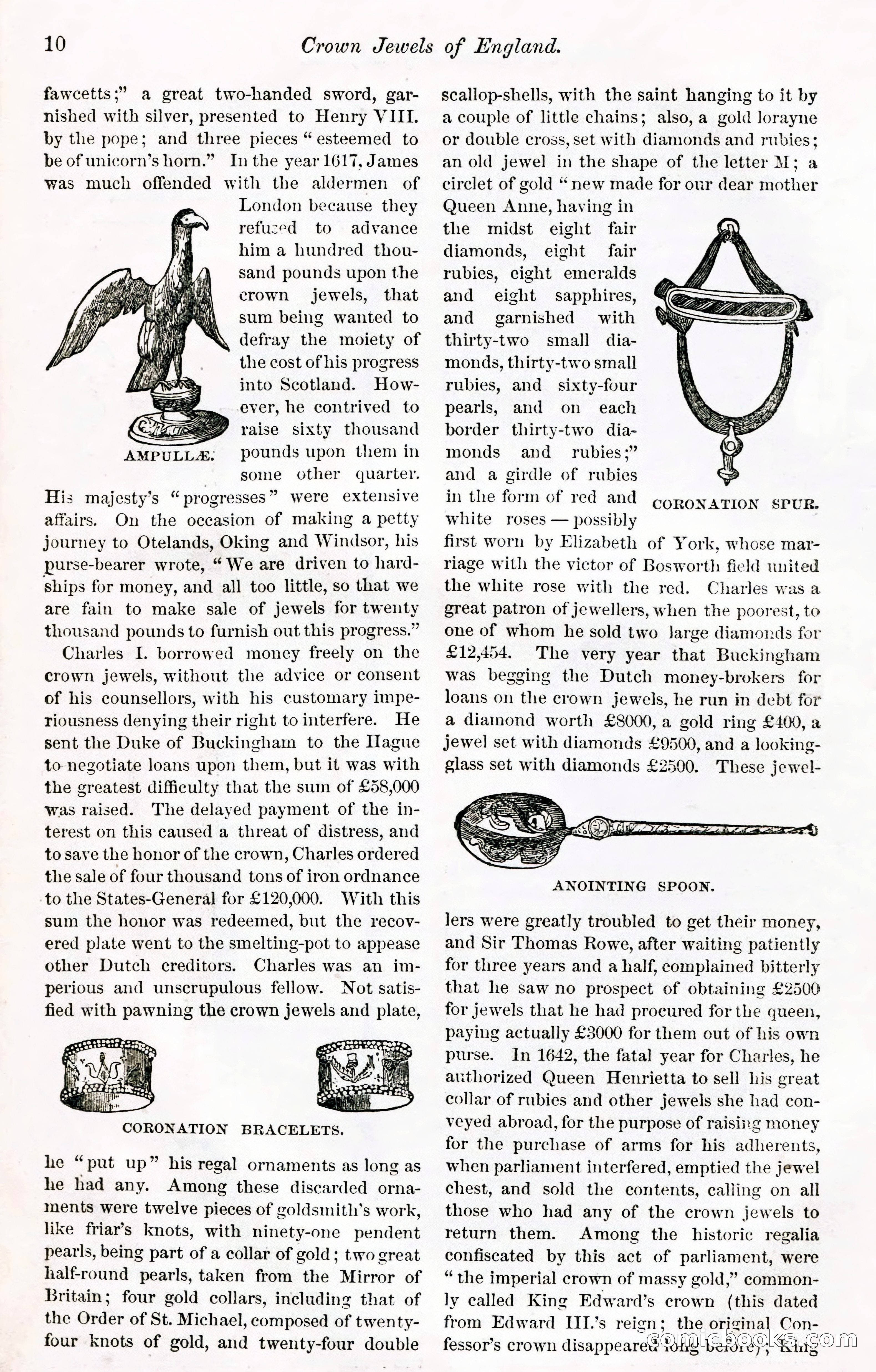
A restored page from Pulp Fiction, 1868. Page through the whole issue in the reader above.
📄 Transcribed text from this page (OCR, searchable)
Machine-transcribed from the original scan — historical spelling and the odd misread are preserved.
10 Crown Jewels of England. fawcetts;” a great two-handed sword, gar- nished with silver, presented to Henry VIII. by the pope; and three pieces “ esteemed to be of unicorn’s horn.” In the year 1617, James was much offended with the aldermen of London because they refused to advance him a hundred thou- sand pounds upon the crown jewels, that sum being wanted to defray the moiety of the cost of his progress into Scotland. How- ever, he contrived to raise sixty thousand pounds upon them in some other quarter. His majesty’s “progresses” were extensive affairs. On the occasion of making a petty journey to Otelands, Oking and Windsor, his purse-bearer wrote, “We are driven to hard- ships for money, and all too little, so that we are fain to make sale of jewels for twenty thousand pounds to furnish out this progress.” Charles I. borrowed money freely on the crown jewels, without the advice or consent of his counsellors, with his customary impe- riousness denying their right to interfere. He sent the Duke of Buckingham to the Hague to negotiate loans upon them, but it was with the greatest difficulty that the sum of £58,000 was raised. The delayed payment of the in- terest on this caused a threat of distress, and to save the honor of the crown, Charles ordered the sale of four thousand tons of iron ordnance -to the States-General for £120,000. With this sum the honor was redeemed, but the recov- ered plate went to the smelting-pot to appease other Dutch creditors. Charles was an im- perious and unscrupulous fellow. Not satis- fied with pawning the crown jewels and plate, CORONATION BRACELETS. he “put up” his regal ornaments as long as he had any. Among these discarded orna- ments were twelve pieces of goldsmith’s work, like friar’s knots, with ninety-one pendent pearls, being part of a collar of gold; two great half-round pearls, taken from the Mirror of Britain; four gold collars, including that of the Order of St. Michael, composed of twenty- four knots of gold, and twenty-four double scallop-shells, with the saint hanging to it by a couple of little chains; also, a gold lorayne or double cross, set with diamonds and rubies; an old jewel in the shape of the letter M; a circlet of gold “new made for our dear mother Queen Anne, having in the midst eight fair diamonds, eight fair rubies, eight emeralds and eight sapphires, and garnished with thirty-two small dia- monds, thirty-two small rubies, and sixty-four pearls, and on each border thirty-two dia- monds and_ rubies;” and a girdle of rubies in the form of red and white roses — possibly first worn by Elizabeth of York, whose mar- riage with the victor of Bosworth field united the white rose with the red. Charles was a great patron of jewellers, when the poorest, to one of whom he sold two large diamonds for £12,454. The very year that Buckingham was begging the Dutch money-brokers for loans on the crown jewels, he run in debt for a diamond worth £8000, a gold ring £400, a jewel set with diamonds £9500, and a looking- glass set with diamonds £2500. These jewel- CORONATION SPUR. ANOINTING SPOON. lers were greatly troubled to get their money, and Sir Thomas Rowe, after waiting patiently for three years and a half, complained bitterly that he saw no prospect of obtaining £2500 for jewels that he had procured for the queen, paying actually £3000 for them out of his own purse. In 1642, the fatal year for Charles, he authorized Queen Henrietta to sell his great collar of rubies and other jewels she had con- veyed abroad, for the purpose of raising money for the purchase of arms for his adherents, when parliament interfered, emptied the jewel chest, and sold the contents, calling on all those who had any of the crown jewels to return them. Among the historic regalia confiscated by this act of parliament, were “the imperial crown of massy gold,” common- ly called King Edward’s crown (this dated from Edward III.’s reign; mee i ewe fessor’s crown disappeared SLU iG KSecomn