
Pulp Fiction, 1868 · page 45 of 97
Ballou's Monthly Magazine, Vol. XXVII, No. 1 — page 45: what you’re looking at
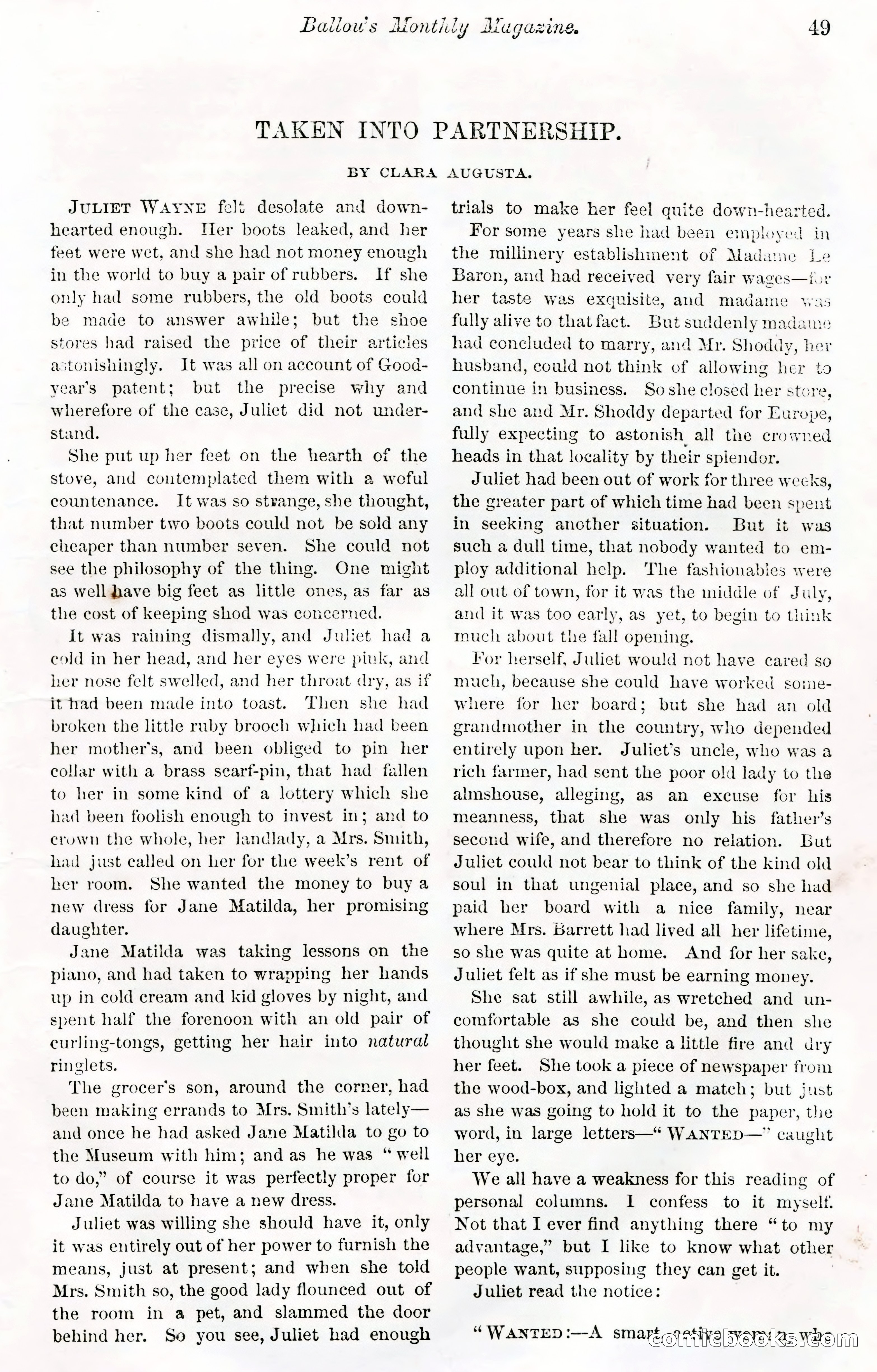
A restored page from Pulp Fiction, 1868. Page through the whole issue in the reader above.
📄 Transcribed text from this page (OCR, searchable)
Machine-transcribed from the original scan — historical spelling and the odd misread are preserved.
Ballou's Monthly du Jaxine. 49 TAKEN INTO PARTNERSHIP. BY CLARA AUGUSTA. JULIET WAYNE felt desolate and down- hearted enough. Her boots leaked, and her feet were wet, and she had not money enough in the world to buy a pair of rubbers. If she only had some rubbers, the old boots could be made to answer awhile; but the shoe stores had raised the price of their articles astonishingly. It was all on account of Good- year’s patent; but the precise why and wherefore of the case, Juliet did not under- stand. She put up her feet on the hearth of the stove, and contemplated them with a woeful countenance. It was so strange, she thought, that number two boots could not be sold any cheaper than number seven. She could not see the philosophy of the thing. One might as well Dave big feet as little ones, as far as the cost of keeping shod was concerned. It was raining dismally, and Juliet had a eold in her head, and her eyes were pink, and her nose felt swelled, and her throat dry, as if it had been made into toast. Then she had broken the little raby brooch which had been her mother’s, and been obliged to pin her collar with a brass searf-pin, that had fallen to her in some kind of a lottery which she had been foolish enough to invest in; and to crown the whole, her landlady, a Mrs. Smith, had just called on her for the week’s rent of her room. She wanted the money to buy a new dress for Jane Matilda, her promising daughter. Jane Matilda was taking lessons on the piano, and had taken to wrapping her hands up in cold cream and kid gloves by night, and spent half the forenoon with an old pair of curling-tongs, getting her hair into natural ringlets. The grocer’s son, around the corner, had been making errands to Mrs. Smith’s lately— and once he had asked Jane Matilda to go to the Museum with him; and as he was “ well to do,” of course it was perfectly proper for Jane Matilda to have a new dress. Juliet was willing she should have it, only it was entirely out of her power to furnish the means, just at present; and when she told Mrs. Smith so, the good lady flounced out of the room in a pet, and slammed the door behind her. So you see, Juliet had enough trials to make her feel quite down-hearted. For some years she had been employed in the millinery establishment of Madame Le Baron, and had received very fair wages—{v her taste was exquisite, and madame was fully alive to thatfact. But suddenly madame had concluded to marry, and Mr. Shoddy, her husband, could not think of allowing her to continue in business. Soshe closed her store, and she and Mr. Shoddy departed for Europe, fully expecting to astonish all the crowned heads in that locality by their splendor. Juliet had been out of work for three weeks, the greater part of which time had been spent in seeking another situation. But it was such a dull time, that nobody wanted to em- ploy additional help. The fashionables were all out of town, for it was the middle of July, and it was too early, as yet, to begin to think much about the fall opening. Tor herself, Juliet would not have cared so much, because she could have worked some- where for her board; but she had an old grandmother in the country, who depended entirely upon her. Juliet’s uncle, who was a rich farmer, had sent the poor old lady to the almshouse, alleging, as an excuse for his meanness, that she was only his father’s second wife, and therefore no relation. But Juliet could not bear to think of the kind old soul in that ungenial place, and so she had paid her board with a nice family, near where Mrs. Barrett had lived all her lifetime, so she was quite at home. And for her sake, Juliet felt as if she must be earning money. She sat still awhile, as wretched and un- comfortable as she could be, and then she thought she would make a little fire and dry her feet. She took a piece of newspaper from the wood-box, and lighted a match; but just as she was going to hold it to the paper, the word, in large letters—“ WANTED—” caught her eye. We all have a weakness for this reading of personal columns. I confess to it myself Not that I ever find anything there “to my advantage,” but I like to know what other people want, supposing they can get it. Juliet read the notice: »? L “WANTED :—A smartoretive|iyeret as wae lin