
Pulp Fiction, 1868 · page 29 of 97
Ballou's Monthly Magazine, Vol. XXVII, No. 1 — page 29: what you’re looking at
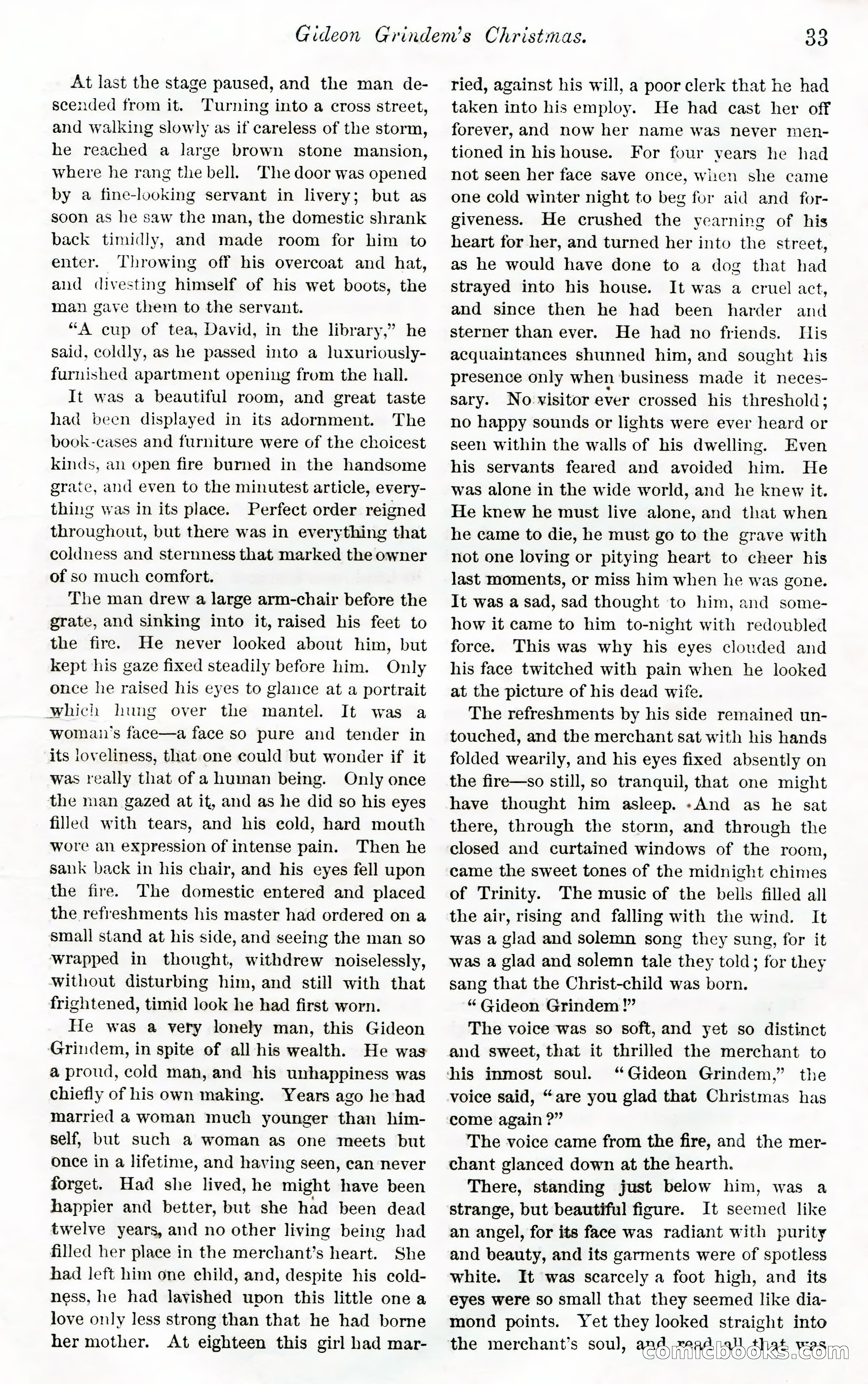
A restored page from Pulp Fiction, 1868. Page through the whole issue in the reader above.
📄 Transcribed text from this page (OCR, searchable)
Machine-transcribed from the original scan — historical spelling and the odd misread are preserved.
Gideon Grindem’s Christmas. 33 At last the stage paused, and the man de- scended from it. Turning into a cross street, and walking slowly as if careless of the storm, he reached a large brown stone mansion, where he rang the bell. The door was opened by a fine-looking servant in livery; but as soon as he saw the man, the domestic shrank back timidly, and made room for him to enter. Throwing off his overcoat and hat, and ivesting himself of his wet boots, the man gave them to the servant. “A cup of tea, David, in the library,” he said, coldly, as he passed into a luxuriously- furnished apartment opening from the hall. It was a beautiful room, and great taste had been displayed in its adornment. The book-cases and furniture were of the choicest kinds, an open fire burned in the handsome grate, and even to the minutest article, every- thing was in its place. Perfect order reigned throughout, but there was in everything that coldness and sternness that marked the owner of so much comfort. The man drew a large arm-chair before the grate, and sinking into it, raised his feet to the fire. He never looked about him, but kept his gaze fixed steadily before him. Only once he raised his eyes to glance at a portrait which hung over the mantel. It was a woman's face—a face so pure and tender in its loveliness, that one could but wonder if it was really that of a human being. Only once the man gazed at it, and as he did so his eyes filled with tears, and his cold, hard mouth wore an expression of intense pain. Then he sank back in his chair, and his eyes fell upon the fire. The domestic entered and placed the refreshments his master had ordered on a smal] stand at his side, and seeing the man so wrapped in thought, withdrew noiselessly, Without disturbing him, and still with that frightened, timid look he had first worn. He was a very lonely man, this Gideon Grindem, in spite of all his wealth. He was a proud, cold man, and his unhappiness was chiefly of his own making. Years ago he had married @ woman much younger than him- self, but such a woman as one meets but once in a lifetime, and having seen, can never forget. Had she lived, he might have been happier and better, but she had been dead twelve years, and no other living being had filled her place in the merchant’s heart. She had left him one child, and, despite his cold- ness, he had lavished upon this little one a love only less strong than that he had borne her mother. At eighteen this girl had mar- his immost soul. ried, against his will, a poor clerk that he had taken into his employ. He had cast her off forever, and now her name was never men- tioned in his house. For four years he had not seen her face save once, when she came one cold winter night to beg fur aid and _ for- giveness. He crushed the yearning of his heart for her, and turned her into the street, as he would have done to a dog that had strayed into his house. It was a cruel act, and since then he had been harder and sterner than ever. He had no friends. Iis acquaintances shunned him, and sought his presence only when business made it neces- sary. No.visitor ever crossed his threshold; no happy sounds or lights were ever heard or seen within the walls of his dwelling. Even his servants feared and avoided him. He was alone in the wide world, and he knew it. He knew he must live alone, and that when he came to die, he must go to the grave with not one loving or pitying heart to cheer his last moments, or miss him when he was gone. It was a sad, sad thought to him, and some- how it came to him to-night with redoubled force. This was why his eyes clouded and his face twitched with pain when he looked at the picture of his dead wife. The refreshments by his side remained un- touched, and the merchant sat with his hands folded wearily, and his eyes fixed absently on the fire—so still, so tranquil, that one might have thought him asleep. -And as he sat there, through the storm, and through the closed and curtained windows of the room, came the sweet tones of the midnight chimes of Trinity. The music of the bells filled all the air, rising and falling with the wind. It was a glad and solemn song they sung, for it was a glad and solemn tale they told; for they sang that the Christ-child was born. “ Gideon Grindem !’ The voice was so soft, and yet so distinct and sweet, that it thrilled the merchant to “Gideon Grindem,” the voice said, “are you glad that Christmas has come again ?” The voice came from the fire, and the mer- chant glanced down at the hearth. There, standing just below him, was a strange, but beautiful figure. It seemed like an angel, for its face was radiant with purity and beauty, and its garments were of spotless white. It was scarcely a foot high, and its eyes were so small that they seemed like dia- mond points. Yet they looked straight into the merchant’s soul, and readial that yes