
Pulp Fiction, 1868 · page 26 of 97
Ballou's Monthly Magazine, Vol. XXVII, No. 1 — page 26: what you’re looking at
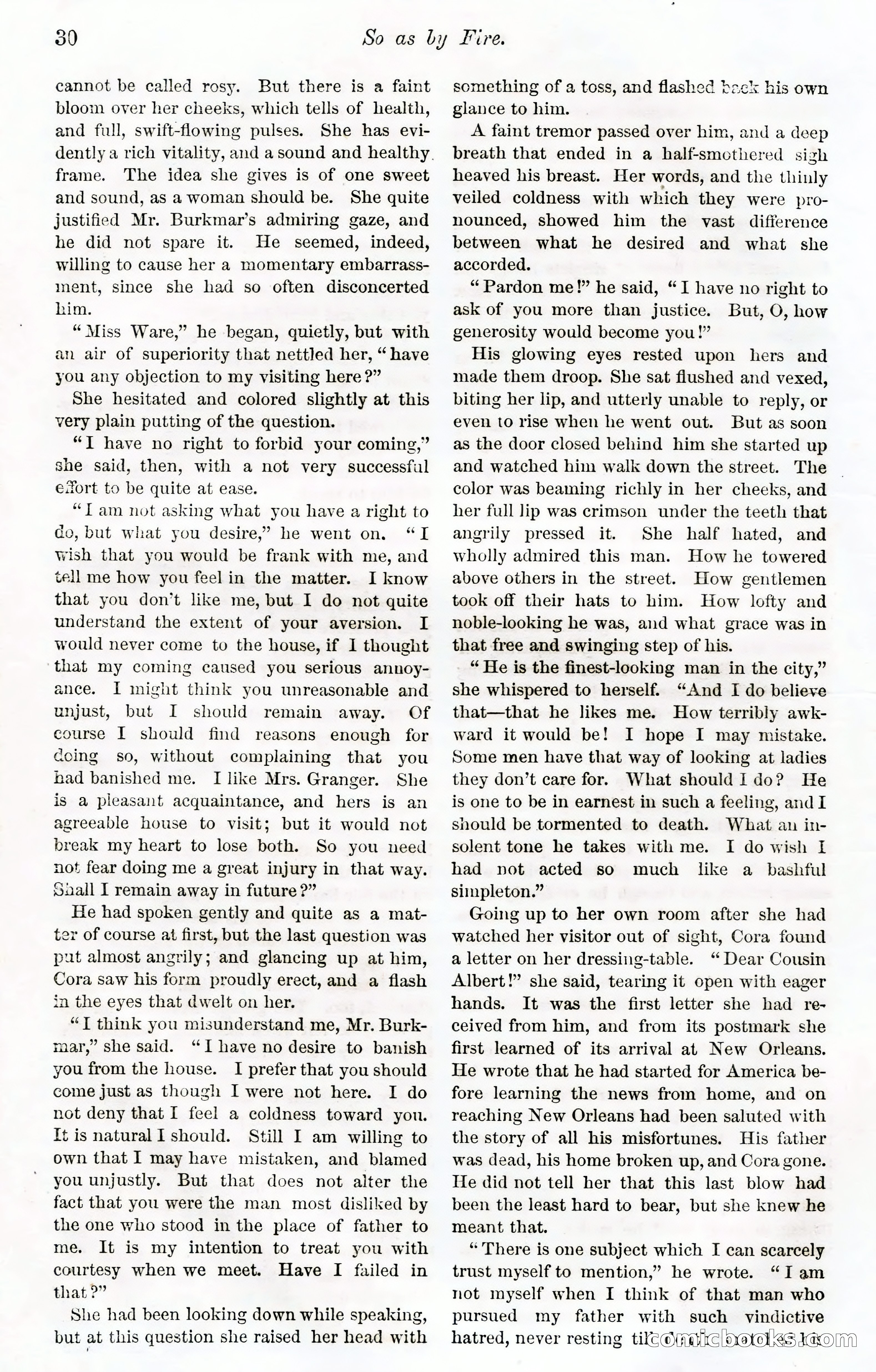
A restored page from Pulp Fiction, 1868. Page through the whole issue in the reader above.
📄 Transcribed text from this page (OCR, searchable)
Machine-transcribed from the original scan — historical spelling and the odd misread are preserved.
30 cannot be called rosy. But there is a faint bloom over her cheeks, which tells of health, and full, swift-flowing pulses. She has evi- dently a rich vitality, and asound and healthy. frame. The idea she gives is of one sweet and sound, as a woman should be. She quite justified Mr. Burkmar’s admiring gaze, and he did not spare it. He seemed, indeed, willing to cause her a momentary embarrass- ment, since she had so often disconcerted him. “Miss Ware,” he began, quietly, but with an air of superiority that nettled her, “have you any objection to my visiting here ?” She hesitated and colored slightly at this very plain putting of the question. “Y have no right to forbid your coming,” she said, then, with a not very successful eZort to be quite at ease. “Tam not asking what you have a right to co, but what you desire,” he went on. “I Wish that you would be frank with me, and tell me how you feelin the matter. I know that you don’t like me, but I do not quite understand the extent of your aversion. I would never come to the house, if I thought that my coming caused you serious annoy- ance. I might think you unreasonable and unjust, but I should remain away. Of course I should find reasons enough for coing so, without complaining that you had banished me. I like Mrs. Granger. She is a pleasant acquaintance, and hers is an agreeable house to visit; but it would not break my heart to lose both. So you need not fear doing me a great injury in that way. Saall I remain away in future ?” He had spoken gently and quite as a mat- ter of course at first, but the last question was put almost angrily; and glancing up at him, Cora saw his form proudly erect, and a flash in the eyes that dwelt on her. “JT think you misunderstand me, Mr. Burk- mar,” she said. “Ihave no desire to banish you from the house. I prefer that you should come just as though I were not here. I do not deny that I feel a coldness toward you. tis naturalI should. Still I am willing to own that I may have mistaken, and blamed you unjustly. But that does not alter the fact that you were the man most disliked by the one who stood in the place of father to me. It is my intention to treat you with courtesy when we meet. Have I failed in that 2” She had been looking down while speaking, but at this question she raised her head with So as by Lire. something of a toss, and flashed back his own glance to him. A faint tremor passed over him, and a deep breath that ended in a half-smothered sigh heaved his breast. Her words, and the thinly veiled coldness with which they were pro- nounced, showed him the vast difference between what he desired and what she accorded. “Pardon me!” he said, “I have no right to ask of you more than justice. But, O, how generosity would become you!” His glowing eyes rested upon hers and made them droop. She sat flushed and vexed, biting her lip, and utterly unable to reply, or even to rise when he went out. But as soon as the door closed behind him she started up and watched him walk down the street. The color was beaming richly in her cheeks, and her full lip was crimson under the teeth that angrily pressed it. She half hated, and wholly admired this man. How he towered above others in the street. How gentlemen took off their hats to him. How lofty and noble-looking he was, and what grace was in that free and swinging step of his. “ He is the finest-looking man in the city,” she whispered to herself. “And I do believe that—that he likes me. How terribly awk- ward it would be! I hope I may mistake. Some men have that way of looking at ladies they don’t care for. What should ldo? He is one to be in earnest in such a feeling, and I snould be tormented to death. What an in- solent tone he takes with me. I do wish I had not acted so much like a _ bashful simpleton.” Going up to her own room after she had watched her visitor out of sight, Cora found a letter on her dressing-table. ‘“ Dear Cousin Albert!” she said, tearing it open with eager hands. It was the first letter she had re- ceived from him, and from its postmark she first learned of its arrival at New Orleans. He wrote that he had started for America be- fore learning the news from home, and on reaching New Orleans had been saluted with the story of all his misfortunes. His father was dead, his home broken up, and Cora gone. He did not tell her that this last blow had been the least hard to bear, but she knew he meant that. “There is one subject which I can scarcely trust myself to mention,” he wrote. “Iam not myself when I think of that man who pursued my father with such vindictive hatred, never resting tife@feric near 6S aon