
Pulp Fiction, 1868 · page 23 of 97
Ballou's Monthly Magazine, Vol. XXVII, No. 1 — page 23: what you’re looking at
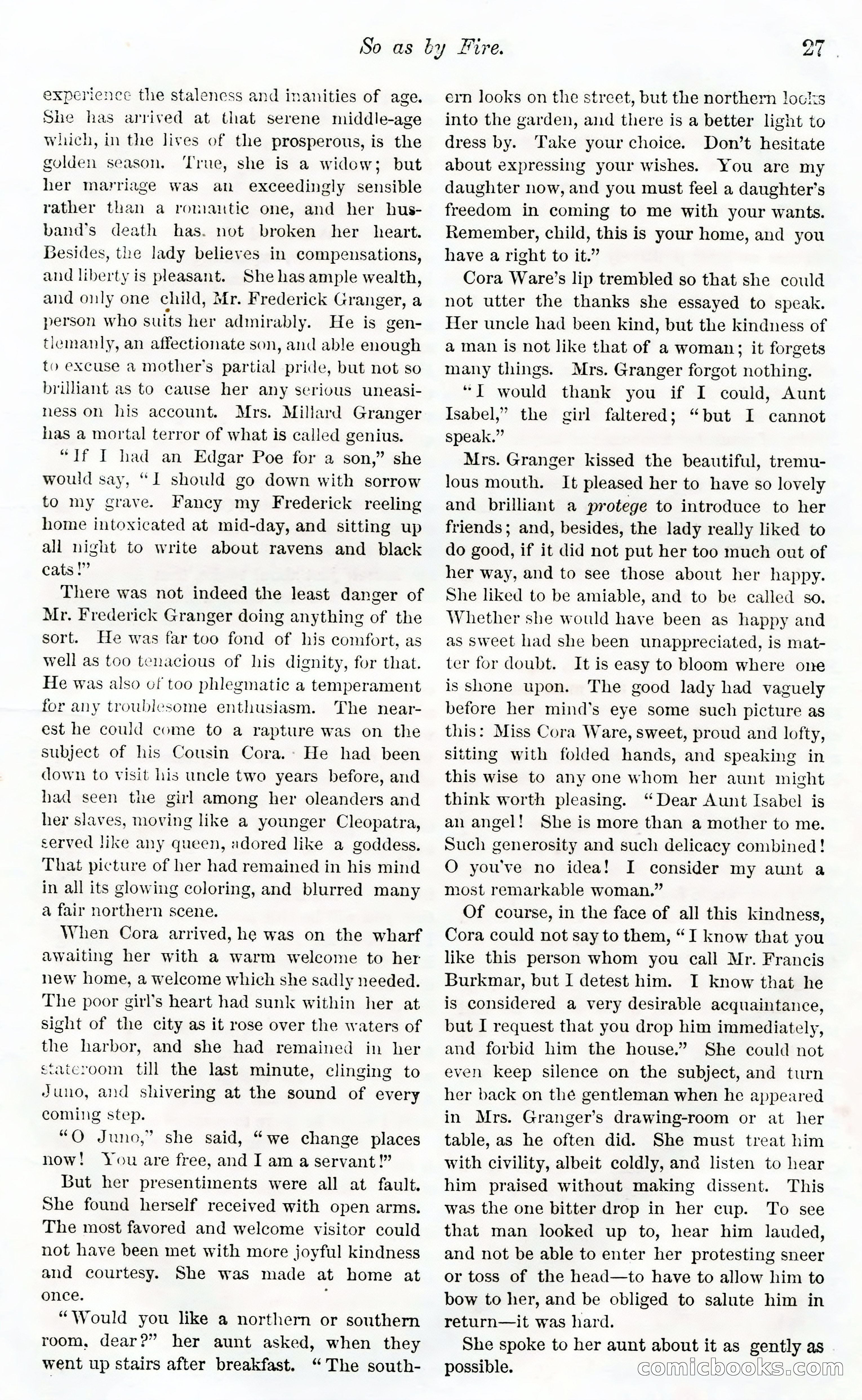
A restored page from Pulp Fiction, 1868. Page through the whole issue in the reader above.
📄 Transcribed text from this page (OCR, searchable)
Machine-transcribed from the original scan — historical spelling and the odd misread are preserved.
So as by Fire. experience the staleness and inanities of age. She has arrived at that serene middle-age which, in the lives of the prosperous, is the golden season. True, she is a widow; but her marriage was an exceedingly sensible rather than a romantic one, and her hbus- band’s death has. not broken her heart. Besides, the lady believes in compensations, and liberty is pleasant. She has ample wealth, and only one child, Mr. Frederick Granger, a person who suits her admirably. He is gen- tlemanly, an affectionate son, and able enough to excuse a mother’s partial pride, but not so brilliant as to cause her any serious uneasi- ness on his account. Mrs. Millard Granger has a mortal terror of what is called genius. “If I had an Edgar Poe for a son,” she would say, “I should go down with sorrow to my grave. Fancy my Frederick reeling home intoxicated at mid-day, and sitting up all night to write about ravens and black eats!” There was not indeed the least danger of Mr. Frederick Granger doing anything of the sort. He was far too fond of his comfort, as well as too tenacious of his dignity, for that. He was also cf too phlegmatic a temperament for any troublesome enthusiasm. The near- est he could come to a rapture was on the subject of his Cousin Cora.- He had been down to visit his uncle two years before, and had seen the girl among her oleanders and her slaves, moving like a younger Cleopatra, served like any queen, udored like a goddess. That picture of her had remained in his mind in all its glowing coloring, and blurred many a fair northern scene. When Cora arrived, he was on the wharf awaiting her with a warm welcome to her new home, a welcome which she sadly needed. The poor girl’s heart had sunk within her at sight of the city as it rose over the waters of the harbor, and she had remained in her statcroom till the last minute, clinging to Juno, and shivering at the sound of every coming step. “O Juno,” she said, “we change places now! You are free, and I am a servant!” But her presentiments were all at fault. She found herself received with open arms. The most favored and welcome visitor could not have been met with more joyful kindness and courtesy. She was made at home at once. : “Would you like a northern or southern room, dear?” her aunt asked, when they went up stairs after breakfast. “The south- or a¢ ern looks on the street, but the northern locks into the garden, and there is a better light to dress by. Take your choice. Don’t hesitate about expressing your wishes. You are my daughter now, and you must feel a daughter's freedom in coming to me with your wants. Remember, child, this is your home, and you have a right to it.” Cora Ware’s lip trembled so that she could not utter the thanks she essayed to speak. Her uncle had been kind, but the kindness of a man is not like that of a woman; it forgets many things. Mrs. Granger forgot nothing. “I would thank you if I could, Aunt Isabel,” the girl faltered; “but I cannot speak.” Mrs. Granger kissed the beautiful, tremu- lous mouth. It pleased her to have so lovely and brilliant a protege to introduce to her friends; and, besides, the lady really liked to do good, if it did not put her too much out of her way, and to see those about her happy. She liked to be amiable, and to be called so. Whether she would have been as happy and as sweet had she been unappreciated, is mat- ter for doubt. It is easy to bloom where one is Shone upon. The good lady had vaguely before her mind’s eye some such picture as this: Miss Cora Ware, sweet, proud and lofty, sitting with folded hands, and speaking in this wise to any one whom her aunt might think worth pleasing. “Dear Aunt Isabel is an angel! She is more than a mother to me. Such generosity and such delicacy combined! O you've no idea! I consider my aunt a most remarkable woman.” Of course, in the face of all this kindness, Cora could not say to them, “I know that you like this person whom you call Mr. Francis Burkmar, but I detest him. I know that he is considered a very desirable acquaintance, but I request that you drop him immediately, and forbid him the house.” She could not even keep silence on the subject, and turn her back on the gentleman when he appeared in Mrs. Granger’s drawing-room or at her table, as he often did. She must treat him with civility, albeit coldly, and listen to hear him praised without making dissent. This was the one bitter drop in her cup. To see that man looked up to, hear him lauded, and not be able to enter her protesting sneer or toss of the head—to have to allow him to bow to her, and be obliged to salute him in return—it was hard. She spoke to her aunt about it as gently as possible. Comiclooks. corn