
Pulp Fiction, 1868 · page 17 of 97
Ballou's Monthly Magazine, Vol. XXVII, No. 1 — page 17: what you’re looking at
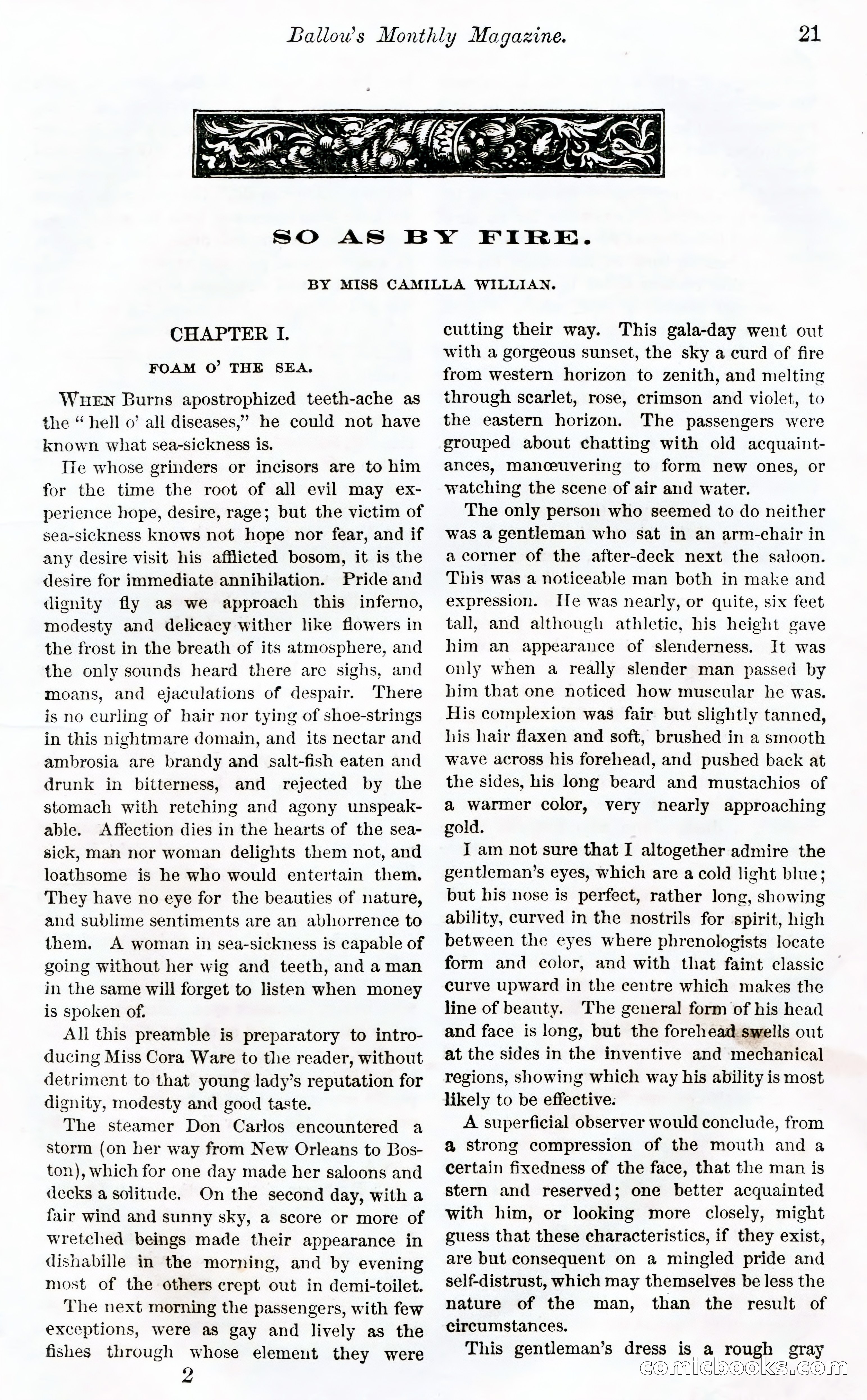
A restored page from Pulp Fiction, 1868. Page through the whole issue in the reader above.
📄 Transcribed text from this page (OCR, searchable)
Machine-transcribed from the original scan — historical spelling and the odd misread are preserved.
Ballou’s Monthly Magazine. CS 21 mh *S IS, TS) Re oe, "= ao SO AS BY FIRE. BY MISS CAMILLA WILLIAN. CHAPTER I. FOAM O’ THE SEA. WueEn Burns apostrophized teeth-ache as the “hell o’ all diseases,” he could not have known what sea-sickness is. He whose grinders or incisors are to him for the time the root of all evil may ex- perience hope, desire, rage; but the victim of sea-sickness knows not hope nor fear, and if any desire visit his afflicted bosom, it is the desire for immediate annihilation. Pride and dignity fly as we approach this inferno, modesty and delicacy wither like flowers in the frost in the breath of its atmosphere, and the only sounds heard there are sighs, and moans, and ejaculations of despair. There is no curling of hair nor tying of shoe-strings in this nightmare domain, and its nectar and ambrosia are brandy and salt-fish eaten and drunk in bitterness, and rejected by the stomach with retching and agony unspeak- able. Affection dies in the hearts of the sea- sick, man nor woman delights them not, and loathsome is he who would entertain them. They have no eye for the beauties of nature, and sublime sentiments are an abhorrence to them. A woman in sea-sickness is capable of going without her wig and teeth, and a man in the same will forget to listen when money is spoken of. All this preamble is preparatory to intro- ducing Miss Cora Ware to the reader, without detriment to that young lady’s reputation for dignity, modesty and good taste. The steamer Don Carlos encountered a storm (on her way from New Orleans to Bos- ton), which for one day made her saloons and decks a solitude. On the second day, with a fair wind and sunny sky, a score or more of wretched beings made their appearance in dishabille in the morning, and by evening most of the others crept out in demi-toilet. The next morning the passengers, with few exceptions, were as gay and lively as the fishes through whose element they were z cutting their way. This gala-day went out with a gorgeous sunset, the sky a curd of fire from western horizon to zenith, and melting through scarlet, rose, crimson and violet, to the eastern horizon. The passengers were grouped about chatting with old acquaint- ances, manoeuvering to form new ones, or watching the scene of air and water. The only person who seemed to do neither was a gentleman who sat in an arm-chair in a corner of the after-deck next the saloon. This was a noticeable man both in make and expression. He was nearly, or quite, six feet tall, and although athletic, his height gave him an appearance of slenderness. It was only when a really slender man passed by him that one noticed how muscular he was. His complexion was fair but slightly tanned, his hair flaxen and soft, brushed in a smooth wave across his forehead, and pushed back at the sides, his long beard and mustachios of a warmer color, very nearly approaching gold. I am not sure that I altogether admire the gentleman’s eyes, which are a cold light blue; but his nose is perfect, rather long, showing ability, curved in the nostrils for spirit, high between the eyes where phrenologists locate form and color, and with that faint classic curve upward in the centre which makes the line of beauty. The general form of his head and face is long, but the forehead swells out at the sides in the inventive and mechanical regions, showing which way his ability is most likely to be effective. A superficial observer would conclude, from a strong compression of the mouth and a certain fixedness of the face, that the man is stern and reserved; one better acquainted with him, or looking more closely, might guess that these characteristics, if they exist, are but consequent on a mingled pride and self-distrust, which may themselves be less the nature of the man, than the result of circumstances. This gentleman’s dress is a rough gra connicloooks. corn