
Pulp Fiction, 1868 · page 13 of 97
Ballou's Monthly Magazine, Vol. XXVII, No. 1 — page 13: what you’re looking at
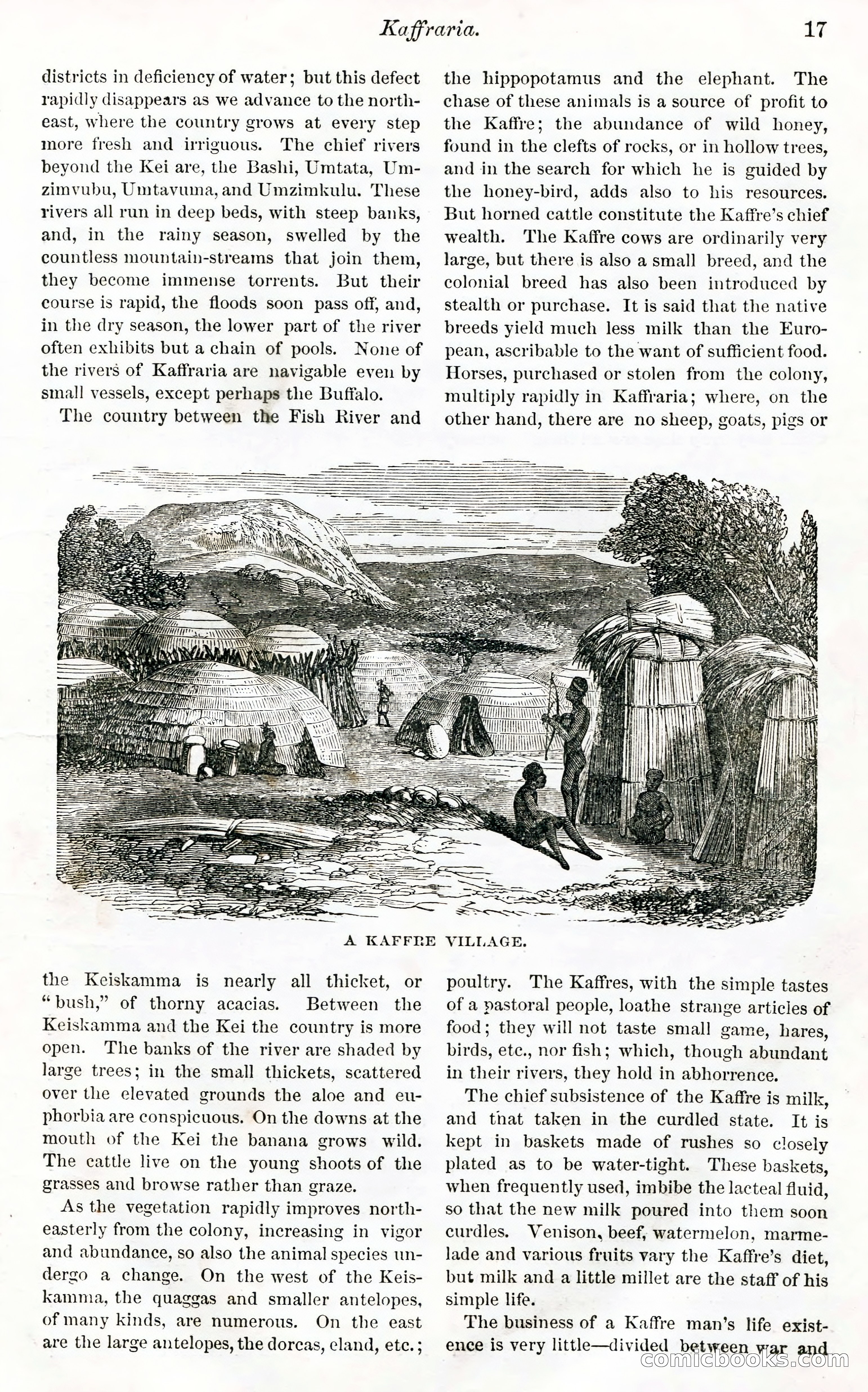
A restored page from Pulp Fiction, 1868. Page through the whole issue in the reader above.
📄 Transcribed text from this page (OCR, searchable)
Machine-transcribed from the original scan — historical spelling and the odd misread are preserved.
Kaffraria. districts in deficiency of water; but this defect rapidly disappears as we advance to the north- east, where the country grows at every step more fresh and irriguous. The chief rivers beyond the Kei are, the Bashi, Umtata, Um- zimvubu, Umtavuma, and Umzimkulu. These rivers all run in deep beds, with steep banks, and, in the rainy season, swelled by the countless mountain-streams that join them, they become immense torrents. But their course is rapid, the floods soon pass off, and, in the dry season, the lower part of the river often exhibits but a chain of pools. None of the rivers of Kaffraria are navigable even by small vessels, except perhaps the Buffalo. The country between the Fish River and 17 the hippopotamus and the elephant. The chase of these animals is a source of profit to the Kaffre; the abundance of wild honey, found in the clefts of rocks, or in hollow trees, and in the search for which he is guided by the honey-bird, adds also to his resources. But horned cattle constitute the Kaffre’s chief wealth. The Kaffre cows are ordinarily very large, but there is also a small breed, and the colonial breed has also been introduced by stealth or purchase. It is said that the native breeds yield much less milk than the Euro- pean, ascribable to the want of sufficient food. Horses, purchased or stolen from the colony, multiply rapidly in Kaffraria; where, on the other hand, there are no sheep, goats, pigs or HTT ATTN Pe TT : oN \\ \\\ \ LMT Uf - T Te Hi Y ‘, “HTT Ii AS i A KAFFRE VILLAGE. the Keiskamma is nearly all thicket, or “bush,” of thorny acacias. Between the Keiskamma and the Kei the country is more open. The banks of the river are shaded by large trees; in the small thickets, scattered over the elevated grounds the aloe and eu- phorbia are conspicuous. On the downs at the mouth of the Kei the banana grows wild. The cattle live on the young shoots of the grasses and browse rather than graze. As the vegetation rapidly improves north- easterly from the colony, increasing in vigor and abundance, so also the animal species un- dergo a change. On the west of the Keis- kamma, the quaggas and smaller antelopes, of many kinds, are numerous. On the east are the large antelopes, the dorcas, cland, ete. ; poultry. The Kaffres, with the simple tastes of a pastoral people, loathe strange articles of food; they will not taste small game, hares, birds, ete., nor fish; which, though abundant in their rivers, they hold in abhorrence. The chief subsistence of the Kaffre is milk, and that taken in the curdled state. It is kept in baskets made of rushes so closely plated as to be water-tight. These baskets, when frequently used, imbibe the lacteal fluid, so that the new milk poured into them soon curdles. Venison, beef, watermelon, marme- lade and various fruits vary the Kaffre’s diet, but milk and a little millet are the staff of his simple life. The business of a Kaffre man’s life exist- ence is very ittle—divided between war