
Pulp Fiction, 1930 · page 82 of 100
Air Wonder Stories, May 1930 — page 82: what you’re looking at
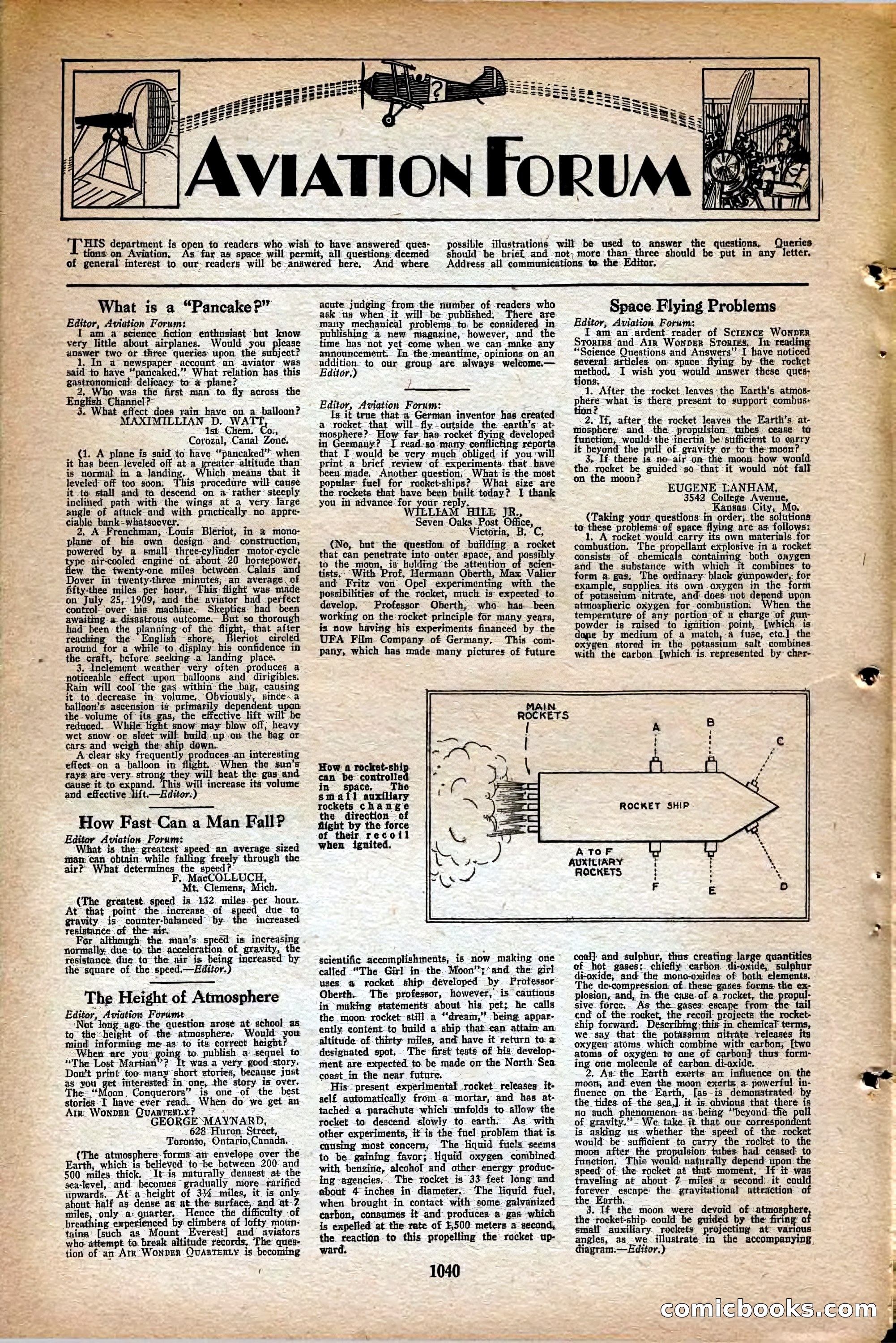
A restored page from Pulp Fiction, 1930. Page through the whole issue in the reader above.
📄 Transcribed text from this page (OCR, searchable)
Machine-transcribed from the original scan — historical spelling and the odd misread are preserved.
THs department is open to readers who wish to have answered ques: tions: on Aviation, As far as space. will permit, alli questions deemed shoul of general interest to our-readers will be answered here, And where What is a “Pancake?” Editor, Aviation Forum: Tam a science fiction enthusiast but Imow very little sbout airplanes. Would you please duipawer two ar titee queries: upon the subject? 1, In a newspaper account an aviator” was said to have “pancaked.” What relation has this gastronomticnl: delicacy to x plane? 2,-Who was the first man to fly across the English Channel?- > $. What effect does rain: brave on a. balloon? MAXIMILLIAN D, 1st- Chem, Co:, Corozal, Canal Zone. is snid to have “pancaked* when has been_leveled off at-a Het altitude than landing. Which meana that it 0 soon. * procedure will cause it-ta stall and to descend on a rather steeply inclined path with the wings at a very. large sgt ve attnek-and with practically no. appre- ciahle eS ERG ai 2, & Frenchman, Louis Bleriot, in mono- plane of own design and construction, powered by a emall. three-cylinder motor-cycle type -nir-cooléd engitié of about -20 horsepower, lew the twenty-one miles between Calais and Dover in twenty-three minutes, an average of fifty-thee miles. ee hour, ‘This flight was- made on July 25,°1909, arid the aviator bad ect control ‘over. his machine. Skepti¢s- had been awaiting-a- disastrous outcome. had been the planning of, the: uu es thit after reaching the English ~ shore, eriot circled. around for a while to display his confidence in the craft, before. seeking .a landing place. 3, Inclement weather very often produces a noticeable effect upon balloons and. dirigibles. Rain will cool ‘the gas-within the bag, causing it to decrease in- volume, Obviously, since. a balloow’s ascension ix primneily dependent the-volume of its-gas, the’ effective lift wilt be reduced. While light snow may blow. off, heavy wet stiow-or. sldet wil build np on the bag or cars and weigh the ship down. Avclear sky frequently produces-.an interesting effect an a balloon in it, “When the sun's rays. are-very strong they will heat the gas and cause it to expand. This will increase ite volume and effective Jift—Baditor.) How Fast Can a Man Fall? Editor Aviation. Forum: = What is the: greatest speed nn average sized mam can obtain: while freely through the air? What determines the sperd? B,. MacCOLLUCH, Mt. Clemens, Mich, (The grentest. speed is 132, miles. hour. At iat) -peant the surcreese xt eed due to gravity. is- ‘counter-balan Ca Tesistince of the air, oom ‘ For although, the man’s: speed is: increasing normally. due-to: the acceleration of gravity, the resistance due to- the uir is being increased’ by fhe square of the speed. Editor.) The Height of Atmosphere Editor, Aviation Forime Not Jorig-ago-the question arose at school. as to. the height of the itmosphere, Would you tind) informing meas to its correct height When-are- you Api to, publish 9 xequel to “The Lost Martian’? It was. a-very good story. Dor't print too many short stories, becanse just 28 you get interested: in one, the story is over, The. “Moon, Conquerors” is one of the best stories I have-ever rend. When do we get an Arm Wonper QvanrenLy? GEORGE MAYNARD, 628: Huron Street, Toronto, Ontario,Canada, (The- atmosphere forma. am envelope over the Earth, which is beleved to-be between-200.and 500 miles thick, It-is naturally densest at the sea-favel, and becomes gradually more rarified 1 rds. At a-height of 3% miles, it is only ahowt half as dense ag-at the surface, and at-? miles, only a» quarter. Hence the difficulty of brenthing enced by climbers of lofty moun- tains: [such ag” Mount Everest] and aviators who: attempt to: break altitude records, ‘The ques. tion of an Am Worver Quaatenty is becoming ' mies at se 3B) Pp wt so thorough- Address all commit acute judging from the number of readers who ask us when it will be published, There are many mechanical problema to be considered in publishing “@ new magazine, however, and the time has “not yet come when we can make any announcement. In the meantime, opinions on an pi to our group are always welcome.— ry Editor, Aviation Forum: _ Ts it true that a-German inventor has created a rocket that will- fly -otttside the--earth’s: at- mosphere? How far. has rocket flying. developed in Germany? IT read-so ‘many-conflicting reports that T- would: be very much obliged “if you will rint a brief review ‘of- experiments. that have teen sande, Another question, What is the most poptlar fuel for rocket-ships? What size are the rockets that have been built today? I thank you in advance for your reply. Seven Onks Post Office, Victoria, B.C, (No, but the question of building a rocket that can penetrate into outer space, and possibly to the moon, ix hulding the attention of scien+ tists“ With: Prof, Hermann Oberth, Mam Valier and Fritz von Opel experimenting with the ponsibilities of the rocket, much: is: expected to develop. Professor Oberth,; who hasbeen working on the rocket-principle for many years, is now having his experiments financed by the UPA Film Company of Germany. This com- pany, which has made many pictures of future How a mache eSB: can be controlle in ace, The small a rockets change the direction of light by the force of their recoil when ignited. scientific accomplishments, is now making one called "The Girl in the..Moon”;/and the girl uses. @ rocket ship: developed by. Protessor Oberth, THe professor, however, is cautious in muaking etatemerits about his pet; Ke calls the moon rocket stil a “dream,” being appar- ently content to build a ship that-can’ attain am altitude: of thirty: miles, and have it return to a designated spot, The first teste of his develop- ment are expected -to be made om the North Sea coast_in the near future. His present experimental rocket releasea it- self automatically from.a mortar, and has at- tached’ a parachute which unfolds to-allaw the rocket to descend slowly to earth. As with other experiments, it is the: fuel problem that is causing most concerny The Hquid fucls seems to be gaining favor; liquid oxygen combined with berizirie, alcohol _and other energy produc- ing ‘agencies, The rocket is 33 feet long: and about 4 inches in- dinmeter,. The Hguid fuel, when brought in contact with some galvanized carbon, consumes it and produces a gas which is expelled at the tate of £500: meters a _secand, the. reaction to this propelling the rocket up- 1040 possible illustrations will be used to answer the questions, id be brie£ and not, more’ than three should be put in any letter, lo Queries ions to the Editor, Space. Flying Problems Editor, Aviation. Forum: T-am- an ardent-reader of Scrence Wonnen Stores and Arr Wonver Sroares,. In “Science Questions and Answers” “I have noticdd. several articles on spnce flying. by the rocket wethed I wish you would answer these ques; ions, 1. After the rocket leaves the Earth's atmos- phere what is there present to support combs jn 2. Té, after the rocket leaves the Earth's: at- mosphere: and the propulsion: tubes cease ta function, would: the ‘inertia he stifficient to oarry it beyond: the pull of- gravity or to the moon? 3, If there 16: no air on the moon how: would. the rocket be gnided=s0-that-it would not full on the moon? EUGENE LANHAM, 3542 College Avenue, : .. ; Kansas City, Mo. (Taking your questions in order, the solutions to these -problems-of space fi ar¢ as. follows: 1, A rocket would carry its own materials for combustion, ‘The propellant explosive in a rocket consists, of chemicals i both ‘omygen and ‘the substance- with which combines” to form a gas, The ordinary: black gunpowder, for example, supplies its own oxygen in the form of potassium nitrate, and does: not epee ‘upon atmospheric. oxygen’ for combustion en the temperature of any portion of w Speen ee owder ig raised to ignition. point, [which is. lage by medium of o match, a fuse, eto.] the exygen stored im the potassium galt. combines with the carbon [which is represented by’ cher- A TOF AUXILIARY ROCKETS n----aef] E chiefly earhon. di-cmide, sulphur di-oxide, and the mono-oxides of both elements, The de-compression: of. these gases. forms the ex- plosion, and, in. the case-of a rocket, the propul- sive. force, As the-gases escape from the tail end of the rocket, the recoil: projects the rocket ehip forward. Di this in. chemicaF terms, we. say that the potissmm nitrate releases its oxygen atoms which combine with carbon; [two atoms of oxygem to one of carboud thus form- ing one molecule of carbon di- 2, As the Earth exerts an influence on the moor, and even the moon exert: a powerful. in- finence on the Earth, [as-is demonstrated by the tides ofthe sea,] it is obvious that there ia na such phénomenon- as heing “beyond-the pull of gravity.”— We. take ft that our ea eared it is asking us whether the speed of the rocket would: be- sufficient to carry the rocket to the moon after: thé propulsion. tubes had ceased: to function, This would naturally depend: upon: the speed of the rocket at that moment, If it was traveling at ahout 7 miles a second) it could forever. cacore the. gravitational! attraction of je. I Le 3. If the moon were devoid of atmosphere, the ‘tocket-stiip. could be guided by the firing of small auxiliary rockets projecting at various angles, as we illustrate in the accompanying, diagram.—Editor,) conll and sulphur, thus creating 1 r quantitics of hot Faaent ton siaee