
Pulp Fiction, 1930 · page 69 of 100
Air Wonder Stories, May 1930 — page 69: what you’re looking at
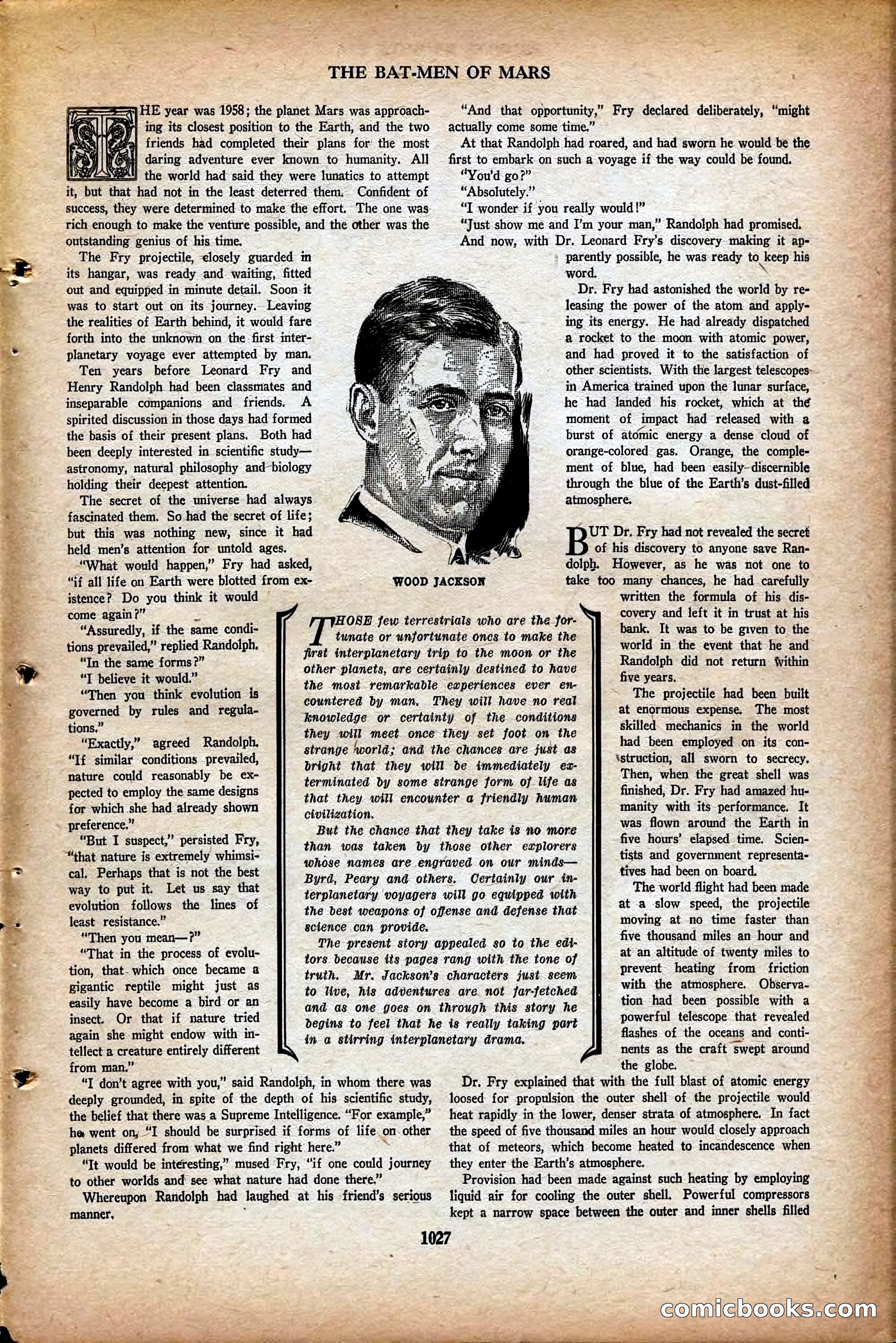
A restored page from Pulp Fiction, 1930. Page through the whole issue in the reader above.
📄 Transcribed text from this page (OCR, searchable)
Machine-transcribed from the original scan — historical spelling and the odd misread are preserved.
HE year was 1958; the planet. Mars. was approach- ing its closest position to the Earth, and the two =| friends had completed their plans for’ the most daring adventure ever mown to humanity. All NS: the world had said they were lunatics to attempt it, but that had not in the least deterred them, Confident of success, they were determined:to make the effort. The one was rich enough to take the venture possible, and the other was the outstanding genius of his time. The Fry projectile, elosely guarded: in its hangar, was ready and waiting, fitted out and equipped in minute detail, Soon-it was to. start out on its journey. Leaving the realities of Earth behind, it would fate forth into the unknown on the first inter- planetary yoyage ever attempted by man, Ten years before Leonard Fry and Henry Randolph had been classmates and inseparable cdmpanions and friends. A spirited discussion in those days had formed the basis of their present plans. Both had been deeply interested in scientific study— astronomy, natural philosophy and-biology holding their deepest attention. The secret of the universe had always fascinated them. So-had the secret of life; but this was nothing new, since it had held- men’s attention for untold ages. "What would happen,” Fry had asked, “tf all life on Earth were blotted from ex- istence?, Do you think it would © THE BAT-MEN OF MARS = WOOD JACKSON “And that opportunity,” Fry declared deliberately, “might actually come some time.” At that Randolph had roared, and had sworn he would-be the first to embark: on such a voyage if-the way: could be found. "You'd go ” “Absolutely.” “T wonder if you really would!” “Just show me and I’m your man,” Randolph:had promised. And now, with Dr. Leonard Fry’s discovery making it ap- parently possible, he was ready to eer his word, Dr. Fry had astonished the world by re- leasing the power of the atom and apply- ing its energy. He had: already dispatched a_rocket to the moon. with atomic power, and had: proved it to the satisfaction of other scientists, With the largest telescopes in America trained upon the lunar surface, he had Janded his. rocket, which at thé moment of impact had released with a burst of atomic energy a dense cloud of orange-colored gas. Orange, the comple- ment of blue, had been easily—discernible through the blue of the Earth’s dust-filled atmosphere, UT Dr. Fry had not revealed the secret of his discovery to anyone save Ran- dolph. However, as he was not one to take too many chances, he had carefully written the formula of his dis- come: again?” “Assuredly, if the same condi- tions prevailed,” replied Randolph, “In the same forms?” “I believe it would.” “Then you think evolution is governed by rules and regula- tions,” ‘Fxactly,” agreed Randolph, “Tf similar conditions prevailed, nature could reasonably be ex- pected to employ the same designs for which she had already shown ~ preference,” “But I suspect,” persisted Fry, “that nature is ‘extremely whimsi- cal, Perhaps that is not the best way. to put it, Let us say that evolution follows the lines of least resistance.” “Then you mean—?” “That in the process of evolu- tion, that- which once became a gigantic reptile night just as easily have become a bird or an insect. Or that if nature tried again she might endow with in- tellect a creature entirely different from man.” HOSE few terrestrials who are the for- timate or unfortunate ones. to make the first interplanetary trip to the moon or the other-planets, are certainly destined to have the most remarkable ewperiences ever en- countered by man, They will have-no real Knowledge or certainty of the. conditions they aolll meet once they set foot. on the strange hworld; and the chances are just as bright that they will be immediately ea- terminated by some strange form oj life as that they avill encownter a friendly human civilization, But the chance that they take is no more than. was taken by those other explorers whose names are engraved on our minds— Byrd, Peary and others. Certainly our in- terplanetary. voyagers will go equipped with the best weapons: of offense and defense that science can provide. The present story appealed so to the edi- tors. because tts pages rang. with the tone of truth. Mr. Jackson's characters just seem to Uve, his adventures are. not far-fetched and as one goes on through this story he begins to feel that he ts really taking part ina stirring interplanetary drama. covery and left it in trust at his bank, It was to be given to the world in the event that he and Randolph did not return: fithin five years, The: projectile had been built at enornious expense, The most skilled: mechanics in the world had been employed on its’ con- ‘struction, all sworn to secrécy. Then, when the great shell was finished, Dr. Fry had amazed hu- manity with its-performance. It was. flown around the Earth in five hours’ elapsed time. Scien- tists and government representa- tives had been on board. The world-flight had been made at a slow speed, the projectile moving at no time faster than five thousand miles an hour and at-an altitude of twenty miles. to prevent- heating from friction with the attmosphere,. Observa- tion had been possible with a powerful. telescope that revealed flashes of the oceans and conti- nents as the craft swept around the globe, “J don’t agree with you,” said Randolph, in whom there was deeply grounded, in spite of the depth of his scientific study, the belief that there was a Supreme Intelligence, “For example,” he went on, “I should be surprised if forms of life on-other planets differed from what we find right here.” Z “Tt would be interesting,” mused Fry, “if one could journey to other worlds and see what nature had done there.” Whereupon Raridolph had laughed at his -friend’s serious manner, : Dr. Fry explained that with the full blast of atomic energy loosed: for propulsion the outer shell of the projectile would heat rapidly in the lower, denser strata of atmosphere, In fact the speed of five thousand miles an hour would closely approach that of meteors, which become heated to incandescence when they enter the Earth’s atmosphere. Provision had been made-against such heating by employing liquid air for cooling the outer shell, Powerful compressors kept a narrow space between the outer and inner shells filled 1027