
Pulp Fiction, 1930 · page 48 of 100
Air Wonder Stories, May 1930 — page 48: what you’re looking at
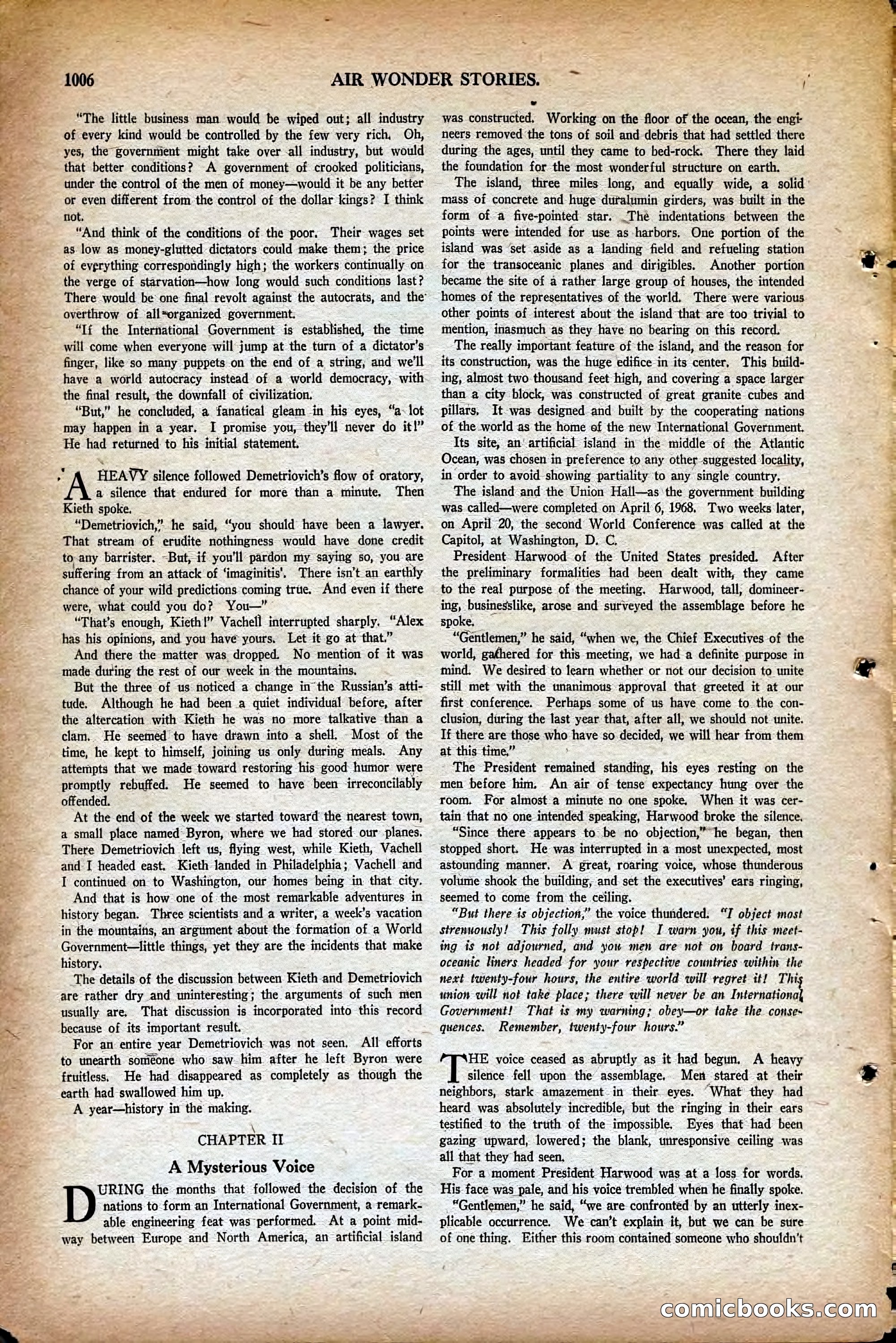
A restored page from Pulp Fiction, 1930. Page through the whole issue in the reader above.
📄 Transcribed text from this page (OCR, searchable)
Machine-transcribed from the original scan — historical spelling and the odd misread are preserved.
- 5m “The little business man would be wiped out; all industry of every kind would be controlled by the few very rich, Oh, yes, the government might take over all industry, but would _ that better conditions? A government of crooked politicians, tinder the control of the men of money—would it be any better or even different fromthe control of the dollar kings? I think not. “And think of the conditions of the poor. Their- wages set as. low as money-glutted dictators could make them; the price of everything correspondingly high; the workers continually on the verge of starvation—how Jong would such conditions last? There would be one final revolt against the autocrats, and the’ overthrow of all*organized government. “If the International Government is established, the time will come when everyone will:jump at the turn of a dictator's finger, like so many puppets on the end of a string, and we'll have ‘a world autocracy instead of a world democracy, with the final result, the downfall of civilization. “But,” he concluded, a fanatical gleam in his eyes, “a-lot may happen in a year. I promise you, they'll never my it!” He had returned to his initial statement. HEAVY silence fllowed Demetriovich’s flow of oratory, a silence that endured for more than a minute, Then Kieth spoke. “Demetriovich,”. he said, “you should have been a lawyer. That stream of erudite nothingness would have done credit to, any barrister. But, if you'll pardon my saying 50, you are suffering from an attack of ‘imaginitis', There isn’t an earthly chance of your wild predictions: coming true. And even if there were, what could you do? You—” “That’s enough, Kieth!” Vachell interrupted sharply, “Alex has his opinions, and you have yours. Let it go at that.” And there the matter was dropped. No mention of it was made. during the rest of our week in the mountains. But the three of us: noticed a change in the Russian’s atti- tude, Although he had been .a quiet individual before, after the altercation with Kieth he was no more talkative than a clam. He seemed’ to have drawn into a shell. -Most of the - time, he kept to himself, joining us only during meals. Any attempts that we made toward restoring his good humor were promptly rebuffed. He seemed to have been irreconcilably offended. At the end of the week we started toward the nearest town, a small place named-Byron, where we had stored: our planes. There Demetriovich left us; flying west, while Kieth, Vachell and-I headed east. Kieth-Janded in Philadelphia; Vachell and I continued on to Washington, our homes being in that city. And that is how: one of the most remarkable adventures in history began. Three scientists and a writer, a week's vacation in the mountaifis, an argument about the formation of a World Goyernment—little things, yet they are the incidents that make history. The details of the discussion between Kieth-and Demetriovich are rather dry and uninteresting; the arguments of such mien usually are, That discussion is incorporated into this record because of its important result. For an entire year Demetriovich was not seen, All efforts to unearth someone who saw him after he left Byron were fruitless, He had disappeared as completely as though the earth had-swallowed him up, A year—history in the making. \ CHAPTER II A Mysterious Voice URING the months that followed the -decision of the nations to form an International Government, a-remark- able engineering feat was performed. At a point mid- way between Europe and North America, an artificial_island AIR WONDER STORIES. - _ quences. was-constructed. Working on the floor of the ocean, the engi- neers removed the tons of soil and debris that had settled there during the ages, until they came to bed-rock. There they laid the foundation for the most wonderful structure on earth. The island, three miles long, and equally wide, a solid’ mass of concrete and huge ditalumin girders, was built in the form of a five-pointed star. The indentations between the points were intended for use as -harbors, One portion of the island was ‘set aside as a landing field and refueling station for the transoceanic. planes and dirigibles. Another portion became the site of a rather large group of houses, the intended homes of the representatives of the world. There were various other points of interest about the island that are too trivial to mention, inasmuch as they have no bearing on this record. The really important feature of the island, and the reason for its construction, was the huge edifice-in its center, This build- ing, almost two-thousand feet high, and covering a space larger than @ city block, was constructed of great granite cubes and pillars, It-was designed-and built by the cooperating nations of. the world as the home of the new International Government. Its site, an’ artificial island in the middle of the Atlantic Ocean, was chosen in preference to any other-suggested locality, in order to avoid-showing partiality to any single country, The island and the Union Hall—as ‘the goyernment building was called—were completed on April 6, 1968. Two weeks later, on April 20, the second’ World Conference was called at the Capitol, at Washington, D. C. President: Harwood- of the United States presided. After the preliminary formalities had been dealt with, they came to the real purpose of the meeting. Harwood, tall; domincer- ing, businesslike, arose and surveyed the assemblage before he spoke, “Gentlemen,” he said, “when we, the Chief Executives of the world, gathered for this meeting, we had a definite purpose in mind, We desired to learn whether or not our decision to unite still met with the nanimows approval that greeted it at our first conference. Perhaps some of us haye come to. the con- clusion, during the last year that, after all, we should not unite. If there are those who have so decided, we will hear from:them at this time,” , The President remained standing, his eyes resting on the men before him, An air of tense expectancy hung over the room. For almost a minute no one spoke, When it:was cer- tain that no one-intended speaking, Harwood broke the silence. “Since there appears tobe no objection,”~he began, then stopped short. He was interrupted in a most unexpected, most astounding manner. A great, roaring voice, whose thunderous volume shook the building, and: sét the executives’ ears ringing, seemed to come from the ceiling. “But there is objection;” the voice thundered: “T object most strenuously! This folly must stop! I warn you, tf this meet- ing is not adjourned, and you men are-not on board trans- oceanic liners. headed for your respective countries within the next twenty-four hours, the entire: world will regret it! Thi: union will not take place; there will never be an Tyicvantionel Government! That is my warning; obey—or take the. conse~ Remember, twenty-four hours.” HE voice ceased as abruptly as it -had begun, A heayy silence: fell. upon the assemblage, Men stared at their neighbors, stark. amazement in their. eyes. “What’ they had heard was absolutely incredible, but the ringing in their ears testified to the truth of the-impossible, Eyes that had been gazing upward, lowered; the blank, unresponsive ceiling was all that they had seen, For. a: moment President Harwood was at a loss for words. His face was pale, and his voice trembled when he finally spoke. _ “Gentlemen,” he said, “we are-confrontéd by an utterly inex- plicable occurrence. We can’t explain it, but we can be stire of one thing. Either this room contained someone who shouldn't jeoks-com . r * oot me