
Pulp Fiction, 1930 · page 35 of 100
Air Wonder Stories, May 1930 — page 35: what you’re looking at
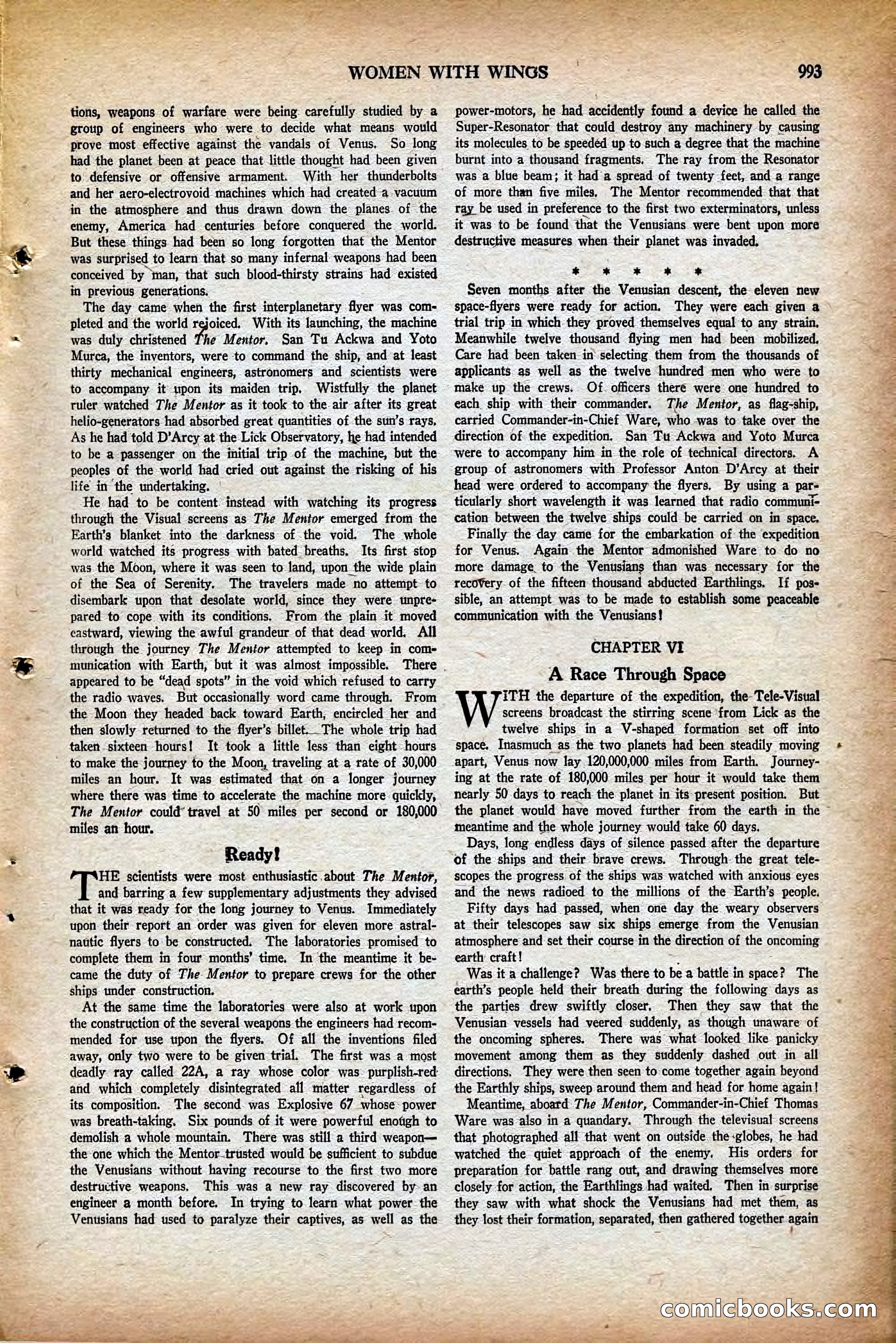
A restored page from Pulp Fiction, 1930. Page through the whole issue in the reader above.
📄 Transcribed text from this page (OCR, searchable)
Machine-transcribed from the original scan — historical spelling and the odd misread are preserved.
} tions, weapons. of warfare were being: carefully studied by a group of engineers who were to decide what means would prove most effective against the vandals of Venus. So long had ‘the planet been at peace that little thought had-been given to defensive or offensive armament. With her thunderbolts and her aero-electrovoid machines which had created-a vacuum in the atmosphere and thus drawn down the: planes. of the enemy, America had centuries before conquered the. «world. But these things had been so long forgotten that the Mentor was surprised to learn that so many infernal weapons had been conceived by , that such blood-thirsty strains had existed in previous generations. The day came when the first interplanetary flyer was com- pleted and the world rejoiced. With its launching, the machine was duly chtistened The Mentor, San Tu Ackwa and Yoto Murea, the inventors, were to command the ship, and at least thirty mechanical engineers, astronomers and scientists were to accompany it: tpon its maiden trip, Wistfully the planet ruler watched The Mentor as it took to the air after-its great helio-generators had absorbed great quantities of the stn’s rays, As he had told D'Arcy at the Lick Observatory, he had intended to be a passenger on the initial trip of the machine, but the peoples of the world had cried out against the risking of his life in the undertaking. | He had to be content’ instead with watching its progress through the Visual screens as The Mentor emerged ftom the Earth’s blanket into the darkness ofthe void. The whole world watched its progress with bated breaths, Its first stop was the Moon, where it was seen to land, upon the wide plain of the Sea of Serenity. The travelers made no attempt to disembark upon that desolate world, since they were tnpre- pared to’ cope with its conditions, From the plain it moved eastward, viewing the awful grandeur. of that dead world, All through the journcy The Mentor attempted to keep in com= munication with Earth; but it was almost impossible, There . appeared to he “dead spots” in the void which refused to carry the radio waves, But occasionally. word came through. From the Moon they headed back toward Earth, encircled her and then slowly returned ‘to the flyer’s billet_The whole trip had taken sixteen hours! It took a little less than eight hours ' to make the journey to the Moon, traveling at a rate of 30,000 miles an hour. It was estimated that on a longer journey where there was time to accelerate the machine more. quickly, The Mentor could“ travel at 50 miles per second or 180,000 miles an hour. Ready! HE scientists were most. enthusiastic, about The Mentor, and barring a few supplementary adjustments they advised that it was ready for the long journey to Venus. Immediately upon. their report an order was given for eleven more astral- nattic flyers to: be constructed, The laboratories promised to complete them in four months’ time, In the meantime it be- came the duty of The. Mentor to prepare crews for the other ships under construction. At the same. time the laboratories were also at work upon the construction of the several weapons the engineers had recom- mended for tse tpon the flyers. Of all the inventions filed away, only two were to be given trial. The first was a most deadly ray called 22A, a ray whose color was purplish-red and which completely disintegrated all matter regardless of its composition. The second. was Explosive 67 whose- power was breath-taking. Six pounds of it were powerful enofigh to demolish a whole mountain. There was still a third weapon— fhe-one which the Mentor-trusted would be sufficient. to subdue the Venusians without having recourse to the first two more destructive weapons, This was a new ray discovered by-an eigineer a month before, In trying to learn what power-the Venusians had used to paralyze their captives, as well as the WOMEN WITH WINGS power-motors, he had accidently found a device he called the Super-Resonator that could destroy any machinery by causing its molecules to be speedéd up to such a degree that the machine burnt into a thousand fragments. The ray from the Resonator was a blue beam; it hada spread of twenty feet, anda range of more than five miles, The Mentor recommended. that. that ray be used in preference to the first two exterminators, unless it was to be found that the Venusians were bent upon more destructive measures when their planet was invaded, * * * # & Seven months after the Venusian descent, the eleven new space-flyers were ready for action, They were each given a © trial trip in which: they proved themselves equal to any strain, Meanwhile twelve thousand flying men had been mobilized, Care had been taken-in‘ selecting them from the thousands of applicants-as well as the twelve hundred men who were to make up the crews. Of. officers there were one hundred to each. ship with their commander. The Mentor, as flag-ship, carried Commander-in-Chief Ware, who-was to take over the direction of the expedition. San Tu -Ackwa and Yoto Murca were to accompany him in the role of technical directors. A group of astronomers with Professor Anton D’Arcy. at their head were ordered to accompany the flyers, By using a par- ticularly short wavelength it was learned that radio communi- cation between the twelve ships could be carried on in space, Finally the day came for the embarkation of: the expedition for Venus. Again the Mentor admonished Ware to do no more damage to the Venusians than was necessary for the recovery. of the fifteen thousand abducted Earthlings. If pos- sible, an attempt was to be made to establish some peaceable communication with the Venusians! CHAPTER VI A Race Through Space ITH the departure of the expedition, the-Tele-Visual V V screens broadcast the stirring scene from Lick as the twelve ships in a V-shaped formation set off into space, Inasmuch as the two planets had been. steadily moving apart, Venus. now lay 120,000,000 miles from Earth. Journey- ing at the rate of 180,000 miles per hour it would take them nearly 50 days to reach the planet in its present position. But the planet wotld have moved further from the earth in the ~ meantime and the whole journey would take 60 days. Days, long endless days of silence passed after the departure ‘of the ships and their brave crews. Through. the great tele- scopes the progress of the ships was: watched with anxious: eyes and the news radioed to the millions of the Earth’s people. Fifty days had passed, when one day the weary observers at their telescopes saw six ships emerge from the Venusian atmosphere and set their course in the direction of the pocomiee earth’ craft! Was it a challenge? Was there to bea battle in space? The earth’s people held their breath during the following days as the parties drew swiftly closer, Then they saw that the Venusian- vessels had veered suddenly, as though unaware’ of the oncoming spheres. Thete was what looked like panicky movement among them as they suddenly dashed out: in all directions, They were then seen to come together again beyond the Earthly ships, sweep around them and head for home again! Meantime, aboard: The Mentor, Commander-in-Chief Thomas Ware was also in a quandary. Through the televisual screens that photographed. all that went on outside the+globes, he had watched the quiet approach of the enemy, His orders for preparation for battle rang out, and drawing themselves more closely for action, the Earthlings had waited. Then in surprise they saw with what shock the Venusians had met them, as they lost their formation, separated, then gathered together again