
Pulp Fiction, 1930 · page 25 of 100
Air Wonder Stories, May 1930 — page 25: what you’re looking at
A restored page from Pulp Fiction, 1930. Page through the whole issue in the reader above.
📄 Transcribed text from this page (OCR, searchable)
Machine-transcribed from the original scan — historical spelling and the odd misread are preserved.
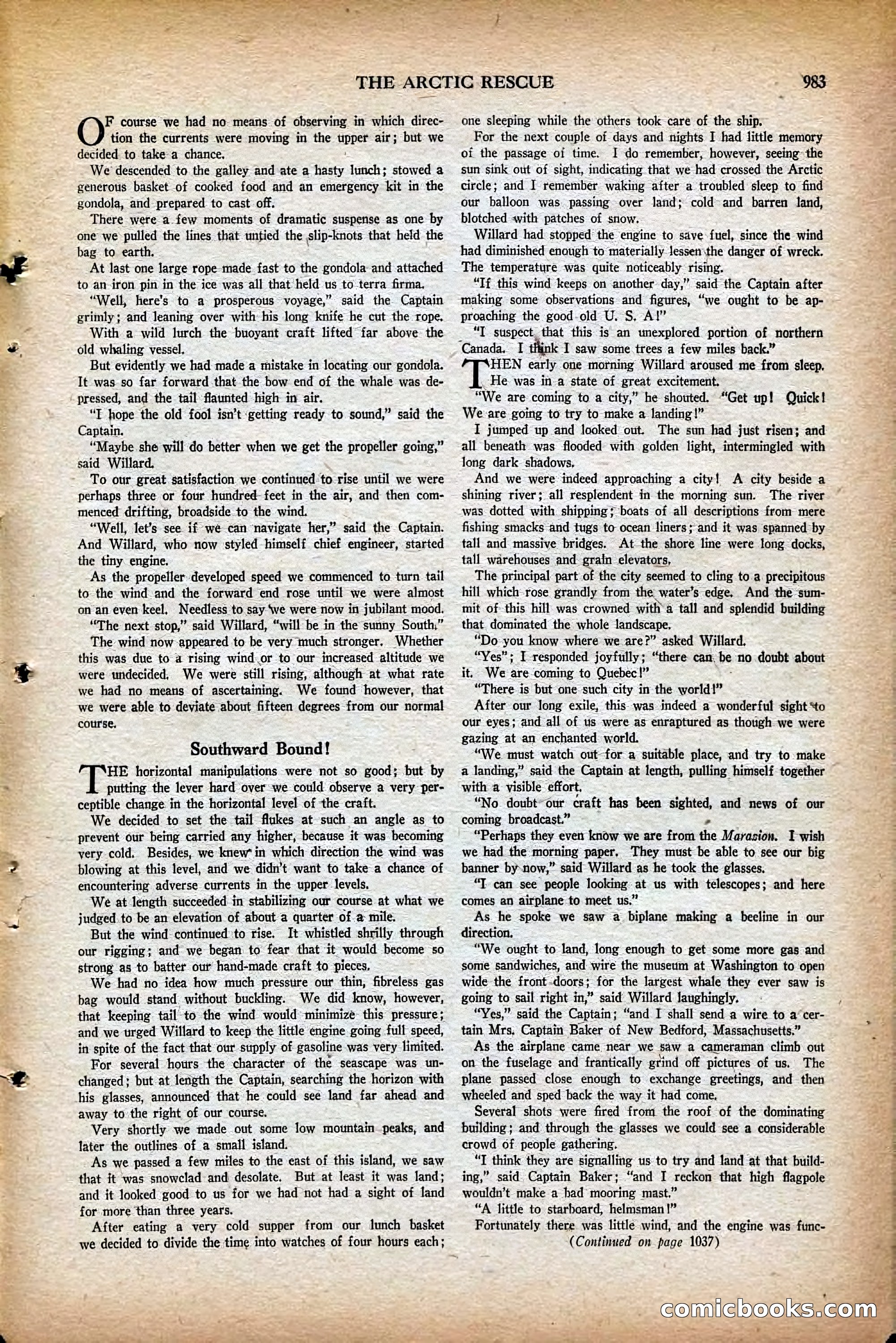
7 Oy + ‘ ht’) ed Lint ; sy THE ARCTIC RESCUE F course we had no- means- of observing in which direc- tion the currents were moving in the upper air; but we decided: to take-a chance. We descended to the galley and ate a hasty lunch; stowed a generous basket of cooked food and an emergency kit in’ the gondola, and prepared to cast off. There were a few moments of dramatic suspense as one by one we pulled the lines that untied the slip-knots that held the bag to. earth. At Jast one large rope-made fast to the gondola and attached to aniron pin in the ice was all that held us to-terra firma, “Well, fere’s to a prosperous voyage,” said the Captain grimly; and leaning over with his long knife he cut the rope. With a wild lurch the buoyant craft lifted “far above the old whaling vessel, But evidently we had made a mistake in locating our gondola. It was so far forward thatthe bow: end of the whale was. de- “pressed, and the tail flaunted high in air. “T hope the old fool isn’t «getting ready to sound,” said the Captain. “Maybe. she will do better when we get the propeller going,” said Willard, To our great satisfaction we continued ‘to.rise until we were perhaps three or four hundred feet in the air, and then com- menced drifting, broadside to the wind. “Well, let’s see if we-can navigate her,” said the Captain. And Willard, who now styled-himself. chief engineer, started the tiny: engine. As the propeller. developed speed we commenced to turn tail tothe wind and the forward end rose until we were almost onan even keel, Needless to say Wwe were now in jubilant mood. ‘The next stop,” said Willard, “will be in the sunny South,” The wind now appeared to be very much stronger. Whether this was due to a rising wind:or to our increased altitude we were undecided, We were still rising, although at what rate we had no means of ascertaining. We found however, that we were able to deviate about fifteen degrees-from our normal course, Southward Bound! HE horizontal manipulations-were not so good; but by putting the lever hard over we could observe a very per- ceptible change in the horizontal level of the craft. We decided to set the tail flukes at such an angle as to prevent our being carried any higher, because it was becoming yery cold. Besides, we knew in which direction the wind was blowing at this level, and we didi't want to take a chance of encountering adverse currents in the upper levels. We at length succeeded in stabilizing our course at what we judged. to be an elevation of about a quarter ofa mile. But the wind: continued to tise. It whistled shrilly through our rigging; and we began to fear that it would become ‘so strong as to batter our hand-made craft to pieces, We had no idea how much pressure our thin, fibreless gas bag would stand. without buckling. We did know, however, that keeping tail-to the wind would -minimize- this: pressure; and we urged Willard to keep the little engine going full speed, in spite of the fact that our supply of gasoline was very limited. For. several hours the character of the seascape was un- changed; but-at length the Captain, searching the horizon with his glasses, announced that-he could seé land far ahead and away to the right of our course, Very shortly we made out some low mountain peaks; and later the outlines of a small island. As we passed a few miles to the east of this island, we saw that it was snowclad and desolate. But_at least it was land; and it looked good to us for we had not had a sight of land for more than three years. After eating a very cold supper from our tunch basket we decided to divide the time into watches of four hours each; “Canada, I one sleeping while the others took care of the. ship. For the next couple of days and nights I had tittle memory oi the passage of time. I do remember, however, seeing the sun sink out of sight, indicating that we had crossed the Arctic circle; and I remember waking after a troubled sleep to find our balloon was. passing over land; cold- and barren land, blotched vith patches of snow, Willard had: stopped’ the engine to save-fuel, since the wind had diminished enough to materially Jessen: ithe danger of wreck. The temperature was quite noticeably rising. “Tf this wind keeps on another day,” said the Captain after making some observations and figures, “we ought to be ap- proaching the good.old U. S, A!” “T suspect. that this is an unexplored portion of northern ink I saw some trees a few miles back.” HEN early one morning Willard aroused me from sleep. He was in-a state of great excitement. “We are coming to a city,” he shouted. “Get up! Quick! Weare going to try to make a landing!” I jumped up and looked out. The sun had just risen; and all beneath was flooded: with golden light, intermingled with long dark shadows, And we were indeed approaching a city! A city beside a shining river; all resplendent in the morning sun. The river was. dotted with shipping; boats of all descriptions from- mere fishing-smacks-and tugs to ocean liners ;-and it was spanned:by tall and massive bridges. At the shore line were long docks, tall warehouses and grain elevators, The principal part of the city seemed to cling to a precipitous hill which: rose grandly from the water’s edge, And the sum- mit ofthis hill was crowned with’a tall and splendid building that. dominated the whole landscape. “Do: you know where we.are?” asked Willard. “Yes”; T-responded joyfully; “there can, be no doubt about it, We are coming to Quebec!” “There-is but one-such city inthe world!” After our long exile, this was indeed a wonderful sight Yo our eyes; and all of us were as enraptured as though we were gazing at an enchanted: world. “We must watch out-for a suitable place, and try to make a landing,” said the Captain at length, pulling himself together — with a visible effort. “No. doubt our craft has been sighted, and news of our coming broadcast.” “Perhaps they even know we are from the Marasion. T-wish we had the morning paper. They must be able to see our big banner by-now,” said Willard as he took the glasses. “T. can see people looking at us with telescopes; and here comes an airplane to meet us.” As he spoke we saw a biplane making a beeline in our direction. “We ought-to land, long enough to get some more gas-and some sandwiches, and wire the museum at Washington to open wide the front-doors; for the largest whale they ever saw is going to sail right in,” said Willard Jaughingly, “Yes,” said the Captain; “and I shall send a wire to a‘cer- tain Mrs, Captain Baker of New Bedford, Massachusetts.” As the airplane came near we saw a cameraman climb out on the fuselage and frantically grind off pictures of us. The plate passed close enough to exchange greetings, and then wheeled and sped back the way it had come, Several shots were fired from the roof of the dominating building; and through the- glasses we could see a considerable crowd of people gathering. “T think they are signalling us to try and land at that build- ing,” said. Captain Baker; “and I reckon that high flagpole wouldn’t make a had mooring mast,” “A little to starboard, helmsman !” Fortunately there was little wind, and the engine was func- (Continued on page 1037)