
Pulp Fiction, 1929 · page 81 of 97
Air Wonder Stories, December 1929 — page 81: what you’re looking at
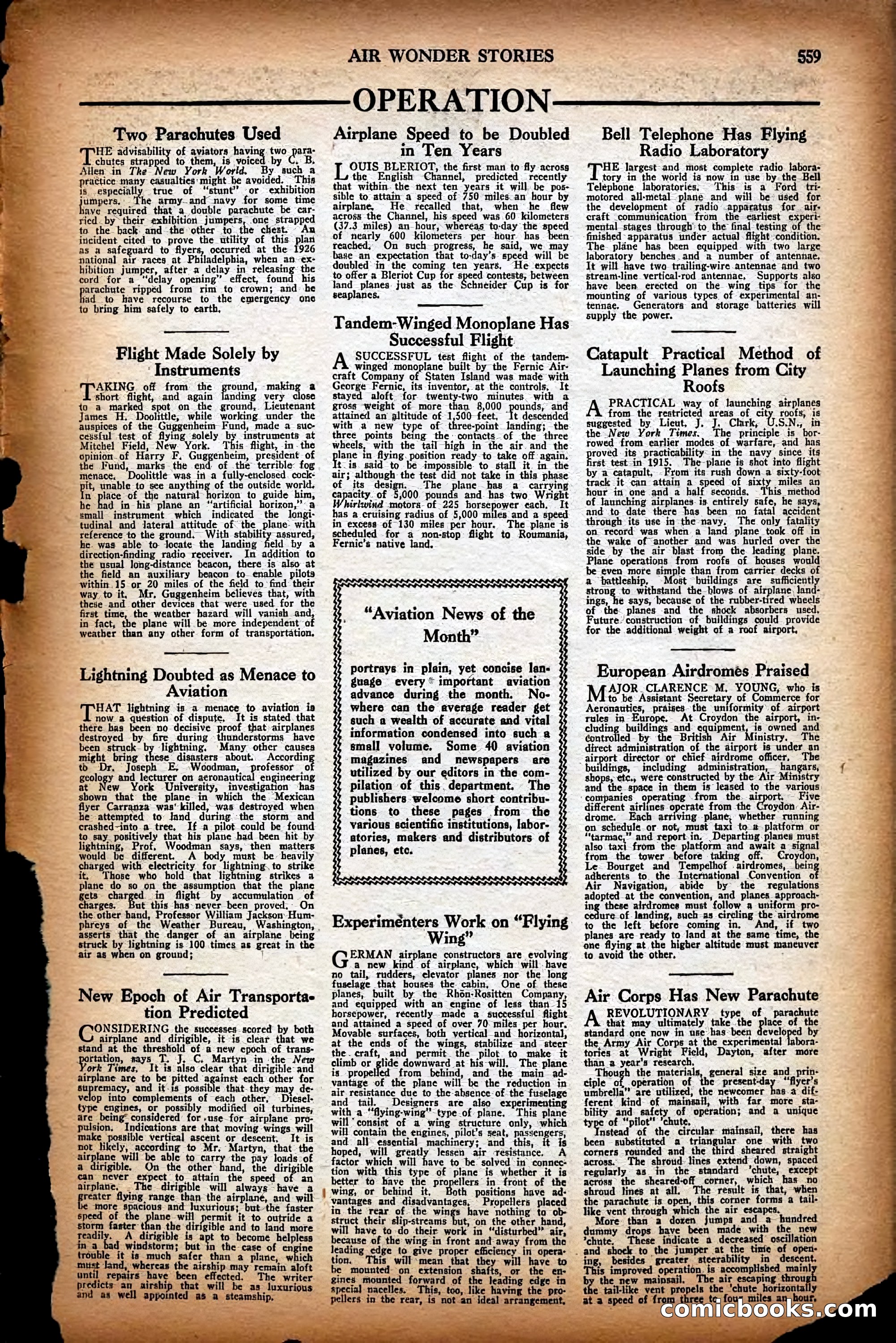
A restored page from Pulp Fiction, 1929. Page through the whole issue in the reader above.
📄 Transcribed text from this page (OCR, searchable)
Machine-transcribed from the original scan — historical spelling and the odd misread are preserved.
Two Parachutes Used HE advisability of aviators having two on chutes strap to them, is voiced by C. B, Allen in The- New York World. By such a practice many casualties ‘might be avoided, “This 18 especinily true of “stunt” or exhibition jumpers, he army—and“navy for some time inve required that a double parachute be car- ried. by~ their exhibition jumpers, one strapped to the back and the other to the chent. incident cited to prove the utility of this plan as a safeguard to flyers, occurred at the 1926 national air races at Philadelphia, when an ex- hibition jumper, after a delay in releasing the cord for a “delay opening” effect, found his eractece ripped from rim to crown; and he iid to have recourse to the emergency one to bring him safely to earth, Flight Made Solely by Instruments EASING. off from the ground, making a short ‘flight, and again Innding very close to a mark spat on the ground, Lieutenant James H. Doolittle, while worling under the auspices of the Guggenheim Fund, made a_suc- ceusful test of flying tolely by instruments at Mitchel Field, New. York. This flight, in. the opinion_of Harry F. Guggenheim, president of the Fund, marks the end of the terrible: fog menace. Doolittle wag in a fully-enclosed. cock- it, ymable to see anything of tha outside world, n place of the natural horizon to guide him, he had in-his plane an “artificial horizon,” a emall inétrument which indicated the Jongi- tudinal and lateral attitude of the plane: with reference to the ground. With stability assured, he. was able to Jocate the landing eld by a direction-finding radio receiver, In addition to the usual long-distance beacon, there is also at the field an auxiliary beacon to enable pilote within.15 or 20 miles. of the field to find: their way to it. Mr. Guggenheim believes that, with these -and other devices that were used for the first time, the weather hazard will vanish and, in fact, the plane will be. more independent of weather than any other form of transportation. Lightning Doubted as Menace to Aviation pp BAT. lightning is a menace to aviation io now a question of dispute, It is stated. that there has been no decisive proof that airplanes destroyed by. fire during thunderstorms have been struck ‘lightning. “Many other causes might bring these disasters nhout., Accordin tb Dr, Joseph E, .Woodman, -professor 0 geology and lecturer on aeronautical engineering at New York University, investigation has shown that the plane in wHich the Mexican flyer Carranza was‘ killed, was destroyed when he-attempted to Jand during.-the storm and crashed-into a tree, If-n pilot_could be found to say_povitively that his plane had been hit by lightning, Prof, Woodman says, then matters would be different. A body must be heavily charged with electricity for dightaini, to strike it, Those who hold that lightning strikes a plane do so on the assumption that the plane cts in flight by accummlation of arges, But this-has never been proved. On the other band, Professor William Jackson. Hum- phreys of the Weather Bureau, Washington, asserts that the danger of an airplane being struck by lightning is 100 times as great in the air as when on ground; 1 New Epoch of Air Transporta- tion Predicted fee SSIDERING the successes scored by both sirplane and dirigible, itis clear that we stand at the threstiold of a new epoch of trans- eS, gays T. J, C. Martyn in the New fork Times, It is also clear that dirigible and airplane are to be pitted against each other for remacy, and it-1s possible that-they may de- velop into complements of ench other, —Diesel- type engines, or possibly modified oil turbines, are being’ considered’ for -use-for airplane pro- pulsion, Indications are that moving wings: will make ‘possible vertical ascent or descent, It is not paces aecording to Mr, sarees pas Bie airplane able to curry the pay louds:o ae diriyible. On the other hand, the dirigible can never expect to attain the speed of an airplane, . The dirigible -will always have a frester flying range: than the airplané, and will more apenas. and Juxtrious; but-the faster speed of the plane will permit it to outride a storm faster than the dirigible and to land more ete A. dirigible is apt to become helpless in a bad windstorm; but in the case of engine trouble it is much safer than a plane, which mist land, whereas the airship may remain aloft until repairs have been effected. The writer predicts an airship that will be as luxurious and ax well appointed as a steamship, AIR WONDER STORIES OPERATION Airplane Speed to be Doubled in Ten Years 1 (Re BLERIOT, the first man to fly across the English Channel, predicted recently that within. the next ten years it will be pos- sible to attain. a speed of 750 miles.an hour by airplane, He. recalled that, when he flew acrogs-the Channel, his speed was 60 kilometers (37.3 miles) an_hour, whereas to-day the sper of nearly 600 kilomneters. per hour. has been reached, On such progress, he said, we may base an expectation that today’s speed will be doubled* in the coming ten yeurs, He ‘expects to offer a Bleriot Cup for sure contests, between land_ planes just as the Schneider Cup is for seaplanes. Tandem-Winged Monoplane Has Successful Flight A SUCCESSFUL test flight of the tandem- winged mougplane buflt by the Fernic Air- craft Company of Staten Island was made with George Fernic, ita inventor, st the controls, It stayed aloft for twenty-two minutes with a gross -weight of more than 8,000 founds, and attained an gltitude of 1,500-feet, ‘It descended with a new type of three-point Ianding; the three points being the contacts of the three wheels, with the tail high in the air and the plone in flying. position ready to take off again. tis. said to be impossible to stall it, in the air; although the test did not take in this phase of its Senige The enlace bas a carrying capacity. of 5,000 pounds and. has two Wright hirlwind motora-of-225 horsepower each, It has a cruising radius of 5,000 miles and a speed in excesa of 130 miles per hour. The plane is scheduled for a non-stop: flight to Roumanis, Fernic’s native land. “Aviation News of the Month” portrays in plain, yet concise lan guage every important aviation advance during the month. No- where can the average reader get such a wealth of accurate and vital information condensed into such a small volume. Some 40 aviation magazines and newspapers are utilized by our editors in the com- pilation of this department. The publishers-welcome short contribu- tions to these pages from the various scientific institutions, Iabor- atories, makers and distributors of planes, ete. Cee | at Experimeénters Work on “Flying Wing” ERMAN airplane constructors are evolving a new kind of airplane, which will have no tail, rudders, elevator planes nor the long fuselage that houses the cabin, One of these planes, built by the Rhén-Rositten Company, and equipped with an engine of less than 18 horsepower, recently -made a successful fight and attained a speed of over 70° miles per hour. Movable surfaces, both yertical_and~ horizontal, at the ends of the wings, stabilize and steer the. craft, and permit the pilot to make it climb or glide downward at his-will. The plane is propelled from behind, and the main ad- vantage of the plane will be the reduction in air resistance due to the ahsence: of the fuselage and tail, Designers are also experimenting with a “flying-wing"-typeof plane, This plane il coaniss fe a wing etericiss only, ‘which will con ¢ erigines, pilot’s seat, passengers, and all essential. machinery; and _ this, ft is hoped, will greatly Jessen air résistance. A factor which will have to be. salved in’ connec- tion with this type of plane is whether it is hetter to bave the propellers in front of the wing, or behind it, oth positions have ad: vantages and disadvantages, Propellers placed in, the ‘rear of. the wings have nothing ta ob- struct their slip-streams but, on the other hand, will have to-do their work in “disturbed” air, because of the wing-in front and-away from the lending edge to give proper efficiency in opera- tion. This will ‘mean that they- will have to be mounted- on extension shafts, or the en- gined mounted forward of the leading edge in special nacelles. This, too, like having the pro- pellers-in the rear, is not.an ideal arrangement, - and sbi 559 Bell Telephone Has Flying Radio Laboratory i ete largest and mont complete radio labora- tory in the world ia now in use by. the Bell Telephone Inhoratories,- This is a Ford tri- motored all-metal plane and will be used for the development of radio -apparatys for air. eraft communication from the earliest experi- mental_stiges through’ to the final testing of the finished - apparatus tinder actual flight--condition, The. pline has been equipped. with two large Jaboratory benches and 2 number of antennae, Tt will have two. trailing-wire antennae and two stream-line_vertical-rod antennae, Supports also have. been. erected on the wing tips for the mounting of various ar of experimental an- tennae, Generatora and storage batteries will supply the power. Catapult Practical Method of Launching Planes from City Roofs A PRACTICAL way of launching. airplanes from the restricted areas of city roofs, is suggested by Lieut, J. }: Clirk, U.S.N. in the New York Times. The principle is bor- rowed from enrlier modes of warfare, and has proved its practicability: in- the navy since its rst test-in 1915. The-plane is shot into flight by a catapult, -From its rush down a sixty-foot track it can attain a speed of sixty miles an hour in one and a half seconds. -This_miethod of launching airplanes-is entirely safe, he says and to date there has been no acciden throtigh its use inthe navy, The only fatality on record was when a land plane took off in the wake of another and was. hurled over the side by the air blast from the. leading plane. Plane operations from roofs of houses would be-even more ae than from ctrrier decks of a battleship, ost “buildings are aHeey strong to withstand the blows of airplane) land- ings, he says, because of the rubber-tired wheels of the planes and the shock absorbers used, Future’ construction of buildings could provide for the additional weight of a roof airport, European Airdromés Praised Mw0R CLARENCE M, YOUNG, who. is to be Assistant Secretary of Commerce for Aeronautics, praives the uniformity’ of airport rules in-Europe, At Croydon the airport, in- cluding. buildings -and sauianrent is owned and controtled by ‘the British Air Ministry. The direct administration of the airport is under an airport director or chief nirdrome officer, The ‘buildings, including administration, hangars, shops, tte, were constructed by the Air Ministry and the space in ee me renee to ie) ae contpanies operating from the ive different airlines operate from the Cr ‘oydon Air- drome. Each ving plane, whether running on schedule_or. not, must taxi to 2 platform or “tarmac,” and report-in. Departing. planes must also taxi-from the platform and await a fromthe tower before taldng off. oy lon, Le- Bourget and Tempelhof . sirdromes, - eing adherents to. the International Convention 0: Air Navigation, abide by the regulations adopted_at the convention, and planes_approach- ing these alrdromcs must follow 9 uniform pro- couse: of Ianding, such-as circling the airdrome to the left before coming in, And, if two planes are-ready to land at the same time, the one flying at the higher altitude must maneuver to avoid the other. Air Corps Has New Parachute REVOLUTIONARY type of parachute A that may ultimately tuke- the pee of the standard one now in use has-been ee by the Army Air Corps at the experimental Jabora- tories at Wright Field, Dayton, after more than 2 year's research, : ; Though the rantoniale, Ceeterel size and_prin- ciple of operation of the present-da; “flyer’s umbrella” are utilized, the newcomer has-a dif- ferent. kind of mainuail, more sta- bility and. safety of operation; and a unique type of “pilot” ’chute, Tnstead of the circular mainsail, there has been substituted a triangular one with two corners rounded and the third sheared straight geross. The shroud-lines extend down, spaced regularly as_in the standard chute, except across. the sheared-off corner, which has no shroud lines at all. The result if that, when the parachute is. open, this corner forms a tail- like vent through which the air escapes. More: than a dozen jumps and a—bundred dummy drops have been made with the new chute, These indicate a decreased” oscillation to the jumper at the tinle of open- ing, les. ‘greater asteerability in descent, This improved operation. is -accompHshed_mnin|: be the new maipsail. The air escaping throu, the tail-like vent propels the ‘chute horizontally ata speed of “co mi cho oks. ee ee err ee