
Pulp Fiction, 1929 · page 7 of 97
Air Wonder Stories, December 1929 — page 7: what you’re looking at
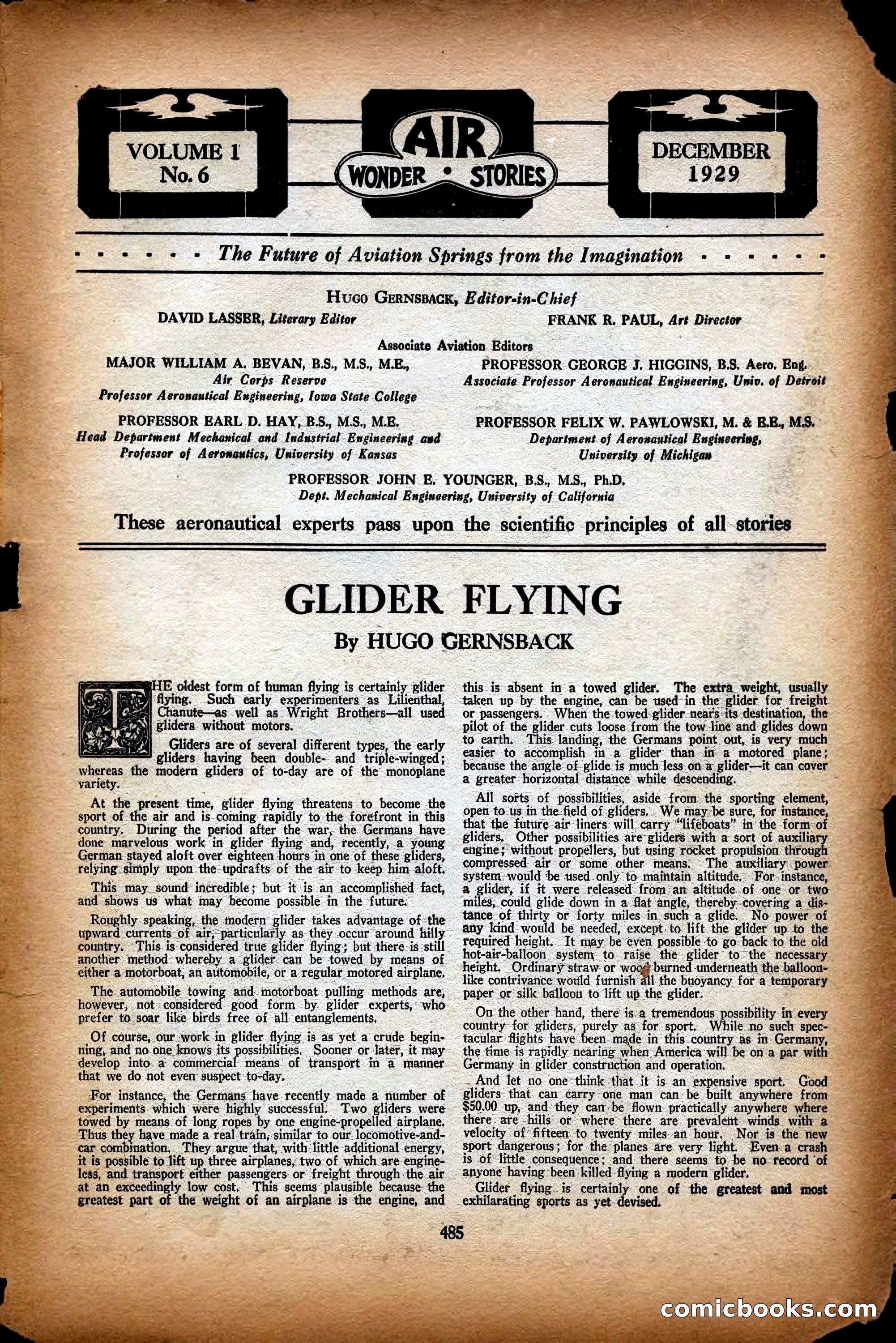
A restored page from Pulp Fiction, 1929. Page through the whole issue in the reader above.
📄 Transcribed text from this page (OCR, searchable)
Machine-transcribed from the original scan — historical spelling and the odd misread are preserved.
Sa ee tS Oe oa ~ = 2 + « =» The Future of Aviation Springs from the Imagination - + + + «+ = Huco Gernssack, Editor-in-Chief DAVID LASSER, Literary Editor FRANK R. PAUL, Art Director Associate Aviation Editors MAJOR WILLIAM. A. BEVAN, B.S., M.S,, M.E., Air. Corps. Reserve Professor Aeronautical Engineering, lowa State-College PROFESSOR EARL D. HAY, B.S. M.S., M.E. Head Department Mechanical and Industrial Engineering awd Professor of Aeronautics, University of Kansas PROFESSOR GEORGE J. HIGGINS, B.S, Aero, Eng. Associate. Professor Aeronautical Engineering, Unio. of Detroit PROFESSOR FELIX W. PAWLOWSKI, M. & E.B., MS. Department-of Aeronautical Buginecring, University. of Michigan PROFESSOR JOHN E, YOUNGER, B.S.,.M.S,, Ph.D. Dept. Mechanical Engineering, University of California These aeronautical experts pass upon the scientific principles of all-stories GLIDER FLYING By HUGO GERNSBACK JHE oldest form of human flying is certainly glider flying. Such early experimenters as Lilienthal, Chanute—as well as Wright Brothers—all used Pa)! cliders without motors. Gliders are of several different types, the earl - gliders having been double- and triple-winged; whereas the modern gliders of to-day are of the monoplane variety. At the present time, glider flying threatens to become the sport of the air and is coming. rapidly to the forefront in this country, During the period after the war, the Germans have done. marvelous work ‘in glider “flying and, tecently, a young German-stayed aloft over eighteen hours in one of these gliders, relying-simply upon the-wpdrafts: of the air. to keep: him aloft. This may sound: incredible; but it:is an accomplished fact, and shows us what may become possible in the future, Roughly speaking, the modern glider takes advantage ofthe upward: currents-of air, particularly as they occur around hifly country, This is considered true glider flying: but there-is still another: method- whereby a glider can be towed by means of either a motorboat, an automobile, or a regular motored airplane, The automobile towing and“motorboat-pulling methods are; however; not considered good form by. glider experts;:-who prefer to soar like birds free of all entanglements, Of course, our workin glider. flying is as yet a crude begin- ning, and no-one’ knows its posstbitiirs: Sooner or Jater, it may develop into. a commercial means of transport in a manner that we do not even suspect: to-day. For. instance, the Germans have recently made a ttumber of experiments which were highly successful, Two gliders were towed by means of long ropes by one engine-propelled airplane. Thus they have made a real train, similar to_our locomotive-and- car combination. They argue that, with little additional energy, it is possible to lift up three airplanes, two of which are engine- less; and transport either passengers or freight through the-air at an exceedingly low cost. This seems plausible because the greatest part of the weight of an airplane is the engine, and 485 this is absent in a towed glider. The extra weight, usually taken up-by the engine, can be used in the glider for freight or passengers. ‘When the towedglider near's-its destination, the pilot. of the glider cuts loose from the tow-line: and glides down to. earth, is landing, the Germans point out, is very much easier. to accomplish in a glider than-in a motored plane; because the angle of glide is much less on-a glider—it can cover a greater horizontal distance while descending. All softs: of possibilities, aside from: the sporting element, open to tis in the field of gliders, We may be sure, for instance, that the future-air-liners: will-carry “lifeboats” in the form: of gliders, Other possibilities ate gliders with a sort of auxili engine; without propellers, but using rocket proptlsion throagh compressed: air or some other means. -The auxiliary power system. would be used only to maintain altitude, For-instance, a glider, if it were -released from-an altitude. of one or two milés, could glide down in a flat angle, thereby covering a dis- tance- of thirty or forty miles-in: such-a- glide. No power of any ‘kind would be needed, except: to lift the glider up to the required-height,. It may: be even possible to go-back to the old hot-air-balloon system to raise the glider tothe necessary height, Ordinary straw or Se ‘burned -mderneath the balloon- like contrivance would furnish’ all-the buoyancy for a temporary paper _or silk balloon to lift up the- glider: On the other hand, there isa tremendous possibility in every country for gliders, purely as>for sport, While no such: spec- tacular flights -have heen mae in this_country as in Germany, the time is rapidly nearing when America will be on a par with Germany in glider-constriction and operation. . And let no one think that it is an expensive sport. Good gliders that. can ¢arry-one man can~-be built anywhere from $50.00 up, and they can-be flown practically anywhere where there - ate -hills’ or where there are prevalent winds with a velocity of: fifteen to twenty miles: an hour. Nor is the new sport dangerous; for the°planes-are very light. -Even.a crash is of little consequence; and there seems to be no record ‘of anyone having been killed flying a modern glider, Glider flying is certainly one of the greatest and most exhilarating sports as yet- devised. eee ee eV NOTES Brera fF