
Pulp Fiction, 1929 · page 57 of 97
Air Wonder Stories, December 1929 — page 57: what you’re looking at
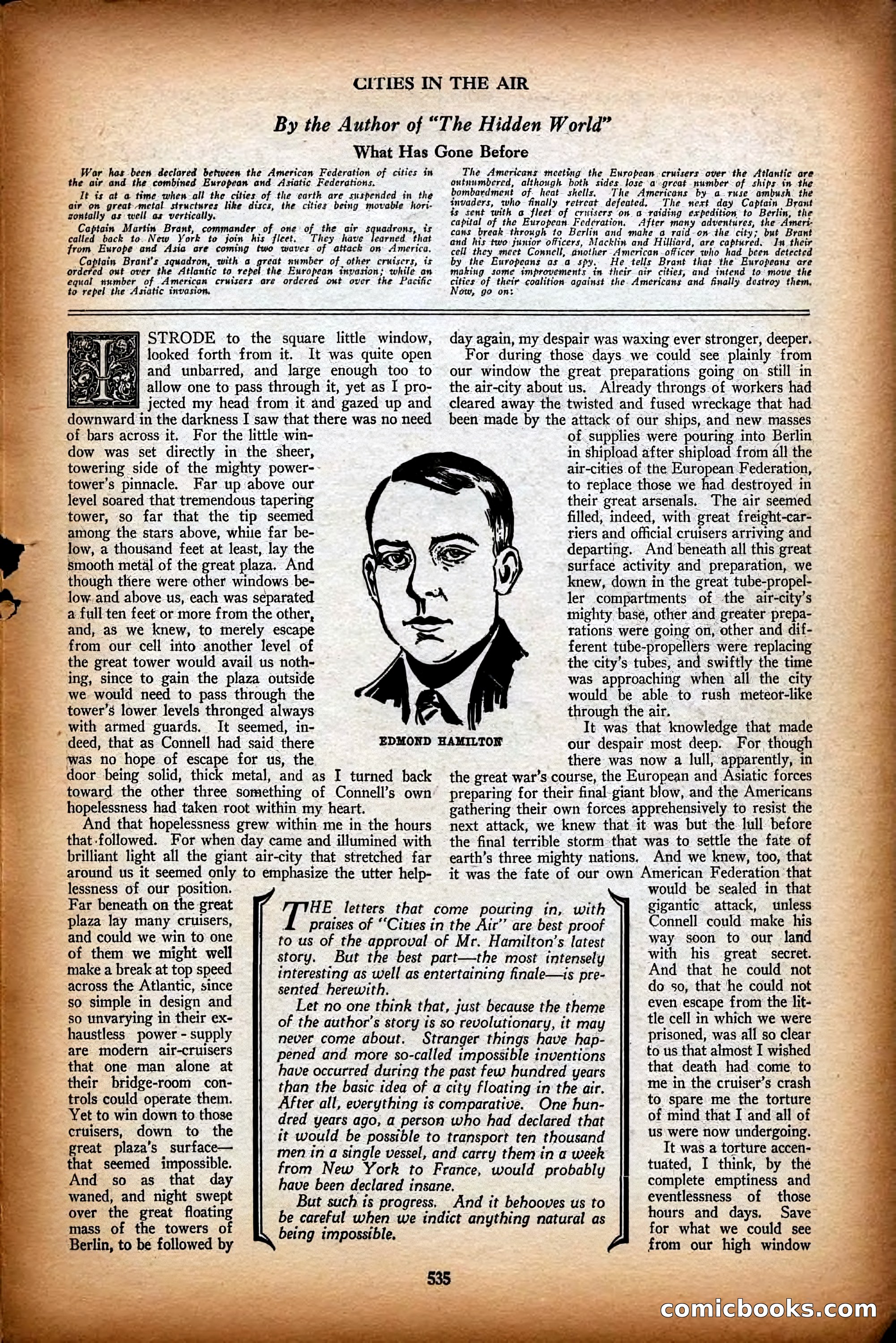
A restored page from Pulp Fiction, 1929. Page through the whole issue in the reader above.
📄 Transcribed text from this page (OCR, searchable)
Machine-transcribed from the original scan — historical spelling and the odd misread are preserved.
ee ee ae ee ee SS ee a ee note =e. ves a es i Re ee "ha te bg CITIES IN THE AIR By the Author of “The Hidden World” What Has Gone Before Wor has been declared between the American Federation of cities in the air and the combined Buropran and Asiatic Federations. It ts at a time when-all the cities. of the arth are suspended in the air on great-metal. structures like discs, the cities being movable hori- gontally as well as vertically. Captain Mortin Brant, commander of one of the air squadrons, is called back toNew York to join his fleet. They have learned. that from Europe and Asia cre coming two waves of attack on America, Captais Brant’s squadron, twith a great aumber of other cruisers, is ordered ont over the Atlantic to repel the European invasion; while on equal number of American cruisers are ordered ont over the Pacific to repel the Asiatic invasion. The Americans mocting the Enropean.cruisers over the Atlantic are oxtiumbered, although both sides lose a'-great-number-of ships. in the bombardment of. heat- shells, -The Americons by a ruse ambush. the invaders, who finally retreat defeated, The next day Captain Brant ts sent with a fleet of cruisers on a-raiding expedition to Berlin, the capital of the European. Federation, After many adventares, the Amert- cans break-through to Berlin and make a raid-on-the city; but Brant and his two junior officers, Macklin and Hilliard, are captured. Is their cell they mact Connell, another Americon-officer who had been detected by the Europeans as a spy. He tells Brant that the Buropeans ore making some improvements tn their air cities, and intend to: mote the Gas of their coalition against the. Americans and finally destroy them, ow, go ont STRODE ‘to the square little window, looked forth from it. It was quite open and unbarred, and large enough too to allow one to pass through it, yet as I pro- i wexea| jected my head from it and gazed up and downward in the darkness I saw that there was no need of bars across it, For the little win- dow was set directly in the sheer, towering side of the mighty power- tower's pinnacle. Far up above our level soared that tremendous tapering tower, so far that the tip seemed among the stats above, while far be- low, a thousand feet at least, lay the smooth metal of the great plaza, And though there were other windows be- low. and above us, each was separated a fullten feet or more from the other, and, as we knew, to merely escape from our cell into another level of the great tower would avail us noth- ing, since to gain the plaza outside we would need to pass through the tower's lower levels thronged always with armed guards. It seemed, in- deed, that as Connell had said there was no hope of escape for us, the door being solid, thick metal, and as I turned back toward the other three something of Connell’s own hopelessness had taken root within my heart. And that hopelessness grew within. me inthe hours that-followed. For when day came and illumined with brilliant light all the giant air-city that stretched far around us it seemed only to emphasize the utter help- lessness of our position. plaza lay many cruisers, and could we win to one of them we might well make a break at top speed across the Atlantic, since so simple in design and $0 tinvarying in their ex- haustless power - supply are modern air-cruisers that one man alone at their bridge-room con- trols could operate them. Yet to win down to. those crtisers, down to the preat plaza’s surface— that seemed impossible. And so as that day waned, and night swept over the great floating mass of the towers of Berlin, to be followed by Far beneath on the great Tes letters that come pouring in, with 4 praises of “Cities in the Air’ are best proof to us of the approval of Mr. Hamilton’s latest story. But the best part—the most intensely interesting as well as entertaining finale—is pre- sented herewith. being impossible, EDMOND HAMILTON Let no one think that, just because the theme of the author’s story is so revolutionary, it may never come about. Stranger things have hap- pened and more so-called impossible inventions have occurred during the past few hundred years than the basic idea of a city floating in the air. After all, everything is comparative. dred years ago, a person who had declared that it would be possible to transport ten thousand men.in a single vessel, and carry them in a week from New York to France, would probably have been declared insane. But such ts progress, be careful when we indict anything natural as day again, my despair was waxing ever stronger, deeper. For during those days we could see plainly “from our window the great preparations going on. still in the air-city about us. Already throngs of workers had cleared away the twisted and fused wreckage that had been made by the attack of our ships, and new. masses of. supplies were pouring into Berlin in shipload after shipload from all the air-cities of the European Federation, to replace those we had destroyed in their great arsenals. The air seemed filled, indeed, with great freight-car- tiers and official cruisers arriving and departing. And beneath all this great surface activity. and preparation, we knew, down in the great tube-propel- ler compartments of the air-city’s mighty basé, other and. greater prepa- rations were going on, other and dif- ferent tube-propellers were replacing the city’s tubes, and swiftly the time was approaching when all the city would be able to rush meteof-like through the air. It was that knowledge that made our despair most deep. For though there was now a lull,’apparently, in the great war’s course, the European and Asiatic forces preparing for their final-giant blow, and the Americans gathering their own forces apprehensively to resist the next attack, we knew that it was but the. lull before the final terrible storm:that was to settle the fate. of earth’s three mighty nations, And we knew, too, that it was the fate of our own American Federation ‘that would be sealed in that gigantic attack, unless Connell could make his way soon to our land with his great secret. And that he could not do so, that ‘he could not even escape from the lit- tle cell in which we were prisoned, was all so clear to us that almost I wished that death had come, to me in the cruiser’s crash to spare me the torture of mind that I and all of us were now undergoing. Tt wasa torture accen- tuated, I think, by thé complete emptiness and eventlessness of those hours and days, Save for what we could see from our high window One hun- And it behooves us to “ ; 4 « 3 : comicbooks.com > ee oe a Ee ,. UCU on